Every hose reel is a drum-and-spindle assembly that coils a flexible hose for storage and pays it out on demand, with retraction energy supplied by a torsion spring, a hand crank, or an electric motor [S1]. Capacity is set by drum diameter, hose length, hose thickness, and pressure rating, while the cylinder is commonly built from steel, aluminum, fiberglass, or molded plastic [S1].
Fire hose reels follow the same mechanical logic but add a fixed water-supply path: isolation valve, drum-mounted hose, and a jet/spray nozzle, governed in Australia by AS 2441 for installation and use [S4]. Knowing which drive and which hose-end hardware is on the reel is what separates a useful spec from a guess.
Spring-Driven Reels: Torsion Energy and Latch Geometry
Spring-driven reels use an internal torsion spring that stores energy as the hose is pulled out, then drives automatic retraction when the operator releases a ratchet latch [S1]. The drum is pre-wound under tension at the factory so the spring is loaded before the hose is even fitted, and a hose guide arm keeps the coil layering clean to prevent overlap wear [S1].
Typical residential and light-commercial spring reels hold up to about 150 ft of garden hose, with retractable action replacing the manual coil that otherwise kinks and abrades the line [S2]. The trade-off is finite cycle life: every payout stores more energy in the spring, and cheap units lose tension after a few thousand cycles, which is why industrial reels ship with replaceable spring cartridges and adjustable drum-side tensioners [S1].
Hand-Crank and Motor-Driven Reels: When Spring Is the Wrong Tool
Hand-crank reels use a side-mounted gear and spindle, so the operator provides all retraction torque, which is fine for short, stiff hoses but punishing beyond about 30 m of 1/2 in. ID rubber [S2]. The hose couples to the drum at one end and to a feeder hose at the other, and the drum rotates on a swivel joint so the supply line does not twist as the drum spins [S1][S2].
Motor-driven reels add an electric, hydraulic, or pneumatic motor to the same drum and are specified for hose lengths and diameters where hand-cranking is unsafe or impractical, typically larger air, water, or chemical-service lines on service trucks and offshore platforms [S1]. On these reels, an adjustable tension control and a hose guide arm are not options but requirements, since uncontrolled recoil on a heavy hose can injure the operator and damage the reel frame [S1]. For plant engineers selecting between drive types, the industrial hose selection guide frames the pressure, temperature, and chemical envelope that the reel must support before drive type is even chosen.
Fire Hose Reel Hydraulics: Constant Pressure Plus Manual Nozzle
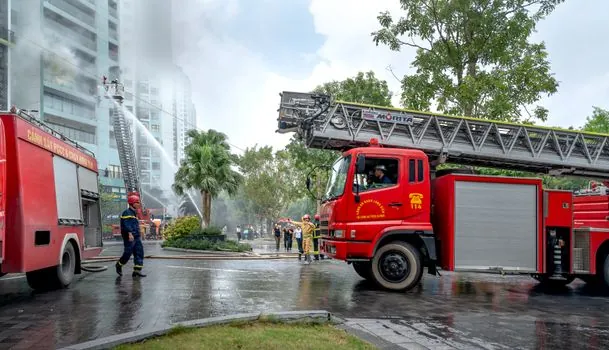
A fixed fire hose reel system is plumbed directly to the building water main through an isolation valve, with the hose permanently attached to the drum and a jet/spray nozzle bracketed beside it [S4][S5]. Its operating principle is constant pressure water supply combined with manual flow control at the nozzle, so as long as mains pressure holds, the system delivers uninterrupted water, unlike a portable extinguisher that is depleted in seconds [S5].
Standard hose length is 20 to 30 m, which sets the radius of attack from the reel, and the nozzle switches between jet and spray patterns to match the fire class [S5]. In Australia the install must comply with AS 2441, which covers hose diameter, run, valve type, and signage, and the system is intended for Class A fires (paper, wood, textiles) only, not for flammable-liquid or electrical fires [S4][S5].
Operating Procedure and Failure Modes
Standard fire-reel operation runs in six steps: open the control valve to charge the line, unclip the nozzle from its bracket, walk to a safe upwind distance from the fire, open the nozzle to start flow, sweep the jet across the seat of the fire, and after the incident close the nozzle, drain the hose, and rewind onto the drum [S7]. The same sequence is taught in operator guides and is what AS 2441 and equivalent codes expect a building occupant to be able to perform without tools [S4][S7].
The main failure modes are not on the drum but in the supply and the hose. Loss of mains pressure starves the reel even with a perfect nozzle; a kinked or aged hose chokes flow at the rated pressure; and a closed or stuck isolation valve turns a working reel into wall furniture [S5]. Mechanical reel failures usually trace back to a broken torsion spring on spring reels, a stripped crank gear on manual reels, or a seized swivel joint from corrosion, all of which are detectable during the periodic inspection that AS 2441 and most plant HSE schemes require [S1][S4].
Selection Criteria: Drive, Material, Mount, and Duty Cycle
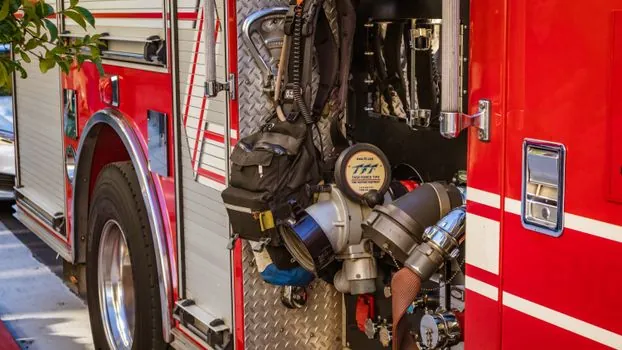
Drive type is the first cut: spring for short, frequent-payout hose (air, water, light chemicals) where the operator is the muscle; hand crank for low-frequency, short-length use where simplicity matters; motor for long, heavy, or hazardous hose where manual handling is unsafe [S1][S2]. The second cut is the drum material, steel for industrial and marine service, stainless (e.g. 304/316) for corrosive or hygienic areas, aluminum where weight matters, and plastic or fiberglass for residential garden duty [S1][S5].
Mount and duty cycle finish the spec. Wall, ceiling, floor, and vehicle mounts are all standard, and a reel rated for 1000 cycles/year is a different procurement from one rated for 100 cycles/year, even at the same hose length [S1]. For plants that already standardise on stainless fixtures and instrument air, the same logic that drives pressure transmitter and flow meter selection, namely matching pressure rating, media compatibility, and maintenance access, applies to the reel's supply-side plumbing and isolation valve. Where the reel sits on a service truck or near rotating equipment, attention to the hose's bend radius and the reel's swivel joint is the same discipline used when sizing industrial valves for cyclic service.
Sourcing and Standards
Public manufacturer pages from IQS Directory and Yard Butler cover the generic spring, hand-crank, and motor categories and confirm that retractable hose reels with swivel joints, locking ratchets, and guide arms are now the default commercial configuration [S1][S2]. Fire-specific operating references, including Forede, CYCO, and Checkpoint Group, all describe the same constant-pressure-plus-manual-nozzle principle and the 20 to 30 m hose run, with Australian installations falling under AS 2441 [S3][S4][S5]. Buyers comparing reels from a directory should therefore request three pieces of data with the quote: the reel's working pressure rating, the hose ID and length at full extension, and the cycle-life or spring-cartridge replacement interval, since these are the only numbers that let a PLC-controlled washdown or fire loop be designed around the reel rather than retrofitted after the fact [S1].
Trackable signals to watch over the next two quarters: (1) any tightening of AS 2441 or equivalent fire codes on hose run, nozzle pattern, or signage, and (2) more motor-driven reels shipping with documented cycle ratings rather than generic "heavy duty" labels.
Background reading: EV Charging Station Manufacturing Cost: BOM, Drivers, and Margins.