
Choosing a ball bearing is a 6-gate spec exercise, not a catalogue browse: load case → speed → tolerance class → lube → seal → temperature must all close before you pencil a part number on a 2026 shop drawing [S5].
The cheapest radial deep-groove unit that survives these gates is the right one; an over-specified ceramic or hybrid assembly is wasted capex when the duty cycle is 1500 rpm, 2 kN radial, and ambient shop air [S5]. Use this article to pressure-test whatever your vendor just quoted, whether it is a flanged LMK25UU on a packaging machine [S2] or a 6201-ZZ on a wheelchair drum [S4].
Gate 1 — Load Type, Magnitude, and Direction
Deep-groove ball bearings are radial load carriers first; they tolerate light axial load in both directions but should not be specified as thrust bearings. A 6203-series steel deep-groove unit typically handles dynamic radial loads in the 7–10 kN range at 1500–3000 rpm; the same envelope in a 6205 climbs to roughly 12–14 kN. When the duty is purely axial, a ball bearing on its own is the wrong part — drop in an angular contact or a true thrust bearing instead, as covered in the roller vs angular contact selection spec cut. [S1]
Combined radial + axial load above roughly 10% of the dynamic load rating C typically pushes the spec away from a deep-groove part to an angular contact pair (DB or DF mounting), which is why angular contact bearing price bands sit visibly above deep-groove equivalents.
Gate 2 — Speed Limit and Cage Type
Limiting speed is the first number to check on the datasheet, and it scales with bore, lubrication, and cage material. A pressed-steel or PA66-caged 6205-2RS is usually rated around 9000–11000 rpm grease-lubricated; the same bore in a 2Z metal-shielded configuration with high-speed grease and a brass or PEEK cage can clear 13000–15000 rpm.
For linear motion on slides, packaging rigs, and 3D-printer gantries, the radial-speed problem disappears and gets replaced by a linear-velocity limit; flanged linear units such as the LMK-LUU series run on 4 mm balls in a recirculating plastic or steel race at typically 1.5–3 m/s sustained [S2].
Gate 3 — Tolerance Class: ABEC-1, ABEC-3, ABEC-5, ABEC-7, P0/P6/P5/P4

Tolerance class is the most over-paid spec on most BOMs. A general-purpose conveyor or fan only needs ABEC-1 (P0) or ABEC-3 (P6); machine-tool spindles, surgical tools, and CNC routers step up to ABEC-5 (P5) or ABEC-7 (P4). A four-class jump typically doubles the unit cost before you add ceramic balls or special clearance — which is the wrong place to spend money if your shaft runout and housing bore were never held to the matching grade. [S2]
Internal clearance (C2 / C0 / C3 / C4 / C5) is the second tolerance call. Deep-groove ball bearings in electric motors and pumps commonly ship as C3 to allow for thermal expansion; tight C2 clearance is reserved for precision grinding spindles where preload is held externally. For the full gate-by-gate spec walkthrough, see the 6 spec gates piece on 2026 shop drawings, which mirrors this exact sequence.
Gate 4 — Lubrication: Grease-Filled, Oil Bath, or Solid
Sealed and shielded bearings (2RS, 2RSR, 2Z, ZZ) are pre-packed with grease and are the right default for anything that is not a high-speed or high-temperature gearbox. A typical general-purpose lithium-thickened mineral grease gives roughly –30 °C to +120 °C operating window, which covers the bulk of conveyor, fan, agricultural, and small-motor duties. Polyurea or PFPE grease pushes the ceiling to +150 °C to +180 °C for oven-fan, motor under-hood, and continuous-duty pump applications. [S3]
For sustained high speed, high temperature, or food-grade duty where grease migration is unacceptable, switch to oil-mist or oil-bath lubrication and drop the shields; the bearing will need an outer oil feed and a scavenge path. Solid-lube (graphite, MoS2, PTFE) is a niche call for vacuum or sterilisation-cycle service and rarely hits a general industrial BOM.
Gate 5 — Sealing and Contamination Control
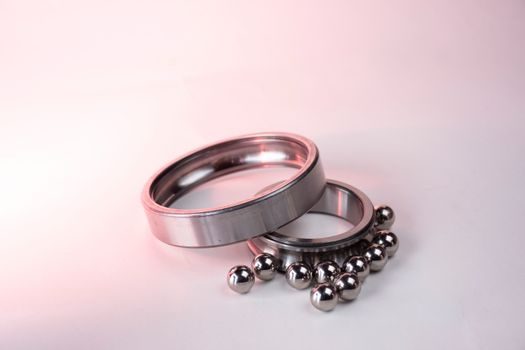
The difference between 2Z and 2RS is not cosmetic: a 2Z metal shield is a non-contact labrynth, drag is near zero, speed limit is higher, and dust/water protection is limited to light splash. A 2RS rubber contact seal is the right call for washdown, outdoor, agricultural, and food-line equipment; the trade-off is roughly 10–25% lower limiting speed and slightly higher running torque at low rpm. [S4]
For severe contamination — mining, cement, paper machines, off-road machinery — specify a 2RS with an additional outer flinger or a sealed-cartridge insert mounted in a pillow block housing; the seal choice is what determines MTBF more than the steel grade in these environments.
Gate 6 — Temperature, Material, and Application Envelope
Standard 52100 (SUJ2) chrome steel deep-groove bearings are rated to roughly –30 °C to +150 °C continuous; beyond that, the call goes to stainless 440C or martensitic 9Cr18Mo for corrosion, or to M50 tool steel for high-temperature aerospace.
A useful triage: chrome steel + 2RS + C3 + lithium grease covers 80% of industrial conveyor, fan, pump, and small-motor duty at 1500–3600 rpm. Step up to stainless 440C for wet/food-grade. Step up to hybrid Si3N4 only for high speed (above 15000 rpm), low friction, electrically insulated, or chemical-resistance duty where the long MTBF pays back the capex.
Comparison — Common Bearing Types Against 4 Buyer Criteria
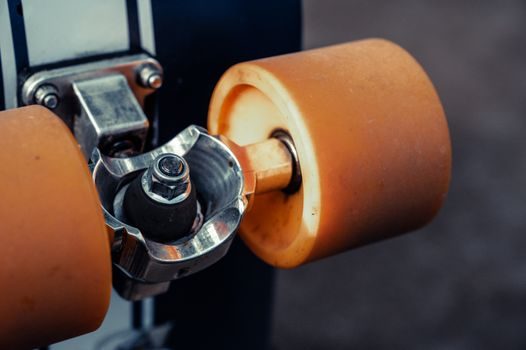
Reading across the same four columns, the deep-groove 6200/6000 series is the cheapest, the most interchangeable, and the best general-purpose radial pick at 1500–9000 rpm; flanged LMK-LUU linear units win on linear slides up to 3 m/s but cannot take a thrust load; angular contact 7000-series pairs take combined radial+axial at higher speeds at a 2–4× price premium; and self-aligning 2200-series trades speed and accuracy for misalignment tolerance up to roughly 1.5–2.5°, useful on agricultural shafts and conveyor idlers. For the misalignment-end of that range, the self-aligning bearing selection guide and the pillow block vs slewing ring cut take the spec further. [S5]
Failure Modes and Constraints Buyers Underweight
Three failure modes kill more bearings than any spec mistake: false brinelling on stationary vibration (skateboard wheels, parked vibrating screens), electrical erosion from VFD-driven motors passing shaft current through the race, and lubrication starvation on a high-temperature continuous-duty cycle. Each has a fix that is cheaper than a re-spec — a shaft-grounding ring on a VFD-driven motor, a periodic rotation on parked vibrating equipment, and a high-temperature polyurea grease refill on oven fans. [S6]
For ball-screw and ball-spline driven axes where the ball race is doing a different job — converting rotation to linear motion under combined axial load — the bearing selection problem overlaps with screw and spline selection; the ball-screw, ball-spline, and ball bearing reference pages cover the distinctions, and a broader linear guide cost cut shows how rail type changes the price tier. A practical watch-out on linear units: the LMK25LUU or LMK35LUU spec sheet usually shows dynamic load in the 0.5–1.5 kN range, not the 5–10 kN of a radial 6205, so use the right part on the right axis [S2].
Sourcing Signals and Standards to Quote on the Drawing
Two 2026 sourcing signals matter on a spec-driven buy: first, ABEC grade must be traceable to ISO 15:2017 (radial bearings) and ISO 492:2014 (tolerance classes), and the ABEC-1/3/5/7 nomenclature should be used as a cross-reference, not the primary callout. Second, 2RS/2Z seal material and grease compatibility should be on the drawing rather than left to the vendor's default — EPDM versus Nitrile versus FKM rubber seals cover different temperature and chemical windows, and a pump-skid 2RS that is great on the test bench will fail in hot oil service if the elastomer is wrong. [S1]
On the China-supplier side, multiple 6200/6000-series vendors are offering ABMA-standard chrome-steel deep-groove units with documented dynamic and static load ratings, MOQ of 1 piece on retail listings, and FOB unit prices in the USD 1.5–10 band depending on bore, seal, and tolerance [S2][S4].
Closing note: the next decision node after bearing selection is almost always the seal and lubrication interface on the housing side, and the one trackable signal to watch is whether your vendor's 2RS elastomer is called out (NBR, FKM, EPDM) on the datasheet — if it is not, the spec is incomplete regardless of how good the ABEC grade looks.