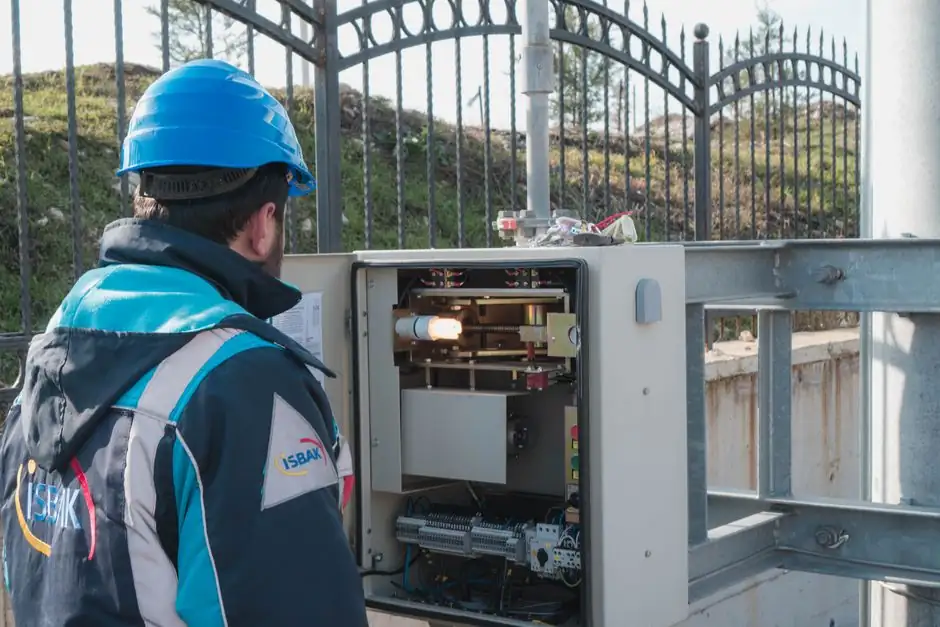
Across-the-line starting pulls 6-10x full-load current on a typical induction motor, which is why any system above roughly 25 HP at 220 V or 50 HP at 440 V usually warrants a soft starter to keep voltage dip in check [S4]. The decision is not whether to add one but how to size and configure it so it survives real industrial duty instead of just passing a bench test.
For fixed-speed pumps, fans, conveyors, compressors, and crushers, a soft starter cuts inrush, eliminates water hammer, and stops belts and couplings from snapping, all at a fraction of the cost of a VFD [S1][S2]. Choosing the right unit comes down to four engineering questions: what is the motor FLA, what is the load duty, what is the environment, and do you need an inside-delta wiring arrangement.
Start From the Motor Nameplate, Not the Horsepower Chart
Soft starter sizing must use the motor's nameplate Full Load Current (FLA or FLC) as the primary input, because nameplate ratings reflect the specific motor's efficiency, power factor, and design letter, data that generic HP tables cannot capture [S5]. NEC Article 430.6 explicitly requires nameplate current for motor overload protection, so table values from NEC 430.250 are only a temporary reference when the plate is unreadable; for reference, a 50 HP three-phase motor is 130 A at 230 V, 65 A at 460 V, and 52 A at 575 V [S5].
Also capture rated voltage (commonly 400 V or 690 V), frequency (50 or 60 Hz), service factor, and enclosure type before doing anything else. With FLA in hand, the baseline rule is simple: soft starter rated current must be greater than or equal to motor FLA after all derating is applied [S1][S5].
Match the Sizing Multiplier to the Load Duty Class
Load type matters more than motor kW when sizing a soft starter [S1]. The widely used duty multipliers are 1.0x FLA for light loads such as centrifugal fans and pumps, 1.2-1.5x FLA for standard duty like conveyors and compressors, and 1.5-2.5x FLA for heavy duty such as crushers, mixers, and high-inertia machinery [S1].
The AC53 utilization code is the formal way to express this: Class 10 (light) draws about 300-400% FLA during start, while Class 30 (heavy) draws 600-700% FLA [S5]. NEMA also defines a 25 HP at 220 V / 50 HP at 440 V inflection point above which soft starting becomes effectively mandatory to prevent nuisance grid complaints [S4]. Never size exactly at FLA: leave a margin, because the SCR stack dissipates roughly 4.5 W per ampere during start and thermal headroom is what determines service life [S5].
Torque, Voltage, and Why a Soft Starter Will Not Replace a VFD
Starting torque scales with the square of voltage, so 70% terminal voltage gives only about 49% of available torque [S1]. That is fine for centrifugal pumps and fans with low breakaway torque, but on high-inertia loads it can stall the motor entirely. Most modern soft starters solve this with kick-start bursts or a current-limit ramp, but if the process really needs constant torque below base speed, a VFD is the correct tool, not a larger soft starter [S1][S3].
The economic rule of thumb is clear: pick a soft starter when the load runs at full speed and you only need to control the start and stop (typical for fixed-speed pumps, fans, crushers, and conveyors), and pick a VFD when you need variable speed or where a variable-torque load spends enough time at part load that the cube-law energy savings pay back the drive [S2][S3]. On variable-torque loads, power falls with the cube of speed, so a VFD trimming a fan from 100% to 70% speed cuts power by roughly 66%; a soft starter bypassed at full line voltage cannot touch that [S2].
Inside-Delta vs. Inline: How Connection Changes the Sizing
Inside-delta (sometimes called six-lead) wiring connects the soft starter's thyristors inside the motor delta, which reduces the current each SCR must handle to 1/sqrt(3), or about 58% of line current [S5]. The practical payoff is that a smaller, cheaper starter can drive a given motor, but it only works on six-wire delta-wound machines and the installer must confirm the motor is rated for the configuration.
Inline (in-line) connection is the default for most IEC installations and is what most Asian and European OEMs document. For inline units, AC53a ratings apply to non-bypassed installations and AC53b to bypassed ones, and using the wrong rating for the duty is one of the most common causes of premature SCR failure [S5].
Environmental Derating: Altitude, Ambient, and Start Frequency

Three environmental factors must be applied as multipliers on top of the duty-based size: ambient temperature above 40°C, installation altitude above 1,000 m, and starts per hour beyond the standard 10-20 starts/hour rating [S1][S5]. High altitude thins the air and reduces SCR cooling, while high ambient shrinks the thermal headroom in the same way.
Frequent starts compound the problem because the SCR junction never fully cools between events; for applications above the rated starts/hour, the conservative move is to oversize by one frame or specify a higher AC53b current rating [S1][S5]. For the electrical environment, the soft starter should also match the system short-circuit current rating and, in classified areas, comply with IEC 60079 series and ATEX 2014/34/EU for explosive atmospheres.
Feature Checklist: What to Spec Beyond Current Rating
The minimum useful feature set on a modern soft starter is ramp-time control, adjustable initial voltage, and a configurable current limit [S1]. Strongly recommended additions are a soft-stop ramp (to suppress water hammer on pump shut-downs), an integrated or co-specified bypass contactor (to cut steady-state heat losses once the motor is up to speed), and motor protection functions including overload, phase loss, phase sequence, and thermal model [S1][S3].
For plant integration, modern units typically ship with Modbus RTU or Modbus TCP, with PROFIBUS, PROFINET, EtherNet/IP, and Ethernet-APL on premium lines.
Selection Criteria Comparison: Soft Starter vs VFD vs DOL
Stack the three options against the criteria that actually drive a spec: DOL starters are the cheapest and simplest but produce the highest inrush (6-10x FLA) and torque shock, making them only suitable for small, low-inertia loads where grid disturbance is tolerable [S3][S4]. Soft starters are moderate cost, add no harmonics once bypassed, limit inrush and torque, and provide no running energy savings; they are the right pick when the process is fixed-speed and the concern is mechanical or electrical stress at start and stop [S1][S2][S3]. VFDs are the most expensive and complex, generate harmonics that may require filtering, but deliver full speed control, constant-torque capability, and large energy savings on variable-torque loads running at part load [S2][S3].
On total cost of ownership, a soft starter sits in the middle: higher upfront than DOL, lower than VFD, with the payback coming from reduced maintenance on couplings, belts, and seals rather than from energy savings during the run [S4].
Common Failure Modes and Sizing Mistakes
Most premature soft starter failures trace back to one of five mistakes: sizing to FLA with no margin, ignoring duty class so a Class 10 unit is bolted onto a Class 30 load, ignoring starts-per-hour, mounting in a sealed enclosure with no derating, and using AC53a ratings on a bypassed installation [S1][S5]. The result is SCR overheating, nuisance trips, and motor winding damage, exactly the failure mode of "an SCR fails six months into operation and the pump station goes offline" [S5].
For an analyst of broader supply-chain signals, the stepper motor suppliers 2026 landscape and the industrial-gas supply inflection points are useful cross-references because both upstream electronics enclosures and downstream compressor packages are sized on the same thermal math. For adjacent spec work on pumping and process flow, the turbine flowmeter conductivity case shows how a different sensor family makes the duty-versus-cost trade-off that soft-starter sizing also depends on.
Spec-level background on the components involved: pressure transmitter, and flow meter.