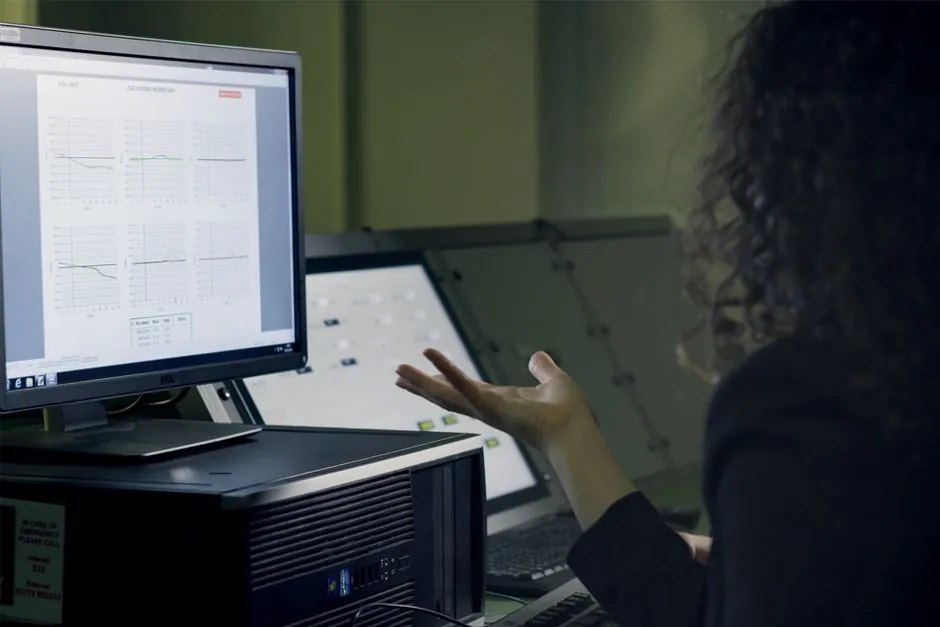
An IGBT-based Static VAR Generator (SVG) is the modern replacement for switched capacitor banks, with response times under 15 ms, stepless inductive and capacitive compensation, and integrated harmonic filtering up to the 13th order [S2].
Selection hinges on five decisions: required kVAr capacity, cabinet headroom, 3-wire vs 4-wire topology, IP rating, and whether harmonic compensation is needed alongside power factor correction [S6].
What an SVG Does, and What It Does Not Do
An SVG detects the phase-angle difference between voltage and current and injects leading or lagging current so the resulting current aligns with the voltage, pushing power factor toward unity [S1]. Architecturally it is closer to an inverter than to a classic power factor correction unit: a high-speed DSP samples the grid thousands of times per second, an IGBT/VSC bridge generates the compensation current, and external CTs provide the feedback [S2][S5].
It is not a harmonic filter by default, although most modern units add active harmonic filtering as an option. Ortea Next's VARYX covers 30-200 kvar without harmonics; the VARYX Plus adds compensation from the 3rd to 13th harmonic in the same 30-200 kvar envelope [S2]. It is also not a UPS or a voltage restorer, so black-start and ride-through need separate hardware.
Sizing: Two Formulas That Work
The classic starting point is 20-40% of transformer capacity for the reactive power compensation share, with 30% as a general default, so a 1000 kVA transformer typically warrants a 300 kvar SVG [S4]. That rule covers transformer-fed sites without detailed load data.
When load data is available, calculate the actual requirement from active power and target power factor: Q = P x K x (tan(arccos COSphi1) - tan(arccos COSphi2)), where K is the average load coefficient (typically 0.7-0.8) and COSphi1 and COSphi2 are the power factors before and after compensation [S4]. This second method is more accurate because it captures the gap between current and target PF, not just the transformer's nameplate.
Decision Matrix: SVG vs SVC vs Capacitor Bank
SVGs differ from SVCs and capacitor banks on four buyer-visible criteria: response time, output resolution, inductive/capacitive coverage, and low-voltage behavior [S2][S5].
On response time, switched capacitor banks step in seconds, SVCs (thyristor-controlled reactor + capacitor) step fast but still discretely, and SVGs respond in under 10-15 ms, which is the only option for welders, robotics, elevators, and rapidly fluctuating crane loads [S2][S5]. On output, capacitors deliver fixed kvar steps, SVCs deliver semi-continuous output via TSC + TCR, and SVGs deliver fully continuous, stepless current [S5]. On coverage, capacitor banks handle inductive loads only and usually need detuning reactors in harmonic-rich plants, while SVGs compensate both inductive and capacitive loads and are immune to harmonic-induced aging [S2]. On low-voltage ride-through, SVGs keep operating where capacitor contactors drop out [S5].
Topology, Environment, and Cabinet Headroom
Three selection choices are mechanical and electrical, not software: 3-wire vs 4-wire, IP rating, and spare capacity inside the cabinet [S6]. 3-wire units suit balanced three-phase industrial loads; 4-wire units are mandatory where single-phase loads, large single-phase lighting banks, or significant neutral current exist, because only 4-wire SVGs can compensate neutral current directly.
IP rating follows the installation environment: IP20 inside a clean switchroom, IP54 in dusty production halls, and IP65 for outdoor or washdown areas [S6]. Cabinet headroom matters because future load growth is the rule, not the exception; sizing the cabinet at 70-80% of nameplate kvar leaves physical room for additional IGBT modules without a new enclosure. SinaVa and Ortea documentation both emphasize modular parallel connection, so extra modules can be added in the field rather than replacing the unit [S2][S5].
Where SVGs Pay Off, and Where They Do Not
SVGs are the right answer for sites with fluctuating reactive demand: welding lines, rolling mills, crane duty, data centers with leading PF from long cable runs, and renewable interconnection points with inverter-driven harmonics [S2][S5][S7]. Plants where reactive load is steady and PF is already above 0.95 do not justify the capex: a fixed or stepped capacitor bank at 20-30% of transformer kVA is cheaper and adequate.
SVGs are also the wrong first choice where the dominant problem is harmonic distortion, not reactive power: a dedicated active harmonic filter sized to the actual THDi budget is the right tool. Typical THDi benchmarks from Noker's industry table are 15% for transit/aviation, 20% for commercial buildings, 30% for automotive, and 35-40% for chemical and metallurgical plants, and the SVG needs to be sized against those numbers, not against nameplate kVA alone [S4].
Reliability, Service Life, and Integration
Solid-state SVGs with no contactors or capacitor banks have an estimated service life of 10-15 years with minimal maintenance, limited to filter cleaning and fan replacement [S2]. SinaVa specifies sub-10 ms overall response for its product line, and the Ortea VARYX line specifies sub-15 ms response with integrated compensation up to the 13th harmonic [S2][S5].
Integration points to verify before purchase: Modbus/TCP or Modbus RTU for SCADA, external CTs with a defined polarity and burden, and a controller that targets a user-set PF (typically 0.95-1.00) in both leading and lagging directions [S2][S5]. For more on sizing harmonics to load type, see the active vs passive harmonic filter selection map; for the broader power-quality device category including related static-reactive equipment, see the static VAR generator encyclopedia entry.
Procurement Shortlist Logic
Build the shortlist in three passes. First, compute Q from transformer kVA (30% rule) and from P + target PF, then take the larger number as the minimum kVAr. Second, fix topology (3-wire vs 4-wire), IP rating, and whether harmonic compensation is in scope; this typically halves the candidate list. Third, verify the four operational claims against vendor datasheets: response time under 15 ms, bidirectional inductive/capacitive compensation, harmonic coverage to at least the 13th order if needed, and parallel-modular expansion [S2][S5][S6].
A reasonable 2026 shortlist pattern: 30-200 kvar wall- or panel-mount SVG for light-commercial and small-industrial sites, 200-600 kvar cabinet SVG with harmonic filtering for discrete-process plants, and modular paralleled 100-300 kvar modules for data centers and renewable interconnection where headroom and N+1 redundancy matter. If the dominant site load is HV/LV distribution with mixed motor and converter duty, a hybrid fixed-capacitor plus dynamic-SVG configuration (capacitor bank for the fixed share, SVG for fine-tuning) is often the lowest-total-cost path [S2].
Next trackable signal: IGBT and DC-link capacitor pricing through 2026, which sets the floor on kvar-per-dollar for new SVGs; a second signal is the rollout of IEEE 1547-2018 interconnection requirements in U.S. utility practice, which keeps pushing utilities to require dynamic VAR support at renewable interconnects [S1][S5].
For component-level specifications, see function generator, and vacuum generator.