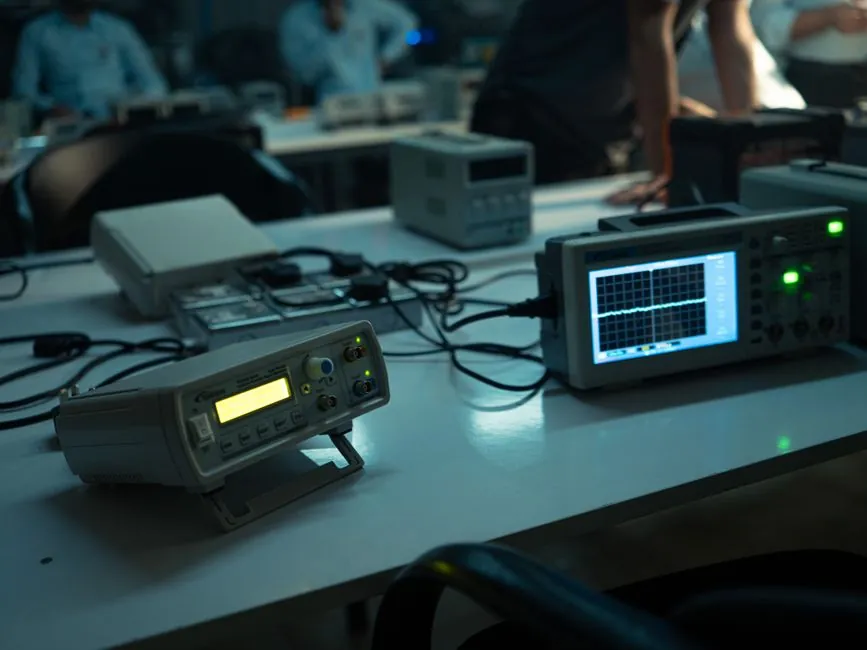
Bandwidth is the single most important spec when selecting an oscilloscope, because the front-end amplifier behaves as a low-pass filter and attenuates input by 3 dB (about 30% amplitude loss) right at the rated frequency [S1][S3]. For a pure sine wave, picking bandwidth at 1.5x the carrier is the minimum; for a digital or pulse waveform with sharp edges, the working rule is bandwidth equal to 3 to 5 times the highest clock or data rate, applied to signals like a 133 MHz memory bus that needs roughly 400 MHz of scope bandwidth to render correctly [S1].
Sample rate must outpace bandwidth, not just signal frequency: Rohde & Schwarz states a minimum of 2.5x bandwidth to reconstruct a waveform, while National Instruments requires at least 5 samples per cycle to reconstruct shape and the Nyquist floor of 2x is treated as insufficient for oscilloscope work [S1][S3][S5]. Memory depth ties both together, because at a fixed sample rate a deeper record lets you keep a long time window at full bandwidth, which matters for catching rare glitches on serial buses and power rails [S3][S5].
Bandwidth Sizing Rules by Signal Type
Oscilloscope bandwidth is defined as the -3 dB point, the frequency at which a sine input is attenuated to 70.7% of true amplitude, and that single number governs how faithfully edges and harmonics are captured [S1][S3]. For sine-only work, sizing bandwidth slightly above the maximum carrier is acceptable, so a 100 MHz sine wave can be measured on a 150 MHz scope with manageable error [S1]. For square waves and digital buses, harmonics dominate, and a 50 MHz square wave needs a scope in the 500 MHz class to look like a square wave rather than a rounded lump [S5].
The shortcut formula is bandwidth in Hz roughly equal to 0.35 divided by the 10 to 90% rise time in seconds, so a 600 picosecond edge implies frequency content up to about 583 MHz, which is consistent with the 3 to 5x rule of thumb [S1][S3]. Buyers also need to know that quoted bandwidth is not always available on every volts-per-division setting on every model, and a few entry-level scopes quietly roll off the analog front end at the lowest ranges [S5].
Sample Rate, Real-Time vs Equivalent-Time, and Memory Depth
Sample rate must be at least 2.5x bandwidth, with 5x being a safer target for clean reconstruction, and most scopes cut their sample rate in half when you use two channels instead of one, so a 4-channel scope at full bandwidth can have a lower per-channel rate than its headline number [S1][S3][S5]. Equivalent-time sampling (ETS) rebuilds a waveform from successive triggers and only works on stable, repetitive signals, so single-shot or one-off events must be captured in real-time mode with enough memory to hold the full record at the chosen rate [S3][S5].
Memory depth determines how long a time window you can hold at full sample rate, and NI's guide flags it as a top-three selection criterion alongside bandwidth and sample rate because shallow memory forces you to drop the rate on long captures [S3]. A simple sizing check: capture time in seconds equals memory depth in samples divided by sample rate in samples per second, so a 100 Mpoint record at 5 GSa/s holds a 20 ms window at full rate. For reference work on the bench, a useful oscilloscope anchor in the lab instrument family, deeper memory (tens to hundreds of Mpoints per channel) is the difference between seeing a glitch and missing it.
Channels, Resolution, Triggering, and Probes
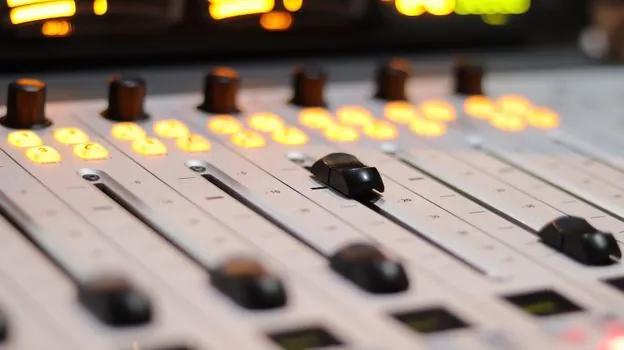
Channel count and ADC resolution drive real-world usability: most digital scopes ship with 8-bit ADCs, and high-resolution or HD modes (where offered) trade bandwidth for extra bits, useful below 20 MHz on power-rail and sensor signals [S1][S3]. 2 or 4 analog channels cover most bench work; mixed-signal oscilloscopes (MSO) add 8 to 64 digital channels for parallel bus decode, and 6-series class MSOs sit at the high end of mainstream channel density [S3][S4].
Triggering is not a checkbox, since edge, pulse-width, runt, and serial-bus triggers determine what you actually catch, and poor trigger fidelity on a low-end scope can hide the very event the bandwidth and sample rate are sized to resolve [S3]. Probe selection matters as much as scope selection: a 1 GHz scope paired with a 100 MHz passive probe rolls off at 100 MHz, so budget for probes whose bandwidth matches the scope's, and remember that active and differential probes carry their own bandwidth, loading, and price tiers [S3][S4].
Form Factor, Application Fit, and Budget Tiering
Form factor sets the ceiling on performance per dollar: bench-top scopes lead on bandwidth, display quality, and channel count; handheld units trade performance for portability and often have poor sunlight readability and short battery life; PC-based scopes (PCIe plug-in or USB-attached boxes like PicoScope) leverage the host PC for display, processing, and storage, and tend to be the cheapest per MHz at the cost of needing a host machine [S5]. Within the bench-top tier, vendors segment basic (entry DSO, up to a few hundred MHz), performance (mid-range, GHz-class), and mixed-domain or MSO classes that add spectrum analysis or digital channels [S4].
A clean way to map application to tier: power-supply and audio work under 20 MHz fits a basic 100 to 200 MHz scope with a 20 MHz bandwidth-limit filter; embedded MCU and low-speed serial (I2C, SPI, UART) work under 50 MHz fits a 350 to 500 MHz scope with MSO digital channels; high-speed serial (USB, PCIe, DDR) needs a 1 to 6 GHz performance scope with deep memory and protocol decode [S1][S4][S5]. For factory-floor sensor and process work where the pressure transmitter and flow meter outputs are slow 4 to 20 mA or HART signals, an entry-level scope is more than enough and the spend is better pushed into a pressure sensor calibrator instead.
Comparison: Main Oscilloscope Classes Against 4 Decision Criteria
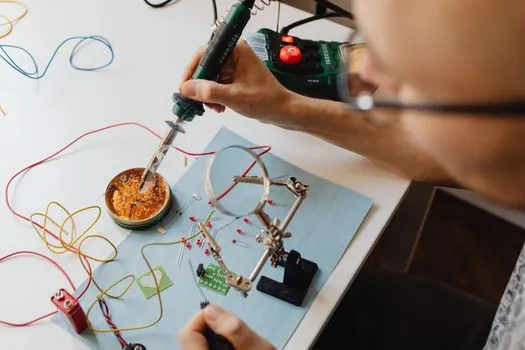
Basic DSO (entry bench, e.g., 100 to 200 MHz class): bandwidth up to 200 MHz, sample rate typically 1 to 2 GSa/s, memory 1 to 4 Mpoints per channel, 2 or 4 channels, 8-bit ADC; best for power, audio, and slow digital work; cheapest tier. Mid-range MSO/performance scope (350 MHz to 1 GHz): bandwidth 350 MHz to 1 GHz, sample rate 5 to 10 GSa/s, memory 20 to 100 Mpoints, 4 analog plus 8 to 16 digital channels, mixed-signal trigger and decode; the workhorse for embedded and low-speed serial design [S4]. High-end performance scope (2 to 6+ GHz): bandwidth 2 to 6 GHz and beyond, sample rate 25 to 50 GSa/s, memory hundreds of Mpoints to 1 Gpoint, 4 channels at full bandwidth, 8-bit ADC with HD modes, jitter and serial-bus analysis packages; sized for high-speed serial compliance and RF debug [S3][S4].
PC-based scope (USB or PCIe): bandwidth 100 MHz to 1 GHz typical, sample rate and memory tied to host streaming, very large displays and easy data sharing, lowest cost per MHz but requires a host PC and software stack [S5]. Handheld scope: bandwidth typically 60 to 200 MHz, isolated channels common for field work on industrial wiring, short battery life and small displays, used for industrial valve actuator troubleshooting and PLC I/O checks rather than lab characterization [S5].
Who Should Not Buy the Mainstream Choice
Engineers measuring only 50 or 60 Hz mains, audio, or slow 4 to 20 mA loops do not need a 1 GHz scope; a 100 to 200 MHz basic DSO with a 20 MHz filter is the right tool and leaves budget for better probes and a calibrator. Buyers chasing 6 GHz performance scopes for power-electronics work are overpaying for bandwidth that the silicon-carbide switching edge will not exploit without specialised probes and fixtures, and the better spend is mid-range scope plus high-bandwidth differential and current probes [S1][S3].
Handheld scopes are a poor fit for lab characterisation because of small displays, limited update rates, and short battery life; they belong in a field-service kit, not on an R&D bench [S5]. PC-based scopes are a weak fit for compliance testing that needs long unattended runs with guaranteed trigger performance, since host OS jitter and streaming limits can break deep captures.
Selection Checklist and Sourcing Standards
Run this shortlist logic before purchase: confirm the highest signal frequency and edge rise time, size bandwidth at 3 to 5x that frequency, set sample rate at 2.5 to 5x bandwidth, compute memory depth as capture-time multiplied by sample rate, pick channel count plus MSO for digital buses, and match probe bandwidth to scope bandwidth [S1][S3][S5]. Used and refurbished units from major vendors are a common path to higher bandwidth at lower cost, with the trade-off of shorter calibration cycles and possibly limited software-update windows [S2].
Standards that govern scope accuracy and calibration include ISO/IEC 17025 for calibration lab competence, while generic safety and EMC conformity (CE, UKCA, UL listed markings on the specific unit) are the buyer-side check for any lab instrument going onto a 230 V bench. For related test-bench work in an electronics lab, electronics lubricant selection covers dielectric and plastic compatibility for connectors and probe contacts, a small but real factor when probes are used daily on the same DUT.