A hydraulic motor RFQ attached to a motor control cabinet request is fundamentally a two-product inquiry: the motor itself (displacement, pressure class, speed envelope) and the cabinet logic (starter, reversal, thermal trip, feedback). Both halves must be written on separate spec blocks, because hydraulic motors and electric motors share cabinet hardware language but not the parameters behind it.
Buyers who treat the hydraulic motor as a generic "MCC load" usually pay for it in requote rounds: missing displacement in cc/rev, missing max continuous pressure in bar, missing the hydraulic-fluid cleanliness target (ISO 4406 code), or missing the feedback signal type the cabinet must accept. Each of these is a separate clarification that pushes lead time out by 3-7 working days per round [S2].
Hydraulic Motor vs Electric Induction Motor: Cabinet Logic Differences
Hydraulic motors are volumetric displacement devices: torque output scales with pressure drop across the motor and displacement volume, while speed scales with inlet flow divided by displacement, not with electrical frequency as on an induction motor. The cabinet does not need a VFD for speed control on a fixed-displacement hydraulic motor — flow control belongs to a control valve upstream, not to the cabinet [S2].
Where the cabinet earns its place on a hydraulic drive is start/stop, directional control (solenoid or pilot), relief-valve supervision, and over-temperature/over-pressure trip. Common MCC-style protection functions for hydraulic motors include: phase-loss trip (when the pump is electrically driven), starter overload sized to the pump motor (not the hydraulic motor), and a hardwired interlock that drops the solenoid on E-stop, a pattern mirrored on the cabinet-side documentation in distribution cabinet reference designs [S2].
RFQ Spec Block 1: Motor Mechanical Line
The first block of the RFQ must name six mechanical parameters or the quote will be generic. The minimum set: displacement in cc/rev (or in³/rev), maximum continuous pressure in bar, peak pressure rating, maximum continuous speed in rpm, maximum intermittent speed, and shaft type (splined, keyed, tapered, or through-hole for piston-type). Acceptable ranges on industrial radial piston motors sit in the 20-500 cc/rev window with continuous pressure ratings of 250-450 bar, depending on series [S2].
Shaft tolerance and mounting flange (ISO 3019-1 4-bolt, SAE J744, or cartridge) belong in this same block, because changing flange pattern mid-quote is the single most expensive requote item. Buyers who list only "hydraulic motor, 10 kW" usually get one of three default answers and none of them match the actual drivetrain envelope.
RFQ Spec Block 2: Hydraulic Circuit Parameters
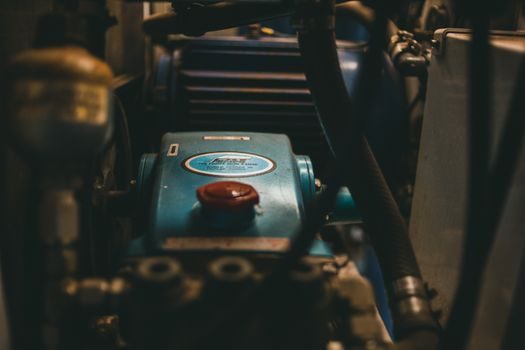
The second block must close the circuit on pressure, flow, and fluid. Required fields: nominal working pressure bar, max pressure bar, flow range in L/min at continuous duty, hydraulic-fluid type (mineral HLP, HFC water-glycol, HFD-U synthetic, or HETG bio), and ISO 4406 solid-contamination target — commonly /18/15 or /19/16 for axial piston motors in factory automation [S2].
Fluid viscosity window (typically 10-100 cSt at operating temp) and temperature range (mineral fluid: -10 to +80 °C) belong on this line, not in a footnote, because case-drain back-pressure limits and seal compound selection both depend on them. Skipping viscosity is the most common cause of premature shaft-seal failure on the first 90 days of service, and the post-failure return-merchandise cycle costs the cabinet integrator as much as the motor itself.
RFQ Spec Block 3: Cabinet Interface and Feedback
The third block defines how the cabinet "sees" the motor. For a fixed-displacement hydraulic motor with no onboard electronics, the cabinet only needs to know solenoid coil voltage (24 VDC is the most common in 2025-2026 MCC builds, with 110/230 VAC still specified for older retrofits), coil wattage (typically 20-35 W per solenoid), and whether the directional valve is single-solenoid or double-solenoid with detent [S2].
Where the motor is a speed- or position-sensing cartridge, the cabinet must accept the feedback signal: 4-20 mA analog (HART or plain), incremental encoder (HTL or TTL, 5 VDC or 24 VDC supply), SSI absolute, or fieldbus (PROFIBUS DP, PROFINET, EtherCAT, EtherNet/IP). Mixing HART on a PROFIBUS-PA segment is a known error: HART is FSK-modulated on a 4-20 mA analog loop, not a digital fieldbus, and cannot be wired into a PROFIBUS-PA trunk without an external multiplexer. Specifying the wrong signaling layer at the RFQ stage is the second most expensive requote trigger, after flange pattern changes.
Comparison: Fixed vs Variable vs Torque-Limited Hydraulic Motors on an RFQ

Three motor families are commonly offered on hydraulic MCC RFQs, and they align against the cabinet's job differently. Fixed-displacement motors: simplest cabinet (solenoid on/off only), lowest unit cost, flow is the only speed control, inefficiency at partial load. Variable-displacement (bent-axis or swashplate) motors: cabinet must supply a proportional solenoid signal (typically 4-20 mA or 0-10 V), pump flow and motor swash angle work together, highest efficiency at partial load. Torque-limiting / pressure-compensating motors: cabinet logic is minimal, motor self-regulates to a set torque, used on winches and conveyors.
For buyers writing a new RFQ, the decision rule is direct: choose variable-displacement when part-load efficiency savings justify the proportional-solenoid wiring in the cabinet, choose fixed-displacement when the cabinet is a standard motor-starter build and the upstream control valve already does the throttling, and choose torque-limiting when the load is inertia-dominated and the cabinet's only job is to interrupt power on a stall event [S2].
Common Spec Mistakes That Force Requote Cycles
Five errors appear on more than half of the hydraulic-motor RFQs that reach a cabinet integrator. One: omitting the displacement in cc/rev and giving only kW, which leaves the supplier to back-calculate displacement from a guessed nominal pressure. Two: writing "IP65" on the motor line without naming the cabinet's IP target, because the motor and the cabinet enclosure have independent ingress ratings and the higher of the two dictates gland selection at the control cable entry.
Three: failing to specify case-drain port size and back-pressure limit (typically ≤2 bar for axial piston motors). Four: naming a maximum pressure above the motor's continuous rating, which forces the supplier to upsize and requote. Five: requesting bidirectional rotation without naming whether the motor is symmetric — many radial piston motors are unidirectional and a rotation-reversal request at the quote stage either doubles the cost or ends in a rejected quote [S2]. For context on how spec omissions cascade across adjacent product lines, see the Tapered Roller Bearing Types and Classifications: Spec Map for Selection reference and the Flange Thermal Expansion Compatibility: Spec Limits, Joint Types, Failure Modes guide for the mechanical-fit half of the drivetrain.
When a Hydraulic Motor RFQ Belongs in a Motor Control Cabinet Scope
Hydraulic-motor RFQs land in a motor control cabinet scope when the cabinet supplies the pump-motor starter, the directional-solenoid power, and the over-pressure/over-temperature trip logic — in other words, when the cabinet is the only electrical enclosure on the machine. A hydraulic motor does not itself need a "cabinet" the way an induction motor does, but the supply-side electrical equipment feeding the hydraulic pump is routinely built to MCC standards and may be co-located with low-voltage distribution and access-control infrastructure in the same skid room.
Where a hydraulic motor RFQ should be excluded from a motor control cabinet scope: when the drive is a self-contained electrohydraulic actuator (EHA) with its own integrated electronics, when the cabinet is a purely pneumatic or purely low-voltage DC assembly with no three-phase AC starter, or when the spec is for an open-loop mobile-hydraulic system where the OEM specifies the cabinet. Buyers in the boundary zone should default to writing the RFQ with the cabinet scope called out explicitly, and attach the motor RFQ as a sub-line — a pattern that aligns with the access control and MCC cabinet documentation conventions used on packaged skid deliveries [S2].
Standards and Sourcing Discipline for Hydraulic Motor RFQs
Standards that govern the spec lines above, and that should be cited on the RFQ by number, include ISO 4391 (hydraulic motor performance test methods), ISO 4406 (fluid cleanliness code), ISO 3019-1 (mounting flange 4-bolt), and SAE J744 (hydraulic motor and pump mounting dimensions). Pressure ratings on industrial axial-piston motors are commonly tested to 1.25× maximum continuous pressure for 30 s minimum during the factory acceptance test. Surface-finish targets on the motor mounting face follow ISO 1302 surface-roughness conventions. [S1]
Sourcing direction: for 2025-2026 procurement, the published lead time on a built-to-order hydraulic motor at the 50-200 cc/rev displacement window sits in the 8-14 week range from the major European and Japanese OEMs, with the North American aftermarket channel typically 2-4 weeks for in-stock units. Cabinet-side lead time is independent and usually shorter, so the RFQ should split delivery dates into motor-line and cabinet-line milestones to avoid the cabinet being held in finished-goods inventory while the motor is still in OEM production.
Trackable signal: the next actionable input is the supplier's clarification list — a clean RFQ (one round of clarifications, no spec rewrite) is the single best leading indicator that the quote-to-PO cycle will close inside 30 days. A second signal is the cabinet integrator's one-line diagram returned with the quote; if the diagram names the solenoid-coil wattage, feedback signal, and case-drain back-pressure limit by value, the integrator has read the motor datasheet, and the project is on a normal schedule [S2].