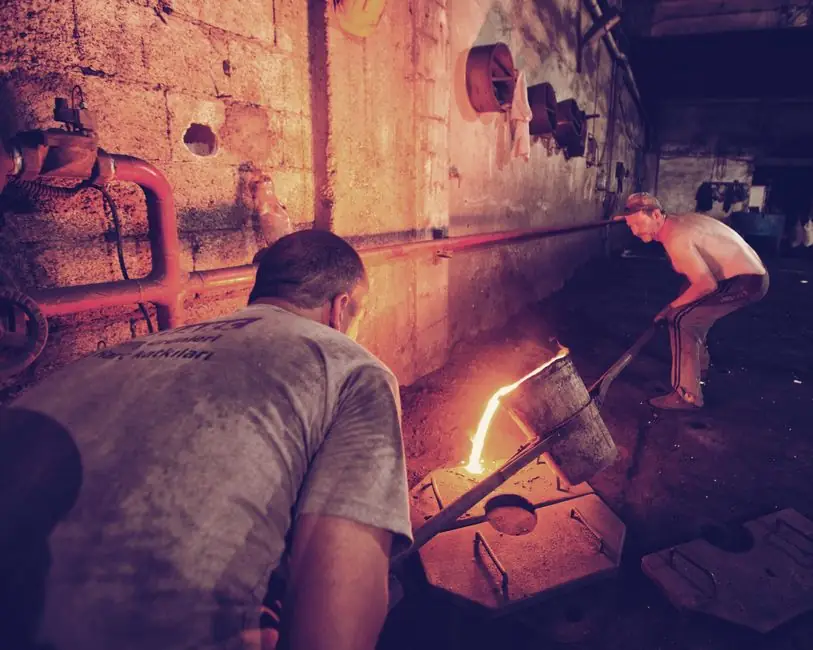
Induction heating furnaces span less than 1 kg to 100 t melt capacity and are used to melt iron, copper, aluminum, and other metals for hardware production [S4].
Hardware plants typically require medium-frequency (1-20 kHz range) coreless units for ferrous forging billets and channel furnaces for non-ferrous holding, with 2700 kW high-temperature vacuum variants available for specialty alloys [S6]. Procurement teams should match furnace class to alloy chemistry, batch mass, and downstream forging or casting steps before comparing OEM quotes [S5].
What the Two Main Classes Actually Do
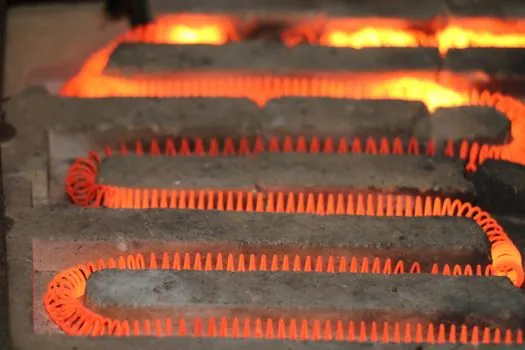
An induction heating furnace is an electrical furnace that produces heat by electromagnetic induction, operating on Faraday's law of mutual inductance between a primary inductor coil and the metal charge [S4]. Induction furnace capacities cover the full industrial range from under 1 kg laboratory crucibles up to 100-ton melt vessels used in steel mills [S4].
The two architectural families most relevant to a hardware plant are the coreless (crucible) furnace and the channel-type furnace. Coreless units carry a water-cooled copper coil wrapped around a refractory-lined crucible, suited to batch melting of steel, iron, and copper; channel furnaces use a closed-loop molten channel as the secondary winding, giving higher electrical efficiency for holding and superheating aluminum or zinc [S4].
Power, Capacity, and Frequency Bands
Listed OEM units illustrate the band hardware buyers will see in RFQs: small precious-metal induction melting furnaces (gold, silver, copper, iron, aluminum) sit at US$ 2,000-3,500 per set, while industrial coreless melting packages run US$ 6,550-80,000 per set on Chinese B2B catalogs [S5]. High-end 5000 kg, 2700 kW high-temperature vacuum induction melting furnaces are offered as specialty units for reactive alloys and aerospace-grade inputs [S6].
Forever Furnace supplies induction bar and tube heaters, induction slab heating systems, and induction forge heating packages with a published supply ability of 100 sets per year and FOB pricing starting at US$ 100,000 per set [S1]. For a hardware shop running continuous fastener or fitting production, this band signals that forging-line induction heaters sit roughly 10x above a small batch melter, and procurement should pre-budget spares for the SCR inverter stack separately [S2].
Sourcing and Spare-Part Continuity
Spare-parts availability is the single largest long-term cost driver after the furnace itself, and it should be scored during RFQ. Induction Furnace Components (India) stocks equivalent SCRs, diodes, inverter modules, control cards, snubber components, water-cooled power cables, chill blocks, current limiting reactors, flow switches, and coil insulation for Inductotherm, Electrotherm, Megatherm, Ajax/Tocco, and Pillar melting furnaces, exporting to Argentina, Bangladesh, Canada, Croatia, England, Indonesia, Malaysia, Pakistan, Philippines, Slovenia, South Africa, and Sri Lanka [S2].
Buyers should confirm a multi-vintage SCR/diode cross-reference (e.g., Inverter SCR 9102/9112, Inverter Diode 1137, Rectifier SCR C431PA) before locking in any brand, because the inverter power section is the highest-failure subsystem and proprietary parts can lock a hardware plant into 4-12 week lead times during a summer outage [S2].
Selection Criteria Mapped to a Hardware Plant
Four decision criteria reliably separate the options: melt mass per shift, alloy family, power-grid availability, and downstream process. Coreless medium-frequency is the right pick for steel and iron billets feeding a forge press, channel-type is correct for aluminum or zinc die-casting cells needing a steady 660-750 degrees C bath, and vacuum induction units are reserved for titanium, superalloy, or reactive-metal hardware where oxygen and nitrogen pickup must stay below 50 ppm [S4][S6].
Grid-side, a 5000 kg, 2700 kW vacuum furnace needs dedicated MV feeder capacity and harmonic mitigation, while a US$ 2,000-3,500 small precious-metal melter can plug into a workshop 400 V drop [S5][S6]. For shops that already operate a roller bearing-intensive rolling mill, the same harmonics and water-quality rules apply, and procurement should reuse the existing chiller skid rather than over-spec a new one. Downstream process matters: induction forge heating delivers a uniform billet skin temperature that closes the loop with precision forging of fasteners, while simple batch melting is fine only when the next step is sand or investment casting.
Price, Lead Time, and What to Demand on the PO
Current RFQ floor prices on the Chinese B2B index sit near US$ 2,000 per set for small precious-metal units, US$ 6,550 for general industrial coreless melters, and US$ 100,000 for complete induction forge heating lines [S1][S5]. Volumes track differently: small melters ship at 1-set MOQ while industrial forge lines list 100 sets per year supply ability from a single Hebei-based OEM [S1].
Minimum PO language for any hardware plant: nameplate kW and frequency band, refractory grade and lining life in heats, cooling water flow in liters per minute and pressure in bar, SCR/diode part numbers with cross-reference list, and a 24-month spares commitment covering inverter modules, control cards, snubber components, water-cooled power cables, and flow switches [S2]. Plants evaluating engineering plastics for the same fastener line should book the induction order on the same critical-path so the water, power, and HVAC upgrades line up.
What Induction Furnaces Are NOT Good For
Vacuum induction is also wrong for very high-throughput commodity steel where an electric arc furnace or basic oxygen route beats it on tCO2/ton and electrode cost; the 2700 kW vacuum class is justified only when alloy chemistry or nitrogen pickup is the binding constraint [S6]. Shops that already run a truck crane fleet for scrap handling should match charge-bucket mass to furnace lift-cap ratings before commit, since a 5-ton vacuum furnace with a 3-ton charge bucket bottlenecks every cycle.
Standards, Safety, and Quality Anchors
No single ISO or IEC number governs "induction furnace for hardware" end-to-end, but the hardware plant should anchor the PO on three documents: ISO 9001:2015 for the OEM's quality system (held by Luoyang Shennai and other audited Chinese suppliers), IEC 60519-1 for general electric heating equipment safety, and the local grid operator's harmonic distortion limit (typically IEEE 519 at the PCC) for any unit above 1 MW [S5].
Cooling-water quality, coil insulation class (typically Class H, 180 degrees C), and refractory specification (alumina, magnesia, or silica depending on alloy) belong in the ITP, not the marketing brochure, because they determine lining life and unplanned downtime more than nameplate kW [S2][S6]. For a hardware plant already specifying wire rod inputs from the same supplier, applying this ITP discipline across the whole melt-to-finished-goods chain is the cheapest insurance against 2026 capacity losses.
Trackable next signals: the published induction furnace manufacturer price index on Made-in-China (last refreshed 2026-05-14 [S5]), and the spare-parts catalog inventory at Induction Furnace Components for Inductotherm and Ajax/Tocco equivalents (last refreshed 2025-12-16 [S2]); both are reliable indicators of supply tightness entering Q3 2026.
For component-level specifications, see induction furnace, additive manufacturing material, and architectural hardware.