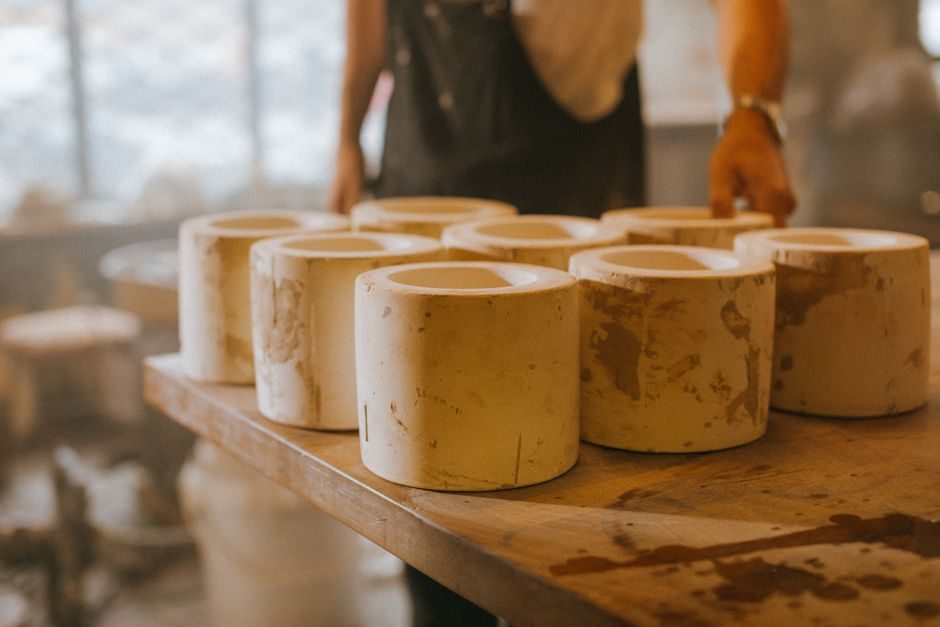
Industrial ceramic suppliers offer materials including silicon nitride, aluminum titanate, O'Sialon, and high-purity alumina (such as A-99 aluminium oxide) for aluminum casting and die-casting applications [S2], while other manufacturers supply alumina ceramics, zirconia ceramics, and diamond cutting tools as customized products [S4].
Chinese advanced-ceramic suppliers such as SGJL, Exasci, and Zibo Yunfeng now publish explicit grades — SG-28 silicon nitride, TA-03 aluminum titanate, OS-11 O'-Sialon, A-99 alumina — that map directly onto molten-aluminum, lithium-battery, and semiconductor hot-end applications, while ISO 9001:2015 + ISO 14001 dual certification has become the baseline gate for export audits on the Made-in-China platform [S2][S4][S5].
Material Family Comparison: Alumina, Zirconia, Silicon Nitride, Aluminum Titanate
Zirconia, in the Y-TZP form stabilised with 3 mol% Y₂O₃ or the Mg-PSZ form, delivers fracture toughness an order of magnitude above alumina, which is why it is preferred for precision ceramic chucks in semiconductor and photovoltaic handling where chipping is the dominant failure mode [S3]. The same property-versus-process trade-off shows up in the industrial coating family, where surface-barrier performance and substrate compatibility follow a closely related curve.
Aluminum titanate (Al₂TiO₅) is the low-thermal-expansion specialist: its coefficient sits near zero (≈ 1–2 × 10⁻⁶ /K) so it survives solidification shock in aluminum launder and trough linings, but its porosity and lower strength rule it out of load-bearing structural use. A useful rule of thumb when comparing families: alumina for cost and dielectric, zirconia for toughness and precision, silicon nitride for thermal-shock + high-temperature duty, aluminum titanate for low-expansion thermal buffers — pick on the dominant failure mode, not on raw hardness [S2][S5].
Selection Criteria Checklist for Process Engineers
A defensible ceramic spec in 2026 should answer, in order: (1) what fluid, melt, slurry, or gas contacts the part, and at what temperature and pH; (2) is the duty static load, cyclic thermal-shock, or impact/abrasion; (3) what dimensional tolerance and surface finish does the downstream process require; (4) is electrical insulation, dielectric strength, or RF transparency a hard requirement; and (5) what regulatory regime — food contact, semiconductor cleanroom, or ATEX/IECEx zone — gates the material certificate chain. For molten-aluminum service, SGJL publishes silicon nitride (SG-28) and aluminum titanate (TA-03) as paired options, with the silicon nitride grade taking structural parts and the titanate grade taking liner and spout parts [S2].
For wear-and-tear pipe and chute duties, ceramic-lined pipe with alumina or silicon carbide tiles is a common pattern at Zibo Yunfeng and similar Chinese mills, with ISO 9001:2015 and ISO 14001 management-system certification listed as the standard audit baseline for North and South American shipments [S5]. Tolerances on pressed and sintered parts commonly land at ±0.1% of nominal dimension or ±0.05 mm whichever is greater, and surface finishes of Ra 0.2–0.8 µm are typical for sealing faces, with tighter Ra only available on ground or lapped adders that materially extend lead time [S2][S4].
Standards, Certification and Audit Trail
ISO 9001:2015 for quality management and ISO 14001 for environmental management are the two management-system certificates most consistently listed by Chinese industrial-ceramic exporters in 2026, and they show up on supplier portal pages alongside product grade tables rather than buried in PDFs [S5]. Material-level standards — hardness per a Vickers or Rockwell scale, density per Archimedes, and dielectric strength per a 50 Hz or impulse test — are usually cited by reference to a test report number rather than a standard number in public catalogs, so specifiers should request the actual test method and sample size on RFQ. The 50 Hz and impulse dielectric-strength methods overlap with those used to qualify industrial buzzer piezoelectric ceramics, so a single test house can often service both product lines.
Where the ceramic part lands inside a regulated assembly, the upstream standard governs: semiconductor fab buyers route through SEMI cleanliness and trace protocols, lithium-battery line builders route through battery-cell OEM material approvals, and molten-metal foundries route through internal alloy-reactivity tests.
Application Cut: Aluminum Foundries, Lithium Battery, Semiconductor
Aluminum foundries and extrusion plants are the single largest user of advanced ceramics in China, with immersion-heater sheaths, launder liners, degasser rotors, and filter boxes almost universally running silicon nitride, O'-Sialon, or aluminum titanate rather than alumina, because the 660–720 °C molten bath and the 200–400 °C start-up transients destroy alumina through thermal-shock cracking within days of service [S2][S3]. Lithium-battery cathode line builders specify alumina or ceramic-lined stainless pipe for slurry transfer to keep metal-ion leach below the ppm thresholds that the cell OEMs enforce, with ceramic-lined pipe (alumina tiles epoxy-bonded into a steel shell) the dominant construction in Chinese mid-tier lines [S5].
The ceramic micropore chuck pattern in particular has become a documented application case in Chinese display-panel and photovoltaic lines, with pore-size control and vacuum distribution doing the work that mechanical clamping does in lower-tech lines [S3].
Limitations and Common Failure Modes

Specifiers who over-rely on a single hardness number routinely discover that thermal-expansion mismatch with a metal housing is the real failure mode, not surface wear [S2][S5].
For more on cost and lead-time bands across engineered materials, see the stainless steel price and cost guide and the titanium vs alloy-steel spec cut, which give the comparable metals-side bands a ceramic part is usually replacing. The alloy steel selection criteria piece is a useful parallel read because the same four-axis filter (temperature, chemistry, load, tolerance) drives both material families. For background on the broader engineered-materials field, the industrial ceramic encyclopedia entry consolidates the property tables referenced above.
Sourcing Map and Supplier Vetting Steps
In 2026 the Chinese industrial-ceramic supply base is concentrated in Shandong (Zibo cluster for alumina tiles and lined pipe), Jiangsu and Zhejiang (silicon nitride and structural parts), and the Pearl River Delta (precision zirconia and chuck components), with export portals showing ISO 9001:2015 + ISO 14001 as the most common dual-certification pair [S2][S4][S5]. A minimum-vet workflow before PO: (1) confirm material grade and chemistry certificate, not just "alumina" or "Si₃N₄"; (2) confirm sintering process and density target; (3) confirm dimensional and surface-finish tolerances with drawing-level callouts; (4) request a sample lot with destructive testing at receipt; (5) verify management-system certificate scope matches the producing site, not a sibling entity [S5].
Lead time in 2026 for pressed-and-sintered standard parts runs 3–5 weeks for alumina and 6–10 weeks for silicon nitride and zirconia in small batches, with tooling amortization pushing down the per-part price only above roughly 1,000 pieces for alumina and 500 pieces for Si₃N₄ — a band that engineers should pressure-test against the related cost analysis in the die casting die price guide, where tooling amortization follows a similar curve. Trackable signals to watch: ISO 9001:2015 surveillance audit cycles revalidating 2026 shipments, and any new SEMI or battery-OEM material-approval announcements from the Shandong and Jiangsu clusters [S2][S4][S5].