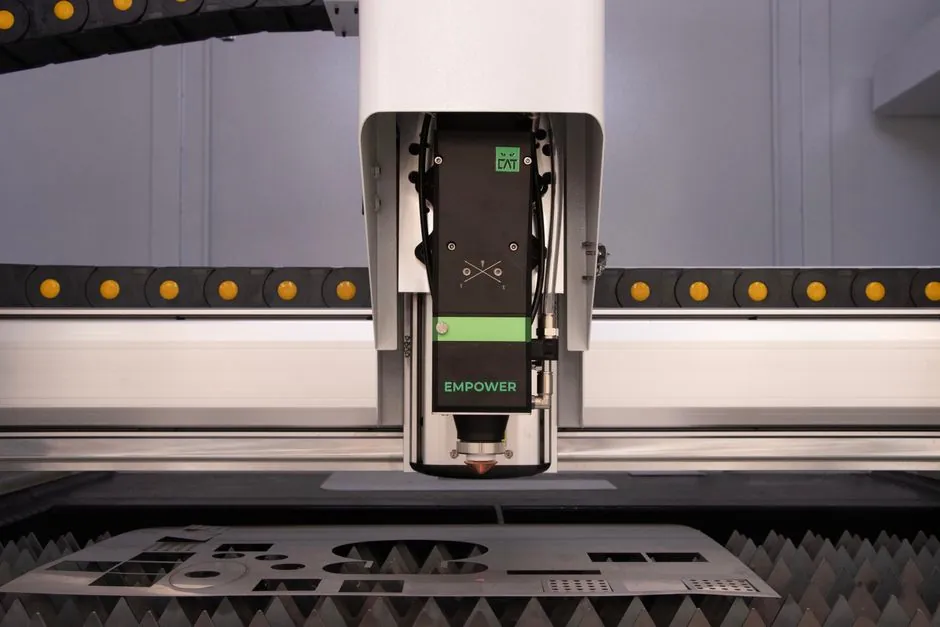
Industrial laser demand is set to grow from a 2025 base of USD 11.43 Billion to USD 20.86 Billion by 2035, a 6.2% CAGR, with fiber laser dominance, EV battery welding, and Asia-Pacific manufacturing capacity as the three structural pillars through 2030 [S3].
Fiber laser accounted for 48.4% of the 2025 type mix, cutting held 40.0% of application share, and Asia-Pacific led regional revenue at USD 4.10 Billion against North America at USD 1.73 Billion and Europe at USD 1.42 Billion [S1]. Procurement patterns in 2024-2025 shifted toward integrated systems that combine machine vision, software controls, and robotic automation inside a single production platform [S3].
Market Size, 2026-2030 Trajectory, and Source Spread
Forecasts vary widely because the underlying scope shifts: PW Consulting sizes the market at USD 7.8 Billion in 2025 rising to USD 11.57 Billion by 2032 at a 5.8% CAGR, while Reports and Data places it at USD 11.43 Billion in 2025 reaching USD 20.86 Billion by 2035 at a 6.2% CAGR [S1][S3]. Research and Markets' August 2026 update projects USD 12.58 Billion in 2026 compounding to USD 20.91 Billion by 2032 at an 8.79% CAGR, and Morgan Reed Insights pegs the 2026 value at USD 28.4 Billion scaling to USD 60.17 Billion by 2035 at 8.70% [S4][S7].
The headline spread reflects different segmentation rules: the lower-band models treat industrial laser as discrete manufacturing equipment, while the upper-band models fold in ultrafast, diode, excimer, and adjacent photonics systems [S1][S3][S4]. For 2026 capex planning, the practical envelope sits between USD 12.58 Billion and USD 17.36 Billion, the latter being the SpecForge 2026 laser technology parent-segment reading at 8.4% YoY [S4][S5].
Type Mix: Fiber Dominance and Solid-State Architecture
Fiber laser held 48.4% type share in 2025 and remains the workhorse for industrial cut, weld, and mark because it combines electrical-to-optical efficiency, beam quality, and packaging that fits robotic cells and gantry systems [S1][S5]. Within the solid-laser branch, three sub-architectures compete: Neodymium (Nd), Yttrium Aluminum Garnet (YAG), and fiber, with fiber dominating sheet-metal cutting below roughly 6 kW and disk or YAG-style layouts retaining a beam parameter product (BPP) advantage for high-brightness remote welding [S5].
Gas lasers (CO2, excimer) retain a defensible position in non-metal cutting, organic-substrate marking, and certain semiconductor lithography steps where wavelength matters more than wall-plug efficiency [S5]. Liquid dye lasers are a niche scientific and spectroscopy tool rather than a production asset. For process engineers sizing a cut or weld cell in 2026, the four-axis comparison is efficiency, BPP, achievable average power, and integration footprint, and fiber wins the efficiency and footprint axes in the under-6 kW envelope [S5].
Application Stack: Cutting, Welding, Marking, and Ultrafast Microprocessing
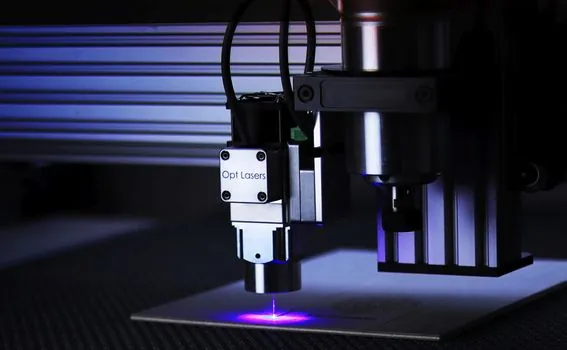
Cutting represented the highest application share at 40.0% in 2025, followed by welding, marking, drilling, cladding, additive manufacturing, and ablation as the broader laser-processing bucket [S1][S5]. A 1.07 µm fiber laser purchased for sheet-metal cutting can also be deployed for polymer welding, while a 10.6 µm CO2 laser is largely locked to non-metals, so the procurement decision is driven by material mix rather than a single application label [S5].
EV battery welding is the single fastest-growing process inside the welding bucket: battery modules require laser welding for tab joining, busbar welding, and lightweight aluminum component fabrication, and the IEA reported global EV sales above 17 million units in 2024, which is translating into direct capital spending on automated battery production equipment [S3]. Ultrafast lasers are simultaneously expanding inside semiconductor packaging and microelectronics, where micron-level precision and minimal thermal distortion justify the higher system cost [S3]. For inline distance and flatness checks downstream of the processing head, a laser displacement sensor or laser profiler is the standard reference pair, and it pairs with the report's real-time quality monitoring and process optimization trend.
Regional Pull: Asia-Pacific Lead, North America Acceleration
Asia-Pacific held the largest 2025 share at USD 4.10 Billion, more than double North America's USD 1.73 Billion and nearly triple Europe's USD 1.42 Billion, with Latin America at USD 315.7 Million and Middle East and Africa at USD 230.9 Million [S1]. The SpecForge 2026 parent-segment read also flags North America as the fastest-growing region inside the 2026-2030 window, driven by EV battery production, aerospace, and high-precision electronics manufacturing [S5][S6].
The United States benefits from a mature manufacturing base, strong R&D spending, and the presence of leading system integrators including IPG Photonics and TRUMPF, with robust adoption in EV battery production and aerospace high-precision electronics [S6]. Morgan Reed's outlook reinforces that EV manufacturing exceeding 50 million units annually by 2030 is a direct accelerator for laser system demand, particularly in battery welding and aluminum body fabrication [S8].
Power Output Tiers, Cooling, and the Under-1 kW vs Above-5 kW Trade
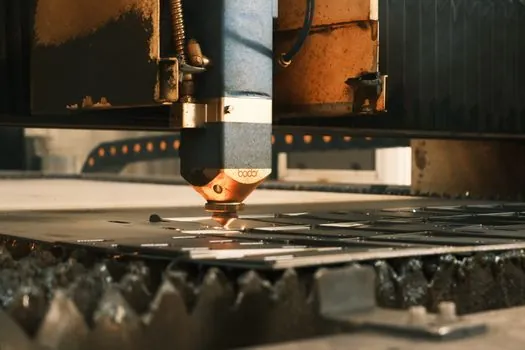
Research and Markets' 2026-2032 forecast slices power output into three bands: under 1 kW, 1-5 kW, and above 5 kW, and cooling into air-cooled, water-cooled, and hybrid-cooled [S2][S4]. The under-1 kW band carries the broadest installed base because it covers marking, micro-drilling, and selective soldering in electronics, while the above-5 kW band concentrates in thick-plate cutting and high-throughput welding cells [S2].
For a process engineer, the decision gate is straightforward: under 1 kW favors air-cooled compact fiber units with low maintenance, 1-5 kW is the mainstream sheet-metal cutting envelope where water-cooled fiber dominates, and above 5 kW requires hybrid or water cooling and is typically integrated into a robotic cell [S2][S4]. The 2024-2025 procurement shift toward compact fiber systems with lower electricity draw and lower maintenance than CO2 in high-volume production is consistent with the under-1 kW and lower 1-5 kW bands picking up share [S3].
Standards, Safety Classes, and the Compliance Cost Layer
Buyers in 2026-2030 must plan for compliance against OSHA rules, the European Machinery Directive, and ISO 21500 laser safety standards, which together govern Class 3B and Class 4 industrial laser deployment and force integrators to invest in safer operating procedures [S1]. The compliance cost layer is structural, not cyclical, and it pushes high-power fiber and ultrafast system integration toward suppliers with established documentation and service networks [S1].
Modular system designs that integrate into smart factory networks with predictive maintenance capability are the 2024-2025 supplier response, with TRUMPF launching upgraded high-power TruFiber laser systems in March 2024 specifically targeting EV battery and copper welding stability in automated lines [S3]. For process engineers tracking the laser marker and laser level segments, the same compliance envelope applies at lower power but with the same documentation overhead.
Selection Gates, Constraints, and Forecast Signals to Track

Industrial laser demand is FOR precision manufacturing buyers in automotive, electronics, semiconductor, aerospace, and medical devices where fiber and ultrafast sources are replacing mechanical machining for throughput and repeatability gains [S3][S8]. It is NOT for high-mix low-volume job shops that cannot amortize the USD 100k-plus upfront cost of a high-power fiber cell, nor for emerging-market operators without locally available skilled labor [S1][S3].
The decision criteria lineup reads as: capital cost vs throughput per shift, fiber vs CO2 by material mix, under 1 kW vs 1-5 kW vs above 5 kW by workpiece thickness, air-cooled vs water-cooled vs hybrid by duty cycle, and Class 3B vs Class 4 by safety envelope and facility readiness [S1][S2][S4]. The 2026-2030 capex envelope is most defensible inside the fiber-cut plus EV-weld combination, with the ultrafast microprocessing branch as the highest-growth secondary bet [S3][S5]. Trackable next signals include the August 2026 Research and Markets update series, the SpecForge 2026 vendor map cross-reference, and the IEA 2024 EV sales figure above 17 million units as the demand anchor for battery welding capacity build-out [S4][S5][S6].
For related coverage, see Sand blasting machine selection for rail components: a 2026 spec path.