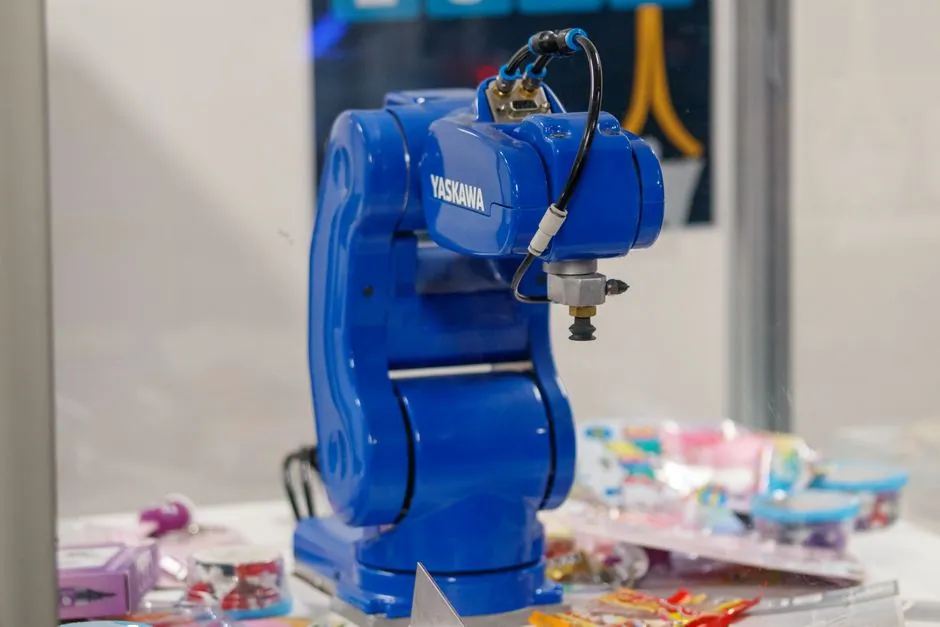
Three price tiers structure the 2026 welding-robot market: entry 6-axis MIG cobots at US$3,400-9,500, mid-band TIG/laser cells at US$10,000-20,000, and imported industrial arms at US$30,000-58,000, with the gap between laser-welding and polishing cells compressing to roughly 1.5x at the entry tier [S1][S2].
The shift is from a one-robot-one-welder sale to a cell-level delivery, and a 2026 cell is a five-layer stack: arc or laser source, 6-axis manipulator or cobot, positioner or rotary table, MES/SDA/PMC monitoring, and end-of-arm dress package, with the same Made-in-China catalog indexing 2,000+ manufacturers and 6,000+ SKUs [S4].
Market sizing and unit-economics baseline
Global robotic welding was valued at US$5,450.5 million in 2018, projected to US$10,784.4 million by 2026 at an 8.7% CAGR per Allied Market Research, while IFR/MarketsandMarkets tracking puts 2025 at roughly US$7.2 billion rising to US$11.8 billion by 2030 at over 10% CAGR [S1][S3]. Robotic arc welding cuts defect rates from 5-8% in manual operations to under 1% in properly calibrated systems, with payback inside 12-24 months, and the American Welding Society's forecast of a 360,000-welder deficit in the United States by 2027 keeps labour-arbitrage cases live across automotive, pressure-vessel, and structural fabrication [S3].
Arc welding remains the second-largest industrial-robot deployment category after material handling, with over 60% of automotive arc welding now robotic and 70%+ of all robotic welding installations running MIG/MAG (GMAW), which travels at 800-1500 mm/min on structural steel versus 200-500 mm/min for TIG [S2][S3].
Vendor split by price band, July 2026
Fanuc ARC Mate series anchors the premium tier: ARC Mate 0iD at 6 kg / 1,373 mm reach, ARC Mate 100iD at 12 kg / 1,637 mm, and ARC Mate 120iD at 20 kg / 1,811 mm, with arms listed at US$35,000-55,000 and iRVision plus ArcTool software in the bundle [S2]. Yaskawa Motoman AR900, AR1440, and AR2010 cover 927-2,010 mm reach at US$30,000-52,000, with the AR2010 specifically targeting extended-reach structural welding [S2].
OTC Daihen FD-B4 and FD-B4L hold 6 kg payload with 1,400 mm and 1,900 mm reach at US$32,000-48,000, and OTC's differentiator is that it builds both the robot and the power source, which tightens the arc-start and wire-feed integration loop [S2]. KUKA KR CYBERTECH ARC covers 6-8 kg payload with 1,840-2,100 mm reach at US$38,000-58,000, and the KR 6 R1840 ARC is the European quality choice for shipbuilding and heavy structural work where WorkVisual programming matters [S2].
Chinese value-tier arms from Estun EA1400N, Efort ER6-1400, and Rokae XB6 all share a 6 kg / 1,400 mm reach envelope and list at US$15,000-28,000 FOB, a 30-50% discount to Japanese and European equivalents that has put spec-grade articulated hardware inside mid-market fabricator budgets for the first time [S2][S3]. For 6-axis arm geometry basics, the articulated robot entry covers the kinematic baseline that every SKU in this market inherits.
Cobot-MIG convergence and the 1-set MOQ signal

Chinese suppliers on Made-in-China.com listed 6-axis MIG welding collaborative robots at US$3,500-9,500 per set as of 2026-07-19, with 1-set MOQ and ISO factory certification, a 40-60% undercut versus imported cobot welders and a removal of the integration-cell minimum that previously excluded small fabricators [S1]. The same listing cohort covers 118,806 robot SKUs from 6,988 suppliers, confirming that welding-robot inventory has moved into mass-market wholesale rather than a niche integration play [S1].
Shenzhen Guanhon's TIG-torch welding robots sit at US$10,000-11,730 per piece with 1-piece MOQ, while the laser-welding tier tops out at US$8,500-20,000 per set with 0.05 mm accuracy claims and 0.5 m/min welding speed, and the price gap between laser welding and polishing cells has compressed to roughly 1.5x at the entry tier, down from a historical 3-4x gap [S1]. For the collaborative robot class baseline and ISO/TS 15066 power-and-force-limiting spec context that gates every cobot RFQ, the encyclopedia covers the duty envelope behind the 6-axis MIG format.
Cell-level selection: payload, reach, axes, positioner
Payload commonly spans 6-20 kg for thin-gauge autobody work and 20-100+ kg for heavy fabrication, with SCARA arms capped at 5 kg for short-stroke spot and micro-TIG tasks where vertical compliance and high speed matter [S2][S6]. The Allied Market Research segmentation pattern splits 6-axis payloads into up to 5 kg, 5.01-15 kg, and 15 kg+ bands, which is the same envelope buyers should use when sizing a positioner [S6].
Three parameters decide 80% of welding-cell RFQs in 2026: payload (typically 6-20 kg for arc welding), reach (1.4-2.0 m for body-in-white), and axis count (6-axis is table-stakes, 7-axis enters when the workpiece geometry obstructs a 6-axis envelope) [S4]. For the broader industrial robot reference that frames the manipulator, positioner, and MES layers as a single delivery contract, the encyclopedia covers the cell topology that 2026 buyers now spec against.
Process comparison: MIG, TIG, flux-core, plasma, laser-hybrid
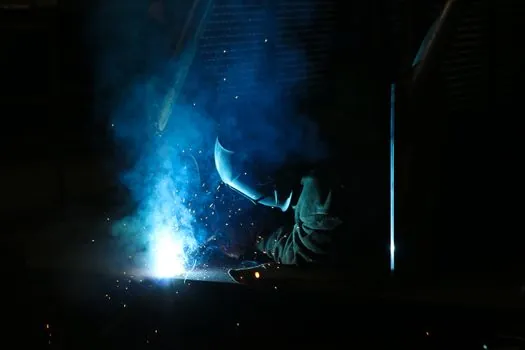
MIG/MAG runs 800-1500 mm/min and accounts for 80%+ of fabrication shop robotic welding, with the best balance of speed, penetration, and cost per meter, but it requires post-weld grinding for cosmetic surfaces [S2][S3]. TIG runs 200-500 mm/min, roughly one-third the speed of MIG, and is mandatory for aerospace, pharmaceutical, and food-grade stainless where aesthetics and corrosion resistance dominate [S3].
Flux-core (FCAW) is the simple, forgiving choice for heavy steel sections; plasma (PAW) is a precision thin-material specialist; and laser-hybrid welding pairs a laser beam with a MIG arc in a single weld pool, increasingly adopted for thick-section steel in shipbuilding and pipeline where single-pass welding of 8-15 mm plate replaces multi-pass MIG [S2][S5]. Power-source integration is non-negotiable: Lincoln Power Wave S350, Miller Auto-Continuum 350, and Fronius TPS 400i are the certified robotic welders with DeviceNet or EtherNet/IP interfaces, and non-robotic welders lack the digital interface for arc start/stop and wire-feed sync [S2].
AI seam tracking, vision, and the digital-twin layer
Vision systems with deep-learning algorithms now enable real-time seam tracking with sub-millimeter accuracy, automatically compensating for part-to-part variation, which reduces fixture-precision requirements and expands robotic welding feasibility for less-controlled job-shop environments [S3]. The 2026 smart-manufacturing cell adds an MES information center plus a Monitoring data acquisition (SDA) module, and without that documented SDA/PMC/MES stack a buyer is purchasing a numerically controlled machine, not a smart one [S4].
Weben's reference architecture for stamping and body-in-white welding explicitly carries a separate MES information center and SDA monitoring layer, which is the layer that turns a robot into a smart cell, and the 2024 Springer HCII paper on welding robotization reinforces this by treating welding as a benchmark task for human-machine collaboration, where cognitive and gestural operator skills must be digitally modelled before full robotisation is feasible [S4]. Buyers writing RFQs in 2026 should require a documented operator-skill data schema on the MES side, not just a robot teach pendant, and the welding cutting tool encyclopedia entry covers the torch-and-dress half of the same stack.
Limits, failure modes, and the cobot safety gate
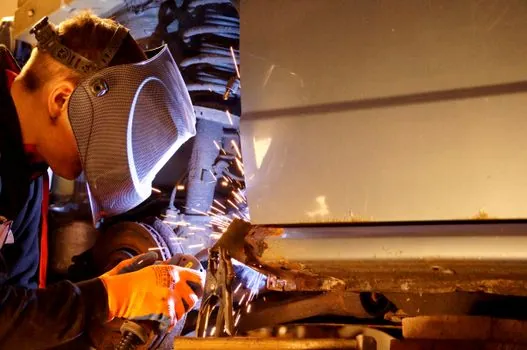
Arc-welding cobots are typically specced at 6-10 kg payload and ±0.03-0.05 mm repeatability, and they are now listed side-by-side with industrial 6-axis arms in the same supplier catalog, with a Jiangsu or Shandong vendor quoting 6-axis arc-welding cells from US$3,400 per piece and a Shanghai cobot OEM quoting 7-axis collaborative arms at US$15,500-16,600 per set [S4]. For collaborative arc welding, the safety gate is ISO/TS 15066 power-and-force-limiting compliance plus a documented risk assessment, not the catalog price, and the agv robot reference covers the intralogistics half of the same cell when the positioner and rotary table are fed by mobile platforms.
For buyers writing spec sheets, the next trackable signals are the July 2025 cell pricing snapshot (US$3,400-23,000 per unit, 2,000+ active manufacturers), Allied Market Research's US$10,784.4 million 2026 market projection, and any new ISO/TS 15066 risk-assessment filings from the Shanghai cobot cohort; the amr robot entry covers how the same MES/SDA stack feeds the autonomous mobile half of a modern welding cell.
See also our earlier report, Laser Cutting Machine Procurement: 2026 Spec Bands, Rejection Gates, and Sourcing Path.