An industrial laser is rarely bought as a standalone instrument; it is specified into a workcell that already has motion stages, controllers, optics, and safety interlocks, so a delivery slip on the laser stalls the whole line [S2]. Procurement teams running 3-10 year production projects should treat the laser as a long-life subsystem and grade suppliers on reliability factors (product consistency, technical support, delivery stability, documentation, spare parts) before they negotiate unit price [S2].
The first decision is beam technology, not vendor: fibre, CO2, ultraviolet, and pulsed nanosecond sources each have different material, absorption, and maintenance profiles, and only one of them will match the substrate, edge quality, and throughput the line needs. Once the beam type is fixed, the rest of the RFQ (power in watts, pulse duration, working-area envelope, positioning accuracy, cooling class, and safety category) becomes a comparison table, not a sales call [S3].
Beam Type and Power: The Non-Negotiable First Cut
Fibre lasers dominate metal cutting and welding cells because of high wall-plug efficiency and diode lifetimes that commonly exceed 100,000 hours, while CO2 sources keep their place in non-metallic cutting, large-area marking, and certain film-processing lines where 10.6 µm absorption is required [S2]. UV (355 nm) and green (532 nm) pulsed sources are specified when heat-affected zone must stay below the threshold visible to downstream inspection, particularly on coated electronics, medical wire, and photovoltaic layers [S3].
Power range and pulse duration are the two numbers a process engineer should write into the RFQ header, because changing them later usually means changing the laser head, the chiller, and the safety class all at once. A typical industrial fibre cutting RFQ starts at 1.5-3.0 kW for thin-gauge steel and aluminium, climbs to 6-12 kW for thick-plate work, and reaches 20-30 kW for heavy fabrication cells; UV marking systems sit in a separate 3-30 W class driven by galvo-head repetition rate, not sheet-metal throughput [S3]. A buyer who skips the power-and-pulse conversation and goes straight to quotation ends up with a machine that meets the brochure spec but not the takt time.
Reliability Factors That Actually Move the Risk Needle
Supplier reliability in industrial laser procurement is best measured as a five-factor scorecard, not as a single vendor promise: product consistency (batch-to-batch performance), technical support depth, delivery stability, documentation quality, and spare-parts availability over the contract life [S2]. Each factor is a hedge against a different failure mode, and dropping any one of them converts a planned production line into a single-point-of-failure dependency on a single factory in a single province.
Predictable lead time is the factor most often cited by long-horizon buyers, because a fibre laser source, a motion stage, a controller, an optics set, and an automation cell must arrive on a synchronised schedule; a 30-day slip on the laser cascades into idle labour, a held shipping berth, and a contractual penalty on the integrator [S2]. A second tier of risk lives in the spare-parts column: diode stacks, focusing optics, chiller pumps, and galvo scanners are wear items with finite service intervals, and a vendor that cannot supply them 5-7 years after the original sale effectively imposes an unplanned replacement capex on the buyer [S2]. Documentation is the cheapest factor to grade and the easiest one to let slip: ask for test reports, beam-quality measurements (M² or BPP), CE/UL declarations, and integration drawings before signing the PO, because missing paperwork is what turns a warranty claim into a finger-pointing exercise.
Building the RFQ: A Spec-First Checklist Buyers Can Reuse

A reusable industrial-laser RFQ has eight rows, in this order: (1) beam type and wavelength, (2) average power and pulse duration, (3) working area or cutting/marking field, (4) positioning accuracy and repeatability, (5) cooling and ambient class, (6) safety category and interlock list, (7) integration interface (fieldbus, analogue I/O, Ethernet), and (8) lifecycle clause covering spares, firmware, and service window [S3]. Each row is a cull: vendors who cannot answer in writing are vendors who will struggle when the line is running at 02:00 and the service hotline is the only support channel.
The same checklist disciplines the comparison between a desktop-class machine and a production-floor cell, which is the most common spec mistake in this category. Desktop laser engravers sit in a sub-1 kW, sub-500 mm working-area class aimed at low-volume workshops; industrial laser marking and cutting systems start in the multi-kW range with interlocked enclosures, extraction, and Class 1 product safety, and the price gap (often a 5-10x multiplier) reflects enclosure, motion, and certification costs, not a "better laser" [S3]. Skipping that step pushes buyers toward under-specified hardware that fails CE, or over-specified hardware that sits idle on the shop floor.
Comparison: Desktop vs Industrial Laser Platforms on Buyer-Relevant Criteria
The cleanest way to compare platform options is on four buyer-relevant criteria at once: working area and power, safety and integration class, throughput, and 5-year lifecycle cost. Industrial laser marking and cutting systems outscore desktop engravers on every row except unit price and footprint, which is exactly the trade-off the spec must surface before the budget conversation starts [S3].
The comparison matters because procurement teams that skip it typically over-spec the desktop (paying for capacity they will never use) or under-spec the cell (discovering that "industrial" in marketing copy can mean "bigger desktop"). A line item that looks 60-70% cheaper on PO day can easily cost more across the 5-year lifecycle once extractor upgrades, enclosure retrofits, and unplanned service calls are added [S3].
Standards, Documentation, and Acceptance Gates
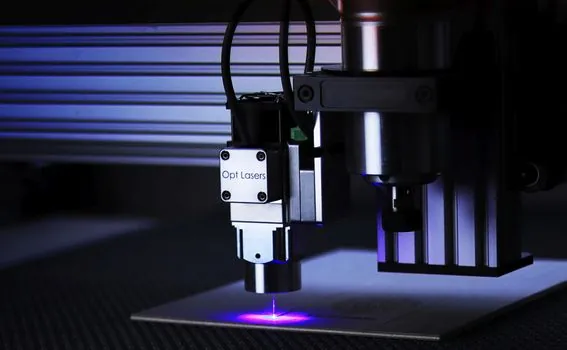
Acceptance gates for an industrial laser should be written into the contract, not negotiated at sign-off, and they should bind the vendor to a measurable beam-quality and positioning test on the buyer's floor. Buyers should require the test methodology (M² measurement, dot-roundness, edge-grind on a reference coupon, cycle-time on a defined path), the pass/fail thresholds, and the re-test cost responsibility; without those clauses, "acceptance" becomes a debate rather than a gate. Documentation handed over at the same time should include risk assessment, CE/UL files, electrical schematics, I/O list, and a recommended spares list with part numbers. [S2]
Where the laser is integrated into a positioning system, the procurement file should reference the upstream motion hardware using the same spec-first language; for example, the linear guide that carries the cutting head, the crossed roller guide inside the galvo or scanning head, or a laser level used for machine alignment at install all carry their own accuracy, load, and stiffness numbers, and a weak mechanical stage will dominate the beam's nominal accuracy. The same logic applies to the marking and welding cells that sit next to the cutting line: a laser marker and a laser screed share the same beam-source, safety, and spares logic, so a multi-vendor framework can amortise qualification effort across them [S2].
Lifecycle Risk: Spares, Service Windows, and the 5-Year Question
The single most expensive mistake in industrial laser procurement is treating the PO as the end of the relationship, when in practice the next 5-7 years are dominated by spares, retrofits, and software updates. Suppliers that score well on product consistency at install often score poorly on year-five support, especially when the original sales engineer has moved on; the RFQ should require named contacts, defined response times, and a written commitment that critical spares (diode modules, focusing optics, chiller compressors, galvo scanners) remain orderable for a stated window [S2].
Service continuity ties directly to lead-time stability, because the only thing worse than a delayed laser delivery is a delayed service part on a line that is already producing revenue. Buyers running multi-site operations should ask whether the vendor can hold a buffer of service stock regionally, not just at the factory, and whether firmware updates are bundled or itemised; the answer changes the operating-cost math more than the headline unit price does [S2]. The same pattern shows up in adjacent categories: a recent spec-first buyer's workflow for lithium battery procurement ranks continuity of supply over sticker price, and the laser playbook should apply the same weighting.
Trackable Signals for the Next Buying Window

Three signals are worth monitoring before the next RFQ: (1) the vendor's published lead-time trend over the last 6-12 months, (2) the price and lead time of critical spares as quoted at RFQ time (not at install), and (3) the vendor's stated policy on firmware, obsolescence, and end-of-life support [S2]. A related upstream pressure worth tracking is the steel and motion-component chain that feeds the same workcell; see the linear guide rail value chain mapping for the pattern, since guide-rail supply shocks hit laser cells through the same logistics channels that hit CNC machines. Buyers who capture those three signals per vendor and re-score annually will catch reliability drift before it shows up as unplanned downtime.