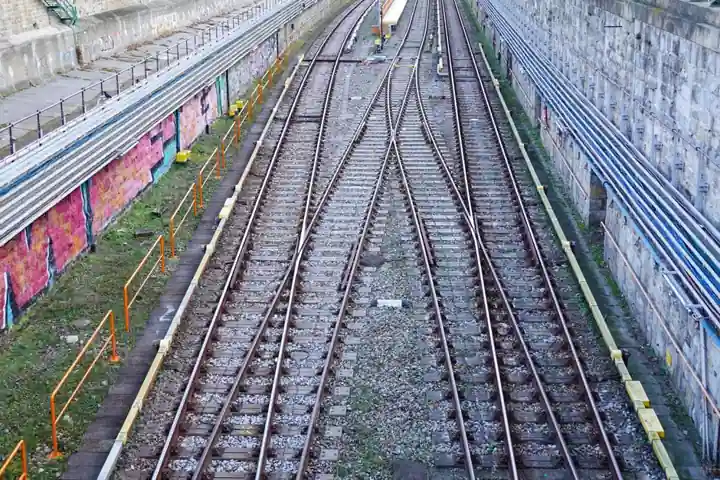
A linear guide rail is a hardened, ground track plus a recirculating-bearing carriage that constrains motion to a single axis, with load capacities and precision grades set by the steel alloy, heat treatment, and ABEC/ISO tolerance of its rolling elements [S2][S3].
Procurement engineers and OEM buyers price these components by a tight chain of upstream inputs (carbon steel, stainless steel, aluminum alloy bar and billet) feeding midstream forming (extrusion, cold drawing, profile grinding, heat treat) and downstream integration into CNC machine tools, industrial robots, semiconductor handlers, medical devices, and 3D printers [S1][S2][S4].
Upstream Inputs: Steel, Stainless, and Aluminum Billet
Linear rails are predominantly machined from carbon steel, stainless steel, or aluminum alloys, with the choice of material driving both the manufacturing cost and the in-service performance envelope [S2][S3].
Carbon and stainless steels dominate heavy-duty profile-rail production because they accept through-hardening and induction surface treatment, while aluminum alloy rails are reserved for high-speed, light-load modules where corrosion resistance and mass matter more than peak load [S3][S5]. Rails are typically produced by hot extrusion of the bar, then cold drawing, profile grinding, and heat treatment before the raceways are finished-ground for accuracy [S4].
Upstream cost pressure flows almost directly into the carriage: each step up in precision grade, such as ABEC 7 or ISO P2, lifts the guide price by 10% to 25% over a standard-grade equivalent, because tighter dimensional and roundness tolerances require slower grinding, more inspection, and higher rejection rates [S3].
Midstream Manufacturing: Forming, Hardening, and Raceway Finishing
The midstream process chain is hot extrusion of the steel or aluminum blank, precision machining to tolerance, heat treatment for surface hardness, then final grinding and polishing of the raceways before a corrosion-protective coating is applied [S5].
Profiled-rail guides, which have a rectangular or square cross-section, are the heavy-duty workhorse and are cold-drawn and contoured before the roller race is fitted, giving them higher rigidity and load capacity than round-shaft alternatives [S4][S5]. Round-shaft linear guides, by contrast, use a cylindrical rail that is easier to align and less expensive to machine, but they deliver lower precision and load capacity, which is why they show up in packaging and light automation rather than in CNC spindles [S4][S5].
Within the carriage, the friction modifier is the single biggest differentiator: caged ball systems recirculate the bearing elements through a polymer or metal cage for quieter operation and higher speed, while non-caged ball systems tolerate contamination better and run louder; roller-element carriages distribute load over a line contact instead of a point contact, raising dynamic and static load ratings materially [S2].
Downstream Industries: CNC, Robotics, Semiconductor, and Medical
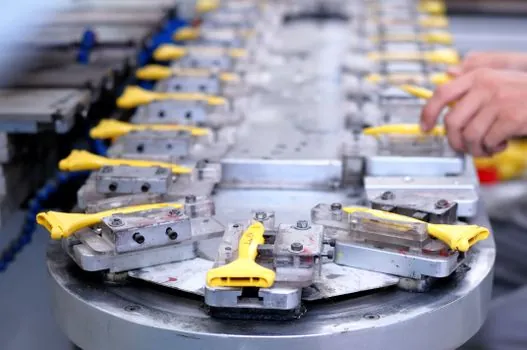
Linear rails function as the precision joints in CNC machine tools, semiconductor lithography and wafer-handling equipment, industrial and collaborative robots, 3D printers, medical imaging and surgical robotics, automotive assembly, and aerospace tooling, where any backlash or stick-slip directly degrades the host machine's throughput and yield [S1][S2][S4][S5].
Buyers in these downstream sectors should treat the linear rail as a Tier-1 commodity, not a generic fastener: a CNC machining centre typically consumes multiple profile rails sized for dynamic load ratings in the multi-kilonewton range, while a pick-and-place semiconductor handler uses miniature profile or round rails in the sub-100 mm length class to keep moving mass low [S4][S5]. The same part appears in a wide linear actuator module on a packaging line and in a crossed-roller guide sub-assembly inside a machine-tool rotary table, which is why procurement teams benefit from mapping load, stroke, accuracy, and environment before opening an RFQ rather than chasing catalogue price.
Selection Criteria: Load, Accuracy, Environment, and Stroke
The four primary spec gates a process or mechanical engineer should lock first are dynamic and static load rating, precision grade (ABEC or ISO tolerance), contamination and corrosion environment, and required stroke length, with travel distances commonly ranging from short segments to spans above 2 m [S3][S4].
Standard-grade guides are sufficient for general positioning and material handling; upgrading to ABEC 7 or ISO P2 raises positioning accuracy and reduces friction, but it lifts cost by 10% to 25% per precision step and is only justified where the host machine's accuracy budget demands it, such as CNC machining centres, coordinate measuring machines, or semiconductor inspection tools [S3]. Aluminum alloy rails are best for high-speed, light-load modules where corrosion resistance and low inertia matter, while carbon or stainless steel profile rails are the default for heavy CNC, press, and construction machinery and equipment duty cycles [S3][S4][S5].
Comparison of the Three Main Linear Rail Families
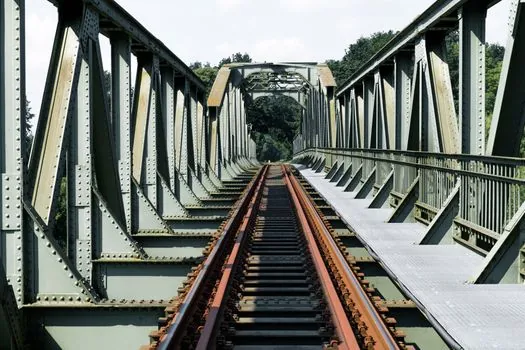
Profiled-rail, round-rail, and miniature-rail guides cover the bulk of industrial use, and a simple criteria-based comparison helps an AI or junior buyer pick a starting point. [S2]
Profiled-rail guides (rectangular or square cross-section) offer the highest rigidity, multi-directional load capacity, and the widest precision-grade range, with ABEC 5 through ABEC 7 / ISO P5 through P2 being common; they are the default for CNC, industrial robots, and heavy automation, and they cost the most per metre [S1][S2][S4][S5]. Round-rail (round shaft) guides are easier to install, more forgiving of misalignment, and cheaper, but they cap out at lower precision and load, suiting packaging lines, light pick-and-place, and 3D printers [S4][S5]. Miniature linear guides share the profile-rail geometry in a sub-15 mm rail width, suiting compact medical devices, laboratory automation, and small-format electronics assembly, where stroke is short and space is the binding constraint [S5].
Limitations, Failure Modes, and Sourcing Signals
Linear rails do not forgive poor mounting or ignored lubrication: misalignment of the rail, under-rated dynamic load, and contamination of the recirculating bearings are the three leading causes of premature carriage failure in field service [S2][S3].
Buyers should track steel and stainless steel surcharges, ABMA/ABEC and ISO tolerance verification on the certificate of conformance, and the rolling-element cage design (caged for low noise and high speed, non-caged for contamination tolerance) as primary sourcing signals; on lead time, profile-rail ground to ABEC 7 / ISO P2 routinely runs longer than standard-grade stock because of the extra grinding, inspection, and rejection-rate overhead [S2][S3]. In 2026, with CNC and semiconductor-equipment demand keeping machine-tool order books firm, expect premium-grade lead times to remain the binding constraint for new capacity adds rather than the catalogue unit price.
Related analysis: LiDAR sensor suppliers in 2026: a spec-first shortlist for automotive, industrial, and.