Industrial oven selection is a process-engineering decision, not a brand decision, and buyers who start with the menu of products, temperature envelope, batch geometry and utility constraints avoid most of the costly mis-specs seen on plant floors [S2][S4].
Industrial duty spans a wide thermal window, with laboratory/industrial-class chambers typically organised in bands up to 200°C, 300°C and 350°C for general heat work, and higher-rated furnace families for metallurgy and ceramics, so the operating setpoint is the first discriminator between candidate units [S4].
Lock the temperature envelope and thermal class first
The absolute minimum and maximum process temperatures must be defined before any oven shortlist is built, because temperature class controls insulation thickness, heater wattage, and safety clearances more than any other single parameter [S2].
Commonly used industrial oven temperature bands include up to 200°C (drying, curing, ageing), up to 300°C (paint bake, powder-coat cure, sterilisation), up to 350°C (composite cure, electronics burn-in), with higher-rated chamber and muffle furnaces used for ashing, ceramics and metallurgy work [S4]. Standard product families in laboratory/industrial supply are explicitly listed under these bands, so a buyer can quickly rule out a chamber whose insulation is rated for a lower continuous setpoint than the process demands [S4]. For food and bakery duty, gas or electric convection platforms typically operate in the 150–300°C baking window, with steam injection and proofing chambers added for bread and viennoiserie work [S3].
Match the oven geometry to your loading method
Geometry, not nominal chamber volume, decides whether an oven fits the actual loading workflow, and two units with the same temperature rating can deliver very different throughput depending on cart, pallet and tray handling [S4].
The main industrial families line up as follows on a loading-and-footprint axis:
Batch chamber oven (with or without removable hearth): parts loaded on trays or a removable base plate; suits small-to-medium batches, R&D, and labs where the hearth can be pre-loaded outside the hot zone to cut door-open time [S4].
Walk-in oven: a floor-level chamber that operators enter to load carts, hanging racks or pallets; the chamber floor is the loading floor, so heavy or tall assemblies are handled with no lifting, at the cost of larger footprint and higher standby losses [S4].
Tunnel / conveyor oven: a continuous chamber where product travels on a belt or chain through zones with controlled temperature ramps; suited to high-volume, single-product flows such as bread, biscuits, paint lines and heat-treated fasteners [S5].
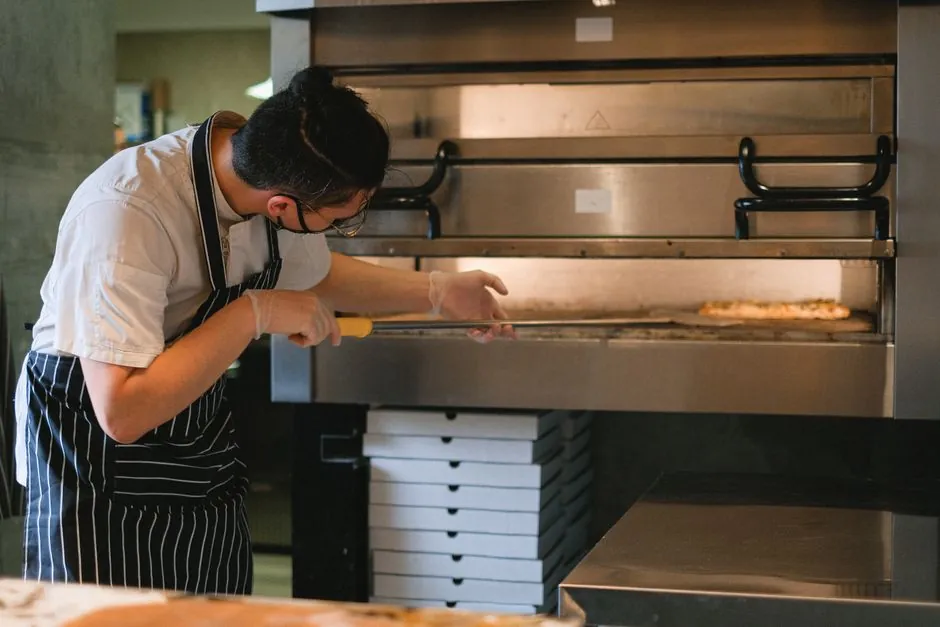
Convection bakery oven: rack or rotary platforms for trays, typically electric or gas, with the 15–20 kW band covering artisanal bakeries and 30–40 kW covering high-volume production lines [S3].
Combi oven: a single platform that combines convection heat and steam in programmable cycles, replacing a separate proofer and conventional oven in bakery and foodservice settings where menu variety matters more than single-product throughput [S3].
Airflow, atmosphere and temperature uniformity

Forced-convection airflow with properly sized recirculation fans is what produces usable ±5°C class uniformity across a loaded chamber, while still-air or low-velocity ovens can easily swing 15–25°C between corners once a real load is in place [S2][S5].
A buyer should request a temperature-uniformity map (typically 9-point per AMS 2750 or equivalent) at the working setpoint and with a representative load, because uniformity at empty chamber is almost meaningless for production duty [S2]. When the process is sensitive to oxidation, moisture, or solvent carry-off, the oven may need an inert-gas purge loop, an exhaust damper with controlled extraction rate, or a Class A/B cleanroom-compatible interior; each of these options adds ducting, vent sizing and instrumentation that the specification must capture early [S5][S8].
Power, utilities and energy footprint
Industrial heating accounts for more than 26% of total energy use in manufacturing, so the utility side of an oven purchase (electrical kW, gas m³/h, steam kg/h, and exhaust losses) usually outweighs purchase price over a 10-year life [S5].
Typical industrial oven power bands line up with class: laboratory and small-batch chambers commonly run 3–15 kW electric; mid-size batch and bakery convection platforms 15–40 kW; large walk-in and tunnel ovens 50–250 kW electric or equivalent gas input. Optimised drying-oven controls have been shown to cut energy use by up to 30% versus baseline cycling, which is a meaningful operating-cost lever on pharmaceutical and coating lines [S5]. High-quality insulation plus standby mode and load-tracking power adjustment are the two features that most often move the energy number in real plants [S3].
Control, automation and data interfaces
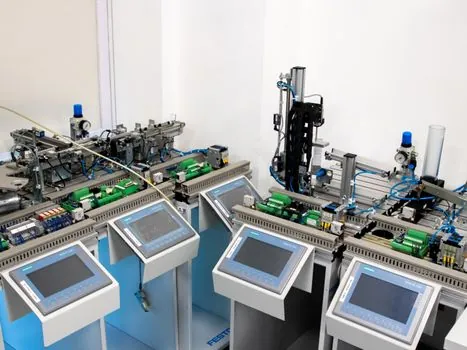
Programmable controllers with profile storage, ramp/soak segments, and a documented data-logging interface are now table stakes on any oven above the smallest bench-top class, because they define whether the unit is actually repeatable in production [S3][S4].
For OEM-class industrial ovens, the spec should explicitly call out: PID controller with at least 8–16 segments, USB or Ethernet recipe export, over-temperature safety cut-out (independent of the main controller), and door-interlock or fan-after-cool logic tied to heater enable [S4]. Cloud connectivity and remote recipe push are increasingly common on bakery and combi platforms, letting a central lab push validated baking profiles to multiple stores, which matters for chain foodservice operations more than for single-site industrial users [S3].
Build quality, materials and after-sales service
Durable construction is what separates an oven that runs for 15+ years from one that needs re-insulation in five: welded structural frames, mineral-wool or microporous insulation rated for the working setpoint, and 304/316 stainless interiors where hygiene or corrosion is a factor [S6].
For lab and cleanroom duty, electropolished interiors and gasketed doors with documented leak rates are worth specifying; for industrial metal-heat-treat duty, refractory linings and alloy racks become the priority instead of stainless. A side-by-side oven shortlist should also score vendor service: lead time for spare heaters, fans and controllers, average field-service response, and whether the controller firmware is supported past the warranty window, because most ovens are scrapped not from chamber failure but from unsupported controls [S6].
Who should NOT default to a generic batch oven
Buyers with high-volume, single-SKU flow should not default to a generic batch chamber, because the door-open/cool-down cycle of a batch unit will cap throughput and waste energy versus a tunnel or conveyor line sized for the same product [S5].
Likewise, a small café or R&D lab has no business installing a walk-in oven: the floor area, ventilation and electrical service will be oversized for the actual duty, and a compact chamber or combi oven will deliver the same process result at a fraction of the operating cost [S1][S3]. Pharmaceutical or electronics applications that depend on documented thermal mapping should avoid any oven family that cannot supply a uniformity survey traceable to a recognised standard, since validation will not close otherwise [S2][S8]. For a spec-led view of how selection logic compares across other capital equipment, the coatings-procurement spec-first framework and the food-grade linear module spec map follow the same envelope-first logic for adjacent duty.
Shortlist logic: a four-step buyer workflow
Step 1, define the process envelope: min/max setpoint, ramp rate, soak time, batch size, atmosphere and required uniformity; without these numbers every other comparison is meaningless [S2][S4]. Step 2, pick the oven family by loading method (chamber, walk-in, tunnel, conveyor) and rule out families whose footprint or utility demand does not match the site [S4][S5]. Step 3, size the utility service: confirm electrical kW, gas or steam supply, exhaust CFM and ventilation, then validate that the building can deliver it without a costly service upgrade [S3][S5]. Step 4, score vendors on build quality, control platform, documentation, and after-sales support, and require a temperature-uniformity map with a representative load before signing the PO [S6][S8].
The first trackable signal for any oven purchase is a vendor-supplied uniformity survey at the working setpoint, with a loaded chamber; the second is a written confirmation of controller firmware support and spare-parts lead time, both of which usually separate the shortlist from the actual order.
Component reference pages worth checking: industrial adhesive, industrial borescope, and industrial buzzer.