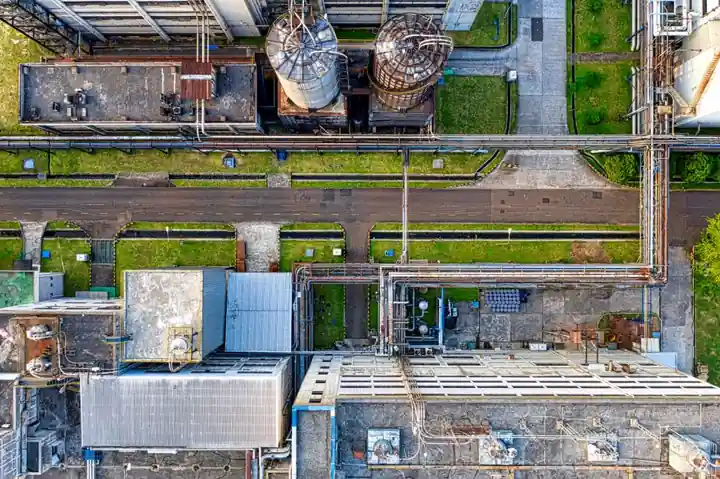
Industrial refrigeration is an integrated chain: ammonia (R-717) and Freon compressor packages from upstream OEMs feed downstream cold storage, food processing, and chemical plant users, with field service, ASME code fabrication, and CRN registration acting as the spec floor rather than the ceiling [S1].
The chain runs from refrigeration compressor brands (e.g., Vilter, Mayekawa, GEA, Johnson Controls industrial refrigeration) and heat exchanger fabricators at the top, through system integrators and contractors in the middle, to end users running cold rooms, blast freezers, and process chillers at the bottom. The list of parts providers typically maintained by a North American industrial refrigeration shop spans Alfa Laval, Armstrong, Baltimore Aircoil, Bell & Gossett, Camco Lubricants, Coldmatic, Colmac Coil, Coolair, Cornell Pump, Danfoss, Docal, Emerson Climate, Heresite, H.T. Industrial, Parker, and Friga-Bohn, illustrating how many SKUs a single job can pull [S1].
Upstream Layer: Compressors, Evaporators, and Coil Fabrication
The upstream layer of industrial refrigeration is dominated by ammonia and Freon compressor OEMs, plus the in-house fabrication of aluminum and stainless-steel evaporators and condensers that feed them [S1]. Custom-designed ammonia systems and Freon packages are the two refrigerant paths most commonly specified for industrial and commercial loads above 100 kW cooling, with screw and reciprocating compressor packages handling the duty [S1].
Evaporator and coil fabrication is a distinct upstream sub-chain. One North American fabricator publishes a product family that maps directly to application: MAC evaporators for coolers and processing rooms, MAF for freezers and low-temperature service, MAB for blast freezers, MRA rectangular coils, BTR between-rails cooling, and HG units for tight temperature/humidity control; condensers split into ACC air-cooled condensers and ACHE air-cooled heat exchangers [S1]. That product split is a useful proxy for the duty bands a buyer should expect: blast-freezer evaporators, for example, carry higher face-velocity and defrost-cycle requirements than a 2 to 4 deg C processing room.
Welding and materials handling is the third upstream leg. Fabrication to ASME standards, with coil fabrication registered to CRN (Canadian Registration Number), is the published spec floor for pressure-bearing components crossing into Canadian jurisdictions, and shops that also hold stainless and aluminum TIG welding certifications cover the typical evaporator and condenser weld set [S1]. When a coil is CRN-registered, the inspector expects material certificates, weld procedure specs, and pressure-test records to be on file, which is why shops publish that fact on the spec sheet rather than leave it implicit.
Midstream Layer: System Integration, Controls, and Field Service
System integrators are the layer that turns upstream components into a working plant: design, installation, project management, controls, and 24/7 service run through one contract, often paired with electrical, mechanical, and gas-fitting work via a parent group [S1]. For an ammonia plant this means PSV sizing, relief-vent routing, and machinery-room ventilation are designed together with the compressor package, not bolted on later.
Controls in industrial refrigeration have largely converged on PLC-based platforms with electronic expansion valves, and vendors in the upstream parts list (Danfoss, Emerson Climate) supply both the valve hardware and the controller layer [S1]. For buyers, the practical question is whether the control panel is UL-listed for the relevant hazardous area classification if ammonia is present; that detail is decided at the integrator level, not at the compressor OEM.
Field service is a separate value stream. Industrial ammonia sites typically run continuous operations, and shops that publish 24-hour emergency service and on-site maintenance treat that as a baseline offering rather than a premium [S1]. For a 24/7 cold-storage or food-processing plant, mean time to respond on a compressor trip or a refrigerant leak is a procurement criterion on par with first cost, because every hour of lost cooling translates directly to product loss.
Downstream Layer: Cold Storage, Food Processing, and Process Cooling
The downstream layer is the end-user set: cold storage warehouses, food processing facilities, dairy and beverage plants, chemical and pharmaceutical process cooling, and district cooling plants feeding commercial loads. Industrial-grade evaporators are split by application temperature band: MAF for freezers, MAC for coolers, MAB for blast freezers, and HG for tight temperature-and-humidity control rooms, with the duty band driving fin spacing, face velocity, and defrost strategy [S1].
Process cooling is a more demanding sub-segment. Chemical and pharmaceutical users typically require redundant compressor trains, ammonia detectors in occupied spaces, and a documented PSM (Process Safety Management) program; food processors run on similar mechanical kits but add wash-down ratings, stainless surfaces in product zones, and tighter temperature control. The same MAC cooler can serve a 4 deg C dairy processing room or a 12 deg C produce cooler, but the controls, defrost logic, and sanitary finish differ.
Cold storage is the volume market. A typical refrigerated warehouse runs between -25 deg C and 4 deg C depending on the SKU mix, with between-rails cooling (BTR evaporators) and penthouse units deployed where floor space is at a premium and overhead clearance is available [S1]. The trade is between ceiling-hung unit coolers (lower install cost, larger footprint) and penthouse units (compact, easier to wash down, higher first cost per kW).
Selection Criteria: Refrigerant, Capacity, and Standards
Three criteria decide almost every industrial refrigeration buy: refrigerant class, cooling capacity band, and the standards package the fabricator holds. Ammonia (R-717) is favored for large industrial plants above roughly 500 kW because of its thermodynamic performance and zero GWP, while Freon-family refrigerants (HFCs, with HFOs such as R-1234ze and R-513A gaining share for lower-GWP service) dominate small to mid-size and commercial-skewed sites [S1]. Capacity bands then drive compressor type: reciprocating below about 300 kW per machine, screw from 200 kW up to multi-megawatt, and centrifugal for very large single-load applications.
Standards and code compliance is the third filter. Fabrication to ASME (Section VIII for pressure vessels) and coil registration to CRN are the published spec floors for North American shops, and a CRN registration on the coil is a hard requirement when the unit ships to a Canadian province, regardless of where it was built [S1]. In parallel, UL listings on control panels and NEMA-rated enclosures for any equipment in a machinery room are the practical gates; the buyer should ask for the certificate number, not just the claim.
Service radius and response time are the fourth practical criterion for downstream operators. Industrial ammonia plants do not run on best-effort service; a 24/7 hands-on service division with technicians trained on both ammonia and Freon systems is the baseline that buyers should require, not an upgrade [S1]. The same logic that drives spec on the equipment side applies to the service contract: documented response time, spare-parts holding on the truck, and direct OEM authorization for warranty work on Vilter, Mayekawa, GEA, or Johnson Controls industrial refrigeration compressors [S1].
Options Compared: Ammonia vs Freon vs CO2 (R-744)

On a four-axis comparison (refrigerant cost, capacity band, regulation load, and downstream fit), ammonia (R-717), Freon-family HFCs/HFOs, and carbon dioxide (R-744) each take a different corner. Ammonia wins on refrigerant cost and thermodynamic performance at large capacities, but loses on regulation load: PSM, machinery-room codes, and charge limits all apply, and detection systems are mandatory. Freon-family refrigerants are easiest to specify for small to mid-size loads, with familiar controls, but face HFC phase-down pressure and rising refrigerant cost. CO2 (R-744) is the rising choice for cascade systems and transcritical booster packs in supermarkets and some food plants, with GWP of 1 but high discharge pressures that drive equipment cost. [S2]
For a buyer running a 2 MW cold-storage or food-processing plant, the ammonia path is the lowest total cost of ownership over a 20-year horizon, provided the site can host the machinery room and the operator. For a 200 to 500 kW processing plant with a mixed indoor load, an HFC or low-GWP HFO system is the lower-friction spec. For supermarkets and small distributed loads, CO2 cascade or transcritical systems are the default in jurisdictions that have moved on HFCs. The upstream parts chain that a shop pulls from (Alfa Laval, Danfoss, Emerson, Mayekawa, GEA, Johnson Controls) covers all three refrigerant paths, so the choice is engineering and site-driven, not supply-driven [S1].
Limitations, Failure Modes, and Sourcing Constraints
The binding constraint on an industrial refrigeration project is rarely the equipment; it is the certification chain and the field-service footprint. Coils without CRN registration cannot be legally installed in a Canadian province, regardless of the ASME stamp, and the registration number has to be on the nameplate, not just the data sheet [S1]. For ammonia systems, the practical limit on a single charge varies by jurisdiction but typically sits around 500 lbs (227 kg) in an occupied building before machinery-room construction and gas detection are mandated.
Failure modes cluster around three points. First, evaporator defrost logic: a poorly tuned hot-gas or electric defrost cycle will ice a coil and collapse capacity within weeks, a problem that shows up first in low-temperature MAF freezer coils. Second, oil management in screw compressors: inadequate oil separators and cooler sizing lead to oil logging in evaporators and a slow capacity loss. Third, control-panel failure on a wet/dusty plant floor if NEMA 4 or 4X enclosures are not specified from the start; the field fix is an enclosure swap, not a control firmware update.
Sourcing-side, lead time for large screw and centrifugal compressor packages from the major OEMs runs 16 to 40 weeks depending on size and configuration, and that lead time is the single biggest project risk a downstream operator can plan around. Specifying a Vilter, Mayekawa, GEA, or Johnson Controls industrial refrigeration compressor on a long lead forces the constructor to order the long-lead item before the building permit is in hand, which is why major cold-storage and food-plant projects lock the compressor vendor at the front-end engineering stage [S1].
Where the Article Fits the Sourcing Chain

Industrial refrigeration borrows the same upstream-downstream logic used in compressed air and pneumatic conveying: a small set of OEM brands at the top feeds a long tail of integrators and end users, with selection driven by capacity, refrigerant, and certification rather than headline price. Buyers that treat the spec floor as ASME fabrication, CRN registration where required, and a documented 24/7 service contract will avoid the most common downstream failures (ice-bound coils, oil-logged evaporators, and unstocked spares) without paying a premium on the equipment side. Two trackable signals to watch into late 2026 are the pace of low-GWP HFO and CO2 system quotes in mid-size processing plants, and the lead-time trajectory for screw compressor packages from the major OEMs. [S1]
For related upstream-downstream mapping work, the pneumatic conveyor and compressed air chains follow a similar OEM-to-end-user structure, and the spec rules translate across the two systems. See Pneumatic Conveyor Selection: Spec Map and Decision Rules and Compressed air upstream and downstream: components, supply chain, and selection signals for parallel coverage of the parts chain and selection logic. For buyers also specifying materials handling in the same plant, Bucket Elevator vs Conveyor Chain: Selection Map for Vertical and Horizontal Bulk Handling covers a closely related selection problem.
Component reference pages worth checking: industrial adhesive, industrial borescope, and industrial buzzer.