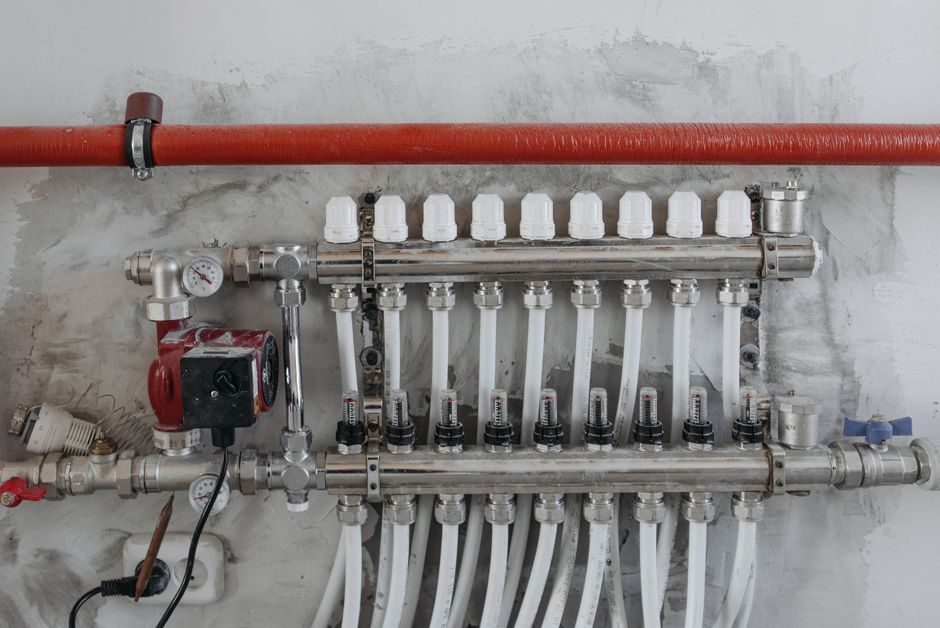
Inline pipeline pumps use one impeller, one shaft, and one mechanical seal; multistage pumps multiply both impellers and seal interfaces on a common shaft, so seal-leakage probability scales roughly with the number of stages and with the net axial thrust that loading devices must absorb (per [S2] Purity, 2024-12; [S6] Mfrbee, 2026-06).
Process engineers weighing the two topologies for low-NPSH, high-head, or hot-oil service should treat seal count, seal-chamber pressure, and thrust-balance arrangement as the three primary leakage-risk variables — not flow or head, which the two topologies deliver by different means [S1][S3].
Topologies and Where Each One Shows Up
Vertical inline centrifugal pumps built to ISO 2858 are single-stage, single-suction, with a close-coupled motor and a single high-quality mechanical seal; the configuration is sold for HVAC, light chemical, and general water service where the working pressure sits inside the seal-chamber rating of a standard cartridge [S6]. The ISG vertical pipeline pump — a Chinese GB-standard variant for chemical service — is a single-stage barrel mounted in-line with the piping, again with one seal interface and no internal stage-to-stage leakage path [S7].
Multistage pipeline pumps — Burks BPI/BPIL horizontal stainless-steel multistage units, or XBD-GDL vertical fire pumps built to GB 6245-2006 / NFPA 20 — stack impellers and diffusers in series inside a single barrel; BPI series explicitly states an "optimized mechanical seal structure" because the higher discharge pressure and the multi-stage internal leakage paths (stage-to-stage via interstage clearance, plus the shaft seal) make the seal a first-order failure point [S3][S5]. Multistage designs also fit higher heads and pressures because each impeller adds its own head contribution, but that same head multiplication is what stresses the seal [S2].
Why Seal Leakage Risk Differs: Three Engineering Variables
Seal leakage is governed by (1) the number of dynamic seals on the wet end, (2) the seal-chamber pressure relative to the seal-mak pressure rating, and (3) the residual axial thrust the thrust bearing/balance device imposes on the shaft. In a single-stage inline pump, those three variables reduce to one mechanical seal, suction-side chamber pressure near system suction, and a small residual thrust absorbed by a standard bearing [S1][S6]. In a multistage pump, the seal still sees only the suction-side pressure — but the internal balance drum or balance disc and interstage clearances become additional leakage paths that can carry process fluid back to the seal chamber or to atmosphere if the balance device wears [S2][S3].
The 4030-series single-stage centrifugal pump from S. A. Armstrong illustrates the inline-side envelope: flow up to 315 L/s, head to 180 m, power to 200 kW, with a single shaft and a single mechanical seal interface — and cast-iron/bronze wetted parts that the manufacturer pairs with a spring-loaded seal for general industrial water service [S1]. A multistage pipeline pump chasing 200+ m of head with similar flow will carry that energy through several impellers, and the seal must hold against whatever chamber pressure the first-stage suction feeds it plus any back-leakage from the balance device [S2][S3].
Criteria-Based Comparison: Inline vs Multistage Pipeline
On four decision criteria that drive seal-leakage exposure: (a) Number of shaft seals — inline 1, multistage 1 (shaft) plus internal stage/balance leakage paths [S2][S3][S6]. (b) Typical seal-chamber pressure — inline ≈ suction pressure, often near atmospheric for flooded suction; multistage ≈ suction pressure (first stage) but with hot, partly recovered fluid from balance-device back-leakage [S2][S3]. (c) Axial thrust on shaft — inline low, absorbed by standard bearings; multistage high, partially cancelled by balance disc/drum, residual thrust still higher and transmitted across the seal [S2]. (d) Sensitivity to upset (dry run, thermal shock, particulates) — inline moderate (one seal); multistage higher, because any particulate that passes the first stage can erode subsequent stage clearances and the balance device, dragging debris into the seal face [S2][S3].
For low-head, high-flow, or hygienic service, the inline topology is the lower-leakage-risk choice. For high-head, lower-flow, or where foot-print constraints force a vertical multistage pipeline pump, the leakage-risk penalty is real and is the reason Burks specifies an "optimized mechanical seal structure" on the BPI/BPIL multistage line [S3].
Standards, Seal Selection, and Sourcing Signals
ISO 2858 governs the dimensional envelope of single-stage end-suction and in-line centrifugal pumps; NFPA 20 and GB 6245-2006 govern fire-service multistage pipeline pumps; the seal itself is normally specified per API 682 seal chambers and plans, regardless of whether the pump is single- or multi-stage [S5][S6]. On the supply side, the 2026-06 Chinese export channel lists both topologies as in-stock catalog items: Shanghai Pacific Pump Manufacture (Group) lists vertical multistage pipeline pumps alongside single-stage pipeline units [S8], and Burks publishes BPI/BPIL as standard multistage offerings with the seal-optimization note cited above [S3].
Trackable signals over the next reporting window: (1) adoption of API 682 Plan 52/53A buffered and barrier-fluid support on in-line pumps handling hydrocarbons above 60 °C, which is the most common upgrade path for reducing atmospheric seal leakage on both topologies; (2) vendor-side release notes on BPI/BPIL seal-cartridge revisions, given Burks's explicit "optimized mechanical seal structure" claim [S3]; (3) any ISO 2858 amendment activity that would change the seal-chamber envelope on the in-line side. Engineers specifying these pumps should pin the seal specification to API 682 plans and to the named pump standard (ISO 2858 for inline, GB 6245 / NFPA 20 for fire-service multistage) rather than rely on generic "mechanical seal" wording [S5][S6].
Related: pressure transmitter, flow meter, industrial valve.