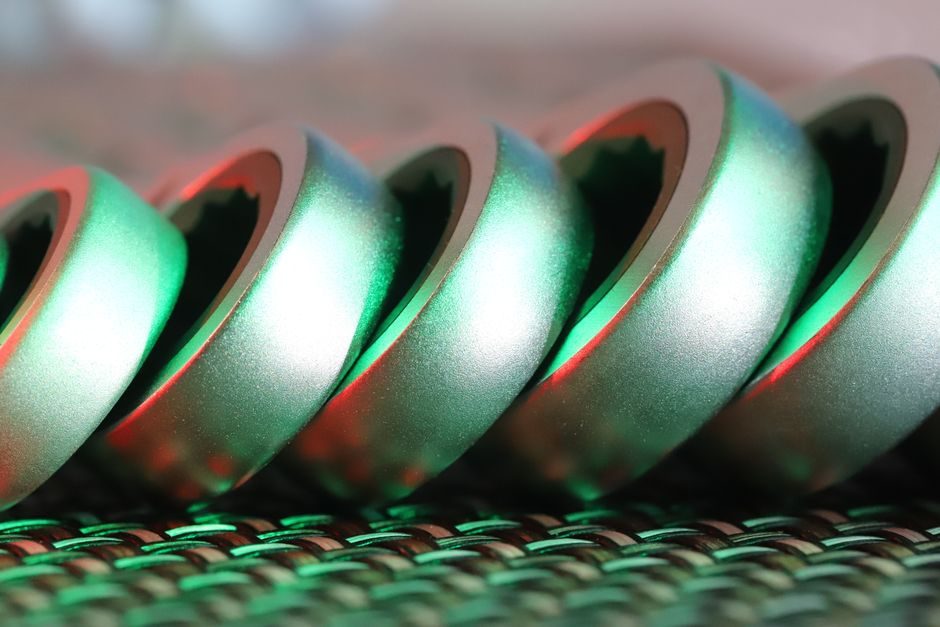
A jaw coupling in 2026 is still the cheapest torsional-elastic shaft coupling on the market, with Made-in-China OEM entries quoted from US$2.49 per piece at 50-piece MOQ [S7] and stainless Huco 702.44 series units reaching 48 Nm at 8,000 rpm [S2]. Across the 85 active product lines indexed on DirectIndustry, torque envelopes stretch from sub-50 Nm instrument-class units to Lovejoy's HercuFlex FXL rated 904–161,003 Nm at 2,000–9,000 rpm [S4].
The buying decision is dominated by three engineering axes — elastomer Shore hardness, hub bore-to-shaft fit, and the operating environment's contamination profile — and mis-specifying any one of them derates the coupling well below its catalog rating. This guide walks through each axis with the data points that show up on real 2026 datasheets, not the generic "flexible coupling" copy that fills vendor landing pages.
Spider Elastomer: Shore Hardness Is the Torque Knob
Jaw coupling torque capacity is set almost entirely by the elastomer spider's Shore hardness, not by the metal hubs [S6]. Manufacturers catalogue the same physical coupling size in multiple spider grades — typically 80 Sh-A (soft), 92 Sh-A (standard), 95/98 Sh-A (hard), and 64 Sh-D (rigid) — and each step roughly doubles the transmissible torque while cutting misalignment tolerance in half [S8]. The plum-shaped (plum blossom) polyurethane element is the dominant Asian-OEM construction; Rokee and other Jiangsu suppliers ship this geometry as their default, with custom hardness available on request [S8].
Specifying a hard spider in a high-parallel-misalignment application is a common failure mode: the harder the element, the less it can absorb angular and parallel offset, and the faster the lobes shear. For pump and small fan drives, the soft 80 Sh-A spider is the safe default. For punch presses and high-inertia industrial mixers where torsional stiffness matters, the 95/98 Sh-A or 64 Sh-D grade is the correct call. ComInTec's backlash-free GAS/SG-AL spacer jaw coupling, machined from solid aluminium, runs the same spider system up to 130,000 Nm by scaling the hub diameter rather than changing elastomer chemistry [S5].
Torque Band Selection: 11 Nm to 161,003 Nm
Torque range is the first filter on any jaw coupling datasheet, and 2026 OEM offerings now cover more than four orders of magnitude. At the bottom of the scale, Huco's 702.44 stainless multi-beam jaw coupling covers 11–48 Nm at 8,000 rpm for clean-room and food-grade applications [S2]. At the top, Lovejoy's HercuFlex FXL (which integrates jaw, disc, and gear elements in a flange/sleeve installation) covers 904–161,003 Nm at 2,000–9,000 rpm for mining, steel-mill, and heavy-process drives [S4].
The mid-band — roughly 100 Nm to 5,000 Nm — is where most general-purpose users live, and it is also the most contested segment on price. Chinese OEM offers on Made-in-China cluster between US$20 and US$20,000 per set, with MOQ from a single set upwards [S7]. Weasler's 507-9512 torque-series jaw coupling sits in this band and is sold in halves, full assemblies, or as replacement spider inserts — a configuration pattern buyers should expect across the segment [S3].
Selection rule: take the application's peak (not nominal) torque, multiply by a service factor of 1.5–3.0 depending on shock load, and then pick the smallest jaw size whose continuous-rating envelope covers that figure. Undersizing is the single most common cause of premature spider failure.
Bore, Keyway, and Hub Material Choices
Jaw coupling hubs come in three bore categories: finished-bore (drilled and keyed to a specific shaft diameter, like the Lovejoy L-075 5/8" hub with standard 3/16" × 3/32" keyway [S9]), QD (quick-detachable) bushed bores, and plain stock bores for finish-machining on installation. Lovejoy's L-series — the de facto North-American standard — uses the L035 through L190 size progression, with each step up roughly doubling torque capacity [S10].
Material choice tracks environment. Aluminium spacers (ComInTec GAS/SG-AL) cut weight for servo and motion-control shafts [S5]. Cast iron is the default for general industrial drives. Stainless steel (Huco 702.44) is the right call for washdown, pharmaceutical, and marine atmospheres where corrosion or caustic cleaning chemicals attack standard finishes [S2]. Buyers specifying stainless should verify the spider material as well — NBR and polyurethane both degrade in aggressive chemicals; Hytrel or PTFE-encapsulated elements are the upgrade path for those services.
For deeper background on flexible coupling geometry, the jaw coupling reference covers the claw-and-spider construction in detail. For comparison against the higher-torsion alternatives, the disc coupling and gear coupling entries show where jaw designs give up stiffness for cost.
Misalignment, Contamination, and Where Jaw Couplings Stop Being the Right Answer
Jaw couplings accommodate up to roughly 1° angular misalignment and 0.2–0.4 mm parallel offset at the soft spider grade, with parallel and axial allowances shrinking as Shore hardness rises. They are also sensitive to abrasive contamination: a jaw coupling running in a dusty mill environment without an enclosure will wear the spider lobes and the hub claw tips in a fraction of its catalog life. [S1]
Where contamination is extreme, the right answer is a fully enclosed disc or gear coupling — the HercuFlex FXL line is explicitly built for "extreme high contamination" service because the flexible element sits inside a sealed flange-and-sleeve housing rather than exposed between two open hubs [S4]. For absolute zero-backlash servo applications, the disc coupling family replaces the elastomer entirely with a metallic membrane stack.
Jaw couplings are also the wrong choice for very high-speed shafts above their rated rpm (Huco caps at 8,000 rpm [S2], Lovejoy FXL at 9,000 rpm [S4]) and for drives with severe torsional vibration — in those cases, the elastomer's damping curve bottoms out and a torsionally stiffer gear coupling or a tuned fluid coupling is the engineered answer. Buyers comparing jaw against linear guide and crossed-roller guide systems should note those are linear-motion bearings, not shaft couplers — they share a buyer's attention when designing multi-axis stages but solve a different mechanical problem.
Spider Replacement and Total Cost of Ownership
The economic case for jaw couplings rests on the replaceable spider. When the elastomer fails — typically from overload, chemical attack, heat ageing, or simply fatigue at 10⁶–10⁷ cycles — only the spider needs to be replaced, not the hubs. This is why Weasler sells "jaw coupling halves" and "jaw coupling spider inserts" as separate SKUs rather than forcing a full-assembly replacement [S3].
On 2026 marketplaces, the L075 NBR rubber spider insert for Lovejoy/Martin S-flex couplers is widely stocked as a consumable [S9][S10], and the L035 size — the smallest of the L-series — is sold at low single-digit GBP per piece on the secondary market [S10]. This service-part availability is the operational reason jaw couplings dominate pump, fan, and small-motor drives: a worn spider can be replaced in minutes during a scheduled shutdown, with no shaft realignment beyond the original setting.
For procurement teams comparing 2026 jaw coupling line items against the disc coupling cost stack, the disc coupling 2026 price and cost guide maps out where the jaw coupling is the cheaper-but-shorter-life option and where the disc's higher unit cost is recovered through longer service intervals. Buyers sizing couplers for compressor packages can cross-check the air compressor manufacturing process reference for the shaft-spacing tolerances that the jaw coupling will need to absorb.
Sourcing and Standards Anchors
There is no single ISO standard that governs jaw coupling geometry end-to-end; the L-series, HRC series, and Asian plum-blossom (plum blossom) series each follow their own manufacturer's dimensional pattern, which is why hub interchangeability is brand-locked in practice. ISO 9001 quality certification and ROHS compliance are the baseline marks to require on 2026 Asian OEM product (GZ Link Automation documents both for its jaw coupling line [S6]), and ATEX/IECEx conformity is the additional gate for any coupling installed in a zone-classified European or Middle-Eastern process plant.
Lead-time and MOQ behaviour on Made-in-China runs from 50-piece MOQ at US$2.49–6.59 per piece for catalog jaw couplings [S7] down to single-set MOQ at US$20–20,000 for engineered configurations [S7]. European buyers pulling from DirectIndustry's 31 listed manufacturers [S1] should expect a 4–8 week lead time on non-stocked bores and a higher unit cost, partly offset by shorter freight and a clearer conformance paperwork trail.
Verifiable signals to track over the next procurement cycle: the published L075/L090/L110 spider replacement SKUs on Lovejoy-authorised distributors (a proxy for installed-base health), any 2026-vintage RoHS/REACH documentation updates from Rokee-class Chinese suppliers [S8], and torque-rating revisions on the Weasler 507-9512 catalogue page [S3].