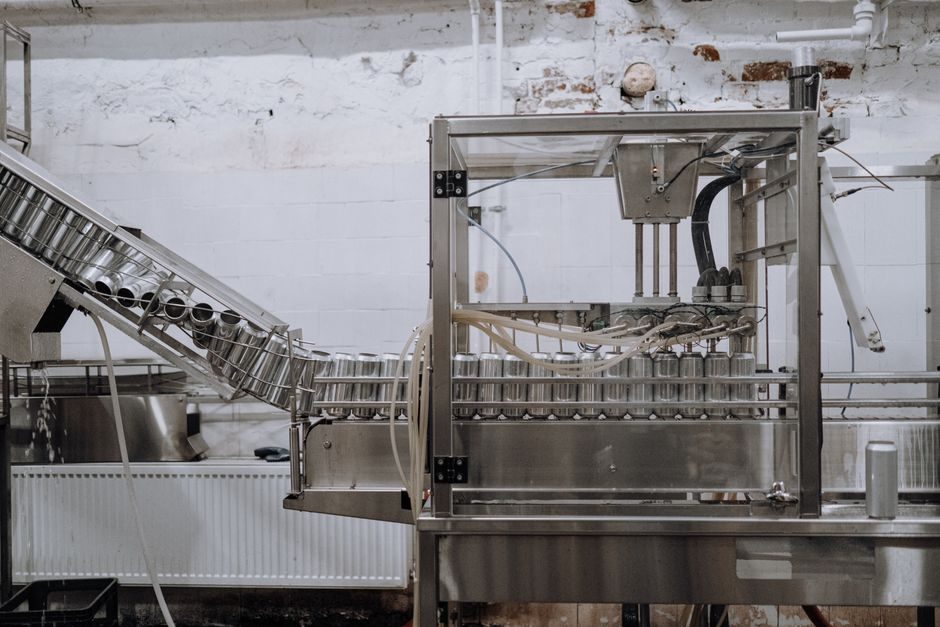
An air compressor leaves the production line as a stacked assembly of four sub-systems: a prime mover (electric motor or diesel engine, typically 2.2–250 kW), the compression element itself, an aftercooler/oil-separator train, and a controls package — and the build sequence tracks that stack from machined casting to tested skid [S1][S3].
For a 2026-spec build, the bill of materials centers on cast-iron crankcases for reciprocating units, steel rotors for oil-injected screw packs, and aluminum heads with integrated cooling fins on portable models; downstream, compressed-air treatment follows ISO 8573-1 classes for solid particulate, moisture, and oil aerosol [S2][S4].
Reciprocating, Screw, and Centrifugal: How Each Compression Element Is Built
The compression element defines the line layout. Reciprocating compressors use a cast-iron crankcase, one or two cast-iron or aluminum cylinders, PTFE or composite piston rings, and inlet/bronze discharge reed valves; production batches for portable 2.2–7.5 kW units run in the tens of thousands per month at typical Chinese OEMs, with the cylinder bore honed to 3–5 µm Ra and the crankcase pressure-leak tested at 1.5× working pressure [S2][S4].
Rotary screw compressors use a pair of asymmetric profile rotors (typically 5/6 lobe count for a 5–250 kW range) machined from forged steel, then case-hardened and ground to AGMA 2001 quality class 9 or tighter, with the rotor pair clearances held around 0.03–0.08 mm at 100 mm rotor diameter; assembly is done in a Class 8 cleanroom, and oil-injection ports are drilled before the unit is sealed and nitrogen leak-tested [S3][S4].
Centrifugal compressors, used above ~250 kW for process gas and large-volume shop air, build around a cast stainless or titanium impeller balanced to G2.5 (ISO 1940-1), with a multi-stage casing machined to ±0.05 mm concentricity; production volume is much lower, with build cycles measured in weeks rather than hours [S6].
Material and Component Sourcing for the 2026 Build
Housing, rotor, and head material selection in 2026 splits cleanly by product tier. Portable and consumer-grade compressors use die-cast aluminum alloy heads and rolled-steel tanks (3–24 L receiver volumes) with powder-coat paint, while industrial reciprocating and screw machines specify GG25 / FC250 gray cast-iron crankcases and ductile-iron cylinder barrels for vibration damping and 100,000+ hour bearing life [S2][S4].
For the air-end, OEMs source forged-steel rotor blanks, AS-standard deep-groove ball bearings, and fluoroelastomer (FKM/Viton) shaft seals; controllers and pressure transducers are bought in as sub-assemblies, with an Ingersoll Rand visualization controller, for example, providing the HMI/PLC layer for higher-end screw and centrifugal skids in 2026 OEM catalogs [S5][S7].
For the on-skid air-treatment train, an OEM 2026 bill of materials typically includes a steel aftercooler sized to cool discharge air within 10 °C of ambient, a coalescing filter rated to 1 µm with a 0.5 mg/m³ oil residual, and a refrigerated or desiccant dryer sized to a +3 °C pressure dew point for the standard ISO 8573-1 Class 4 moisture spec [S3][S5].
Assembly Line Sequence and Process-Control Anchors

The 2026 assembly cell follows a fixed order: rotor/stator sub-assembly → crankcase or air-end mounting on a welded steel base frame → coupling alignment between motor and compression element (laser-aligned within 0.05 mm) → piping of the aftercooler, separator vessel, and receiver → wiring of the controller, contactor, and pressure transducer → vacuum draw-down and oil fill → final performance test [S3][S4][S7].
Process-control gates along the line are concrete: a rotor pair must pass a 60-second spin test with vibration under 1.8 mm/s RMS at rated speed; a completed skid is run for 30–60 minutes at full-load to capture delivered CFM (ACFM), specific power (kW per 100 CFM), and sound-level readings at 1 m, with the controller's inlet modulation and unload cycle validated against a programmed test profile [S5][S7].
For a smart-factory buildout, the same air-end that runs through this manual test stand is increasingly tied into a machine-level IIoT workcell, mirroring the integration pattern described in machine tool smart manufacturing case studies; the V-process line and air pick reference pages document adjacent casting and pneumatic-tool workflows that feed and consume the same compressed-air plant.
Maintenance Economics and Quality Targets in 2026
Operator-side maintenance economics drive several build choices. A 2025 maintenance study (2025-03) showed that regular servicing — oil change at 2,000–4,000 hours, filter swap at 1,000 hours, separator replacement at 4,000 hours, and valve inspection at 8,000 hours — keeps specific-power drift under 5% and avoids the 15–25% energy penalty seen on unmaintained units [S1].
Quality targets for a build acceptance test in 2026 are: delivered flow within ±3% of nameplate CFM, specific power at or below the manufacturer-published kW/100 CFM value, sound pressure at 1 m no greater than 78 dB(A) for indoor-rated screw units, and ISO 8573-1 Class 1-2-1 (solid-water-oil) for critical-application packages [S3][S4][S5].
Where Air Compressors Fit — and Where They Do Not
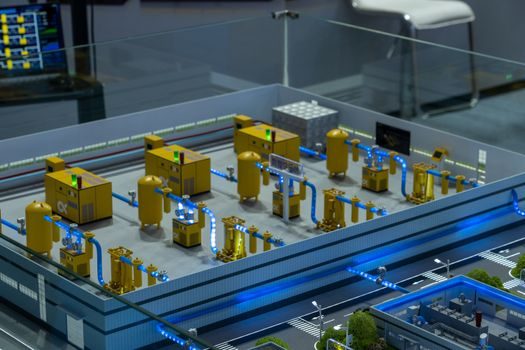
Air compressors are the right spec for shop-floor pneumatic tools, paint spraying, sandblasting, plastic-bottle blowing, and instrumentation air in process plants — applications where the user needs 6–10 bar(g) of clean, dry air and the load profile is steady or moderately cyclic. They are NOT a substitute for hydraulic power above ~250 bar, NOT a fit for vacuum below 100 mbar absolute (use a dedicated vacuum pump), and NOT a fit for oxygen-enriched or ATEX-classified zones unless the unit is built to ATEX 2014/34/EU with a zone-appropriate motor and purge system [S1][S3][S6].
Selection logic is straightforward: pick reciprocating (piston) for 0.75–15 kW intermittent duty and low capital cost, rotary screw for 5–250 kW continuous duty at the lowest specific power, and centrifugal for 250 kW and above where oil-free air or very high volumes are required. For portable field work, a 12 V or 24 V DC piston unit is standard; for chassis and air-suspension service, dedicated oil-less pump modules such as those catalogued by Longly Electric are the production-line answer rather than a shop compressor [S2][S4][S6].
Failure Modes and Reliability Anchors to Audit
Common 2026 failure modes trace to the same three sub-systems: oil carry-over from a saturated separator (fixed by element swap and pressure-equalization check), elevated discharge temperature from a fouled aftercooler (fixed by fin cleaning and ambient-air path audit), and bearing failure on the drive end from misalignment (fixed by laser re-alignment and a soft-start VFD upgrade) [S1][S3].
Reliability anchors a buyer should audit on the line: rotor dynamic balance to ISO 1940-1 G2.5 or better, pressure-vessel certification to ASME BPVC Section VIII for the receiver tank, electrical build to IEC 60204-1 for the control panel, and an OEM-published MTBF of 60,000–80,000 hours for an oil-injected screw air-end with scheduled service [S3][S5].
2026 Standards and Sourcing Map for the Build
Manufacturing standards in 2026 read across the same specification stack: ISO 8573-1 for compressed-air purity, ISO 1219 for graphical symbols, ISO 2151 for sound test code, ISO 1940-1 for balance grades, ASME BPVC Section VIII for the air receiver, IEC 60034 for the motor, IEC 60204-1 for the electrical panel, and ATEX 2014/34/EU for any unit going into a classified zone. Suppliers serving this segment include Ingersoll Rand for the controls layer [S7], High Air for high-pressure and natural-gas compressor skids [S6], and Chinese OEMs such as Longly Electric for portable piston and air-suspension units [S2].
Two signals to track over the next two quarters: (1) wider release of oil-free screw and centrifugal skids tied to ISO 8573-1 Class 0, and (2) IIoT controller rollouts that publish per-machine energy and airflow data over Ethernet-APL — both already visible in OEM catalogs as of 2026-06-25 [S5][S7]. For related sourcing context, the jaw coupling selection guide covers the motor-to-air-end coupling that sits at the center of any compressor build.
For component-level specifications, see additive manufacturing material.