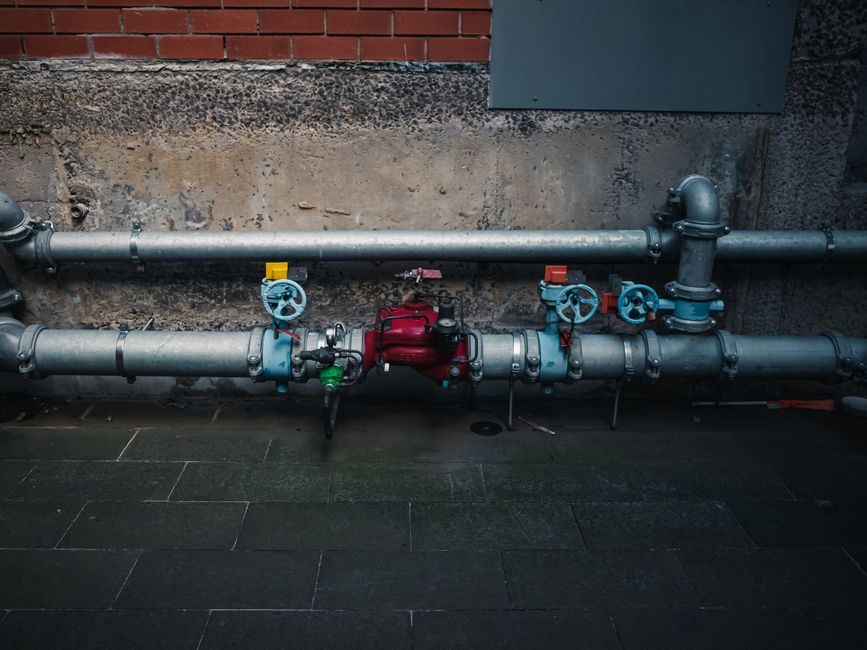
A knife gate valve is a uni-directional, through-conduit shut-off device whose thin gate slices through fibrous or particulate media; its strength on a paper-stock or fly-ash line is the weakness that disqualifies it from most clean steam-condensate duty unless the line is explicitly solids-loaded [S2].
Steam condensate in a standard process plant is a two-phase, often flashing liquid with elevated temperature, dissolved oxygen, and trace corrosion products. Specifying a KGV here is a niche decision, not a default, and the selection criteria below are written from the perspective of an engineer who has been burned by the wrong seat material in a condensate trap discharge line.
Why Most Condensate Lines Do Not Need a Knife Gate
Condensate is, by definition, the liquid phase recovered after steam gives up latent heat, and on a properly trapped system it is a low-solids, hot (typically 80–200 °C) water stream with possible entrained flash steam. Merrick Industries' own product literature positions KGVs as isolation valves at feeder outlets, pulverizer outlets, and burner-line furnace-face positions in solid-fuel handling, not in clean condensate return [S2]. LOCKWOOD's 81208 series is explicitly catalogued for oil, acids, and solvents rather than for condensate service [S1]. Specifying a KGV on a clean condensate line is a category error: the bonnet geometry, the elastomeric seat in most designs, and the unidirectional through-conduit shut-off all work against the duty.
The standard duty that does justify a KGV on a condensate sub-loop is the blowdown leg from a steam trap to a flash tank where the line carries rust scale, mineral precipitate, and pipeline debris. Even there, the valve is acting as a solids-tolerant isolation, not as a tight-shut steam valve, and seat leakage class is intentionally relaxed.
Selection Criteria When a KGV Is the Right Call
When the line carries entrained solids — slurry blowdown, soot-water discharge, or black-liquor condensate from a sulphite digester — four criteria dominate the data sheet: body style, seat material, actuation, and end connection. Uni-directional lug or wafer bodies are the dominant form factor on the Valve World Expo show floor, with bidirectional designs reserved for clean service [S3].
Seat material is the line between a working install and a six-month failure. On hot condensate, EPDM and NBR are the wrong answer; PTFE, metal-to-metal, or high-temperature FKM are the workable choices, with stainless or duplex gate and stem as the default for corrosion resistance. DirectIndustry's LOCKWOOD 81208 listing, for example, surfaces acid and solvent compatibility as headline characteristics, not condensate compatibility [S1].
Actuation follows duty: manual handwheel or bevel gear for infrequent isolation, pneumatic cylinder for fast cycle or for fail-safe closure on a blowdown leg. End connections should be matched to the upstream piping class — flanged lug bodies to ASME B16.5 / B16.47 flanges, wafer bodies sandwiched between flanges with through-bolts. Push-on or grooved ends are unsuitable for steam service regardless of valve type, and that constraint applies just as strictly to a knife gate valve.
Condensate-Specific Failure Modes
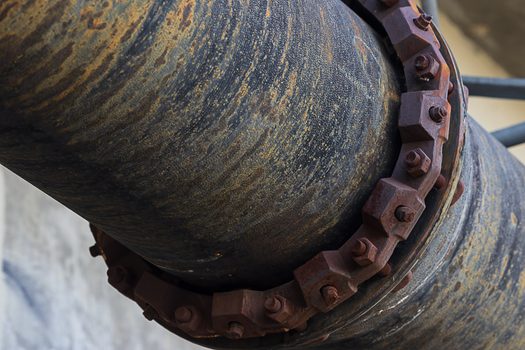
The three failure modes that show up first in service are seat softening, gate-edge erosion, and packing leakage. Seat softening in a hot condensate line is a consequence of selecting an elastomer rated below the operating temperature; once the seat swells, shut-off class collapses and the line dribbles continuously. [S1]
Gate-edge erosion in a condensate blowdown is mechanical, not chemical: scale and rust particles carried in the flow sandblast the leading edge of the gate every time the valve cycles. The remediation is a hardened gate edge (Stellite or equivalent overlay) or, on the most abrasive service, a replaceable gate insert. For comparison, the sensing element in a pressure transmitter on the same line is exposed to the same erosion mechanism; engineers who have chased a drifting condensate-leg PT will recognize the symptom.
Packing leakage on a KGV is amplified by the geometry. The stem packing is a small cross-section gland, and on a hot line the leakage path dries out and channels in a way a fully-bonneted industrial valve does not. Live-loaded packing and a proper lantern ring with a leak-detection port are the minimum mitigation, and the gland should be re-torqued after the first thermal cycle.
Comparison Against Alternative Valve Types on Condensate Duty
Stacked against the realistic alternatives on a condensate blowdown leg, the KGV trades tight shut-off for solids tolerance. A globe valve gives a class IV–VI shut-off but chokes on debris within a season. A ball valve delivers class VI on a clean line but will score in slurry service. A pinch valve handles abrasive slurry but cannot survive the temperature envelope of a flashed condensate. A KGV sits in the corner where solids are present and tight shut-off is negotiable — a smaller population of services than vendor catalogues suggest. [S2]
The decision matrix is therefore short: if the line is clean condensate return, pick a globe or ball valve; if the line is solids-bearing blowdown, the KGV is on the short list provided the seat is rated for the temperature and the gate is hardened. For a deeper view of the broader valve family, the industrial valve reference page is the right starting point. For instrument-side selection on the same skid, a flow meter sized for two-phase flashing condensate is a separate problem and is called out separately because most mag meters will not read accurately in those conditions.
Standards, Sourcing, and Where the Market Is Heading
The dominant manufacturing base for KGVs in the 2026 sourcing window is split between European specialty makers and a fast-growing China and India supply tier. Kolink Industrial, a Shanghai-based manufacturer and wholesale supplier, lists sixteen knife gate valve catalogue entries alongside gate and ball valve lines, indicating the breadth of SKUs now available from Chinese OEMs [S4]. Knife Edge Gate Valve, an Indian manufacturer and exporter, markets itself on precise and efficient control for industrial applications, reflecting the same commoditization trend [S5]. Valve World Expo 2026 catalogues three named exhibitors in the knife-gate category, confirming that the segment is active but not oversaturated at the major European show [S3].
Standards alignment matters: KGV bodies are typically specified to ASME B16.34 (valve design) with flanges to ASME B16.5 and face-to-face to the manufacturer's standard (MSS-SP 81 for wafer KGVs, MSS-SP 88 for lug KGVs). On a steam-condensate leg the relevant material standards are ASME B16.34 for pressure-temperature rating, ASTM A216 WCB or A351 CF8M for body materials, and the applicable piping code for the installation. The end-user's procurement document should pin these standards explicitly rather than rely on vendor defaults.
Field Checklist Before Signing the PO
Confirm the operating temperature on the seat graph, not the marketing brochure; ask the vendor for a pressure-temperature curve that includes the steam-condensate envelope and the blowdown case. Confirm that the gate is uni-directional or bi-directional matched to the actual flow direction, including the failure-mode direction. Confirm that the packing is live-loaded and that a leak-detection port is included if the line is in a normally-occupied area. Confirm that the actuation matches the cycle count: manual gear for under one cycle per shift, pneumatic for faster or for fail-safe. [S3]
If the answer to "is this line solids-bearing" is no, do not specify a KGV; the catalogue entry is not a substitute for the duty description. If the answer is yes, the KGV goes on the short list and the seat, gate, and packing selections above determine whether the install lasts one year or ten.
Trackable signals for the next procurement cycle: Valve World Expo 2026 exhibitor rosters for new KGV entrants with high-temperature seat options [S3], and the published data sheets from Kolink and Knife Edge Gate Valve for updated pressure-temperature curves and seat material offerings [S4][S5].