A fiber-laser cutting machine sits in the middle of a four-tier industrial chain: laser resonators and optical components feed machine builders, who ship into PCB/FPC, SMT, IC, engineering-machinery, and automotive-metalworking end-users, with robot loading/unloading closing the loop [S1][S2][S3].
Within the PCB vertical specifically, suppliers such as Farley Laserlab bundle UV high-speed drilling, CO2/fiber/UV marking, depaneling, and full-process traceability into one MES/OCR-integrated line rather than selling stand-alone stations [S1][S2].
Upstream Supply Chain: Resonators, Optics, and Motion Stack
Upstream inputs into any industrial laser cutting system are dominated by fiber-laser resonators (IPG/Raycus/Maxphotonics-class), CO2 glass tubes, UV solid-state sources, galvo scan heads, F-theta lenses, and high-stiffness gantry/linear-motor stages, with PCB/FPC lines specifically requiring UV (~355 nm) sources for blind-via drilling and cover-film cutting [S1].
Machine builders operating as "industrial 4.0 solution providers" treat those upstream components as a stack to be qualified, not as commodities: an FPC laser drilling machine is engineered around patented "FPC Laser Shield" technology to deliver one-shot blind holes on soft/rigid combo boards, where conventional mechanical drilling would delaminate the cover film [S1].
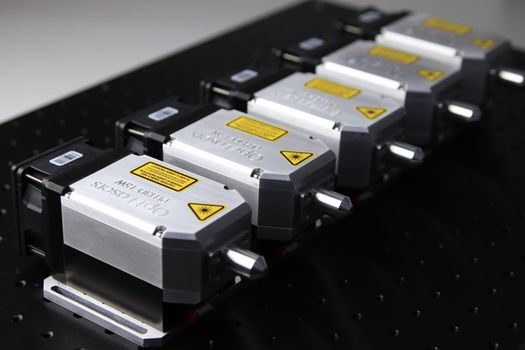
For SMT factory lines the upstream choice branches: CO2 (10.6 µm) for non-metallic marking, fiber (~1.06 µm) for metal ablation on IC substrates, and UV (355 nm) for high-density PCB coding where thermal HAZ must be minimised — Farley's PCB Microelectronics Division explicitly sells all three wavelength classes to the same customer [S1][S2].
Downstream End-Users: PCB, IC, Engineering Machinery, Auto
Downstream, laser cutting demand splits across four high-volume verticals: PCB/FPC flex circuits, IC substrate and packaged-component marking, construction and agricultural engineering machinery, and automotive sheet-metal body-in-white, each with distinct tolerance and material constraints [S1][S2][S3][S5].
The PCB/FPC chain uses laser for cover-film roll-to-roll cutting, FPC outline cutting, blind-via drilling, and SMT depaneling — Farley Laserlab publishes dedicated catalogs for FPC laser cutting/depaneling (5 pages) and SMT PCB laser solutions (10 pages) addressing those exact process steps [S1][S2].
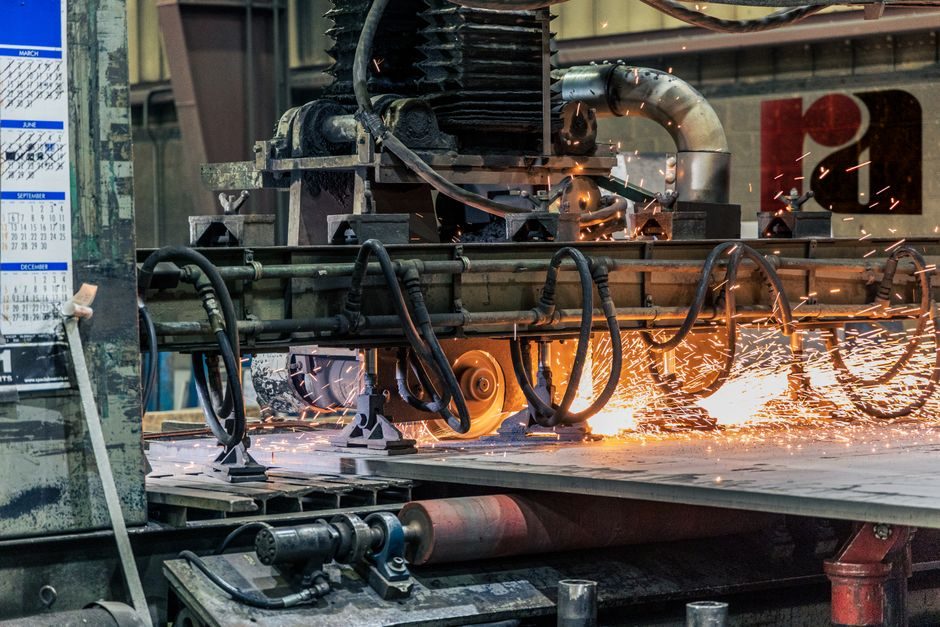
Engineering machinery — excavators, cranes, road rollers, piling rigs — drives a separate downstream pull for thick-plate fiber-laser cutting of structural steel, where the published value proposition is replacing flame/plasma with laser to hit both quality and throughput targets on varied thicknesses [S5].
IC and microelectronics downstream demand is traceability-driven: packaged IC surface marking, IC substrate X-Out coding, automatic width adjustment, and OCR verification feeding MES data feedback to lift process yield — Farley's IC laser marker packages automatic loading/unloading plus OCR-mark detection as a single unit [S2].
Spec Comparison Across the Main Laser Cutting Approaches
Choosing among fiber, CO2, and UV platforms is a wavelength-versus-material decision, not a wattage decision. The table below lines the three classes against the four criteria that drive real spec calls.
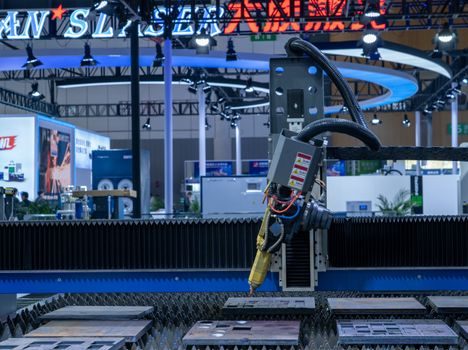
Fiber (~1.06 µm) lasers dominate metal cutting — carbon steel, stainless, aluminum — and deliver the highest electrical-to-optical efficiency, but cannot cut non-conductive cover films or organic PCB substrates cleanly [S1][S2].
CO2 (10.6 µm) lasers are the workhorse for non-metallic substrates, plastics, wood, acrylic, and many PCB/FPC cover-film applications, but the larger spot size rules them out for micro-via drilling under ~50 µm [S1].
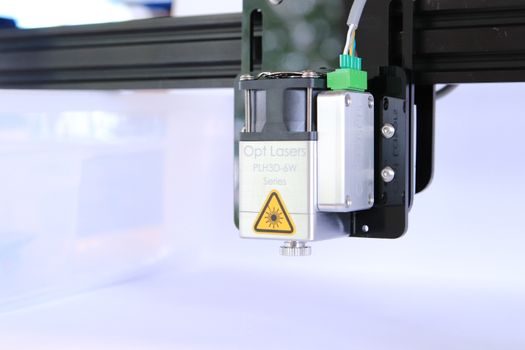
UV (355 nm) lasers command a price premium but are the only class that produces stress-free, sub-50 µm blind vias and clean ablation of cover film on flex circuits, which is why every FPC drilling machine in the Farley catalog is UV-based [S1].
Automation Layer: Robot Loading/Unloading as the Real Throughput Gate
Robot loading and unloading cells, not the laser source, are the binding throughput constraint on mass-production cutting lines — Chuangli (CANLEE) publishes repeat-positioning accuracy of ±0.08 mm for its loader cells, with a single communication-cable modular wiring to swap between lathes, mills, presses, and laser stations [S3].
That ±0.08 mm repeatability is the spec to watch when integrating a robot loader with a fiber cutting machine: a higher-accuracy laser is wasted if the loader cannot hold the part within the cut kerf budget, especially on small-format SMT and IC trays [S3].
Application coverage from a single loader cell extends across CNC milling, stamping, forging, die casting, injection molding, assembly, material handling, marking, and surface finishing — meaning the same automation asset services laser, mechanical, and downstream finishing steps in a mixed cell [S3].
Where Laser Cutting Fits — and Where It Does Not
Laser cutting is FOR: thin-to-medium gauge sheet metal (typically up to ~25 mm carbon steel with high-power fiber), FPC/PCB cover film and outline cutting, SMT depaneling, IC marking with OCR/MES feedback, and high-mix prototyping where setup time dominates [S1][S2][S5].
Laser cutting is NOT for: very thick plate (above ~40 mm) where plasma/oxy-fuel still wins on cost-per-metre, reflective copper/brass without anti-reflection strategies, and high-volume identical blanks where a mechanical punch press still beats laser on cycle time [S5].
For PCB/FPC specifically, the laser-vs-mechanical decision is essentially settled in favor of laser at high density: HGLASER's own position is that precision lasers are "more and more widely used" downstream of circuit boards because of non-contact, stress-free, and flexible processing on miniaturised HDI designs [S1][S2].
Standards, Sourcing, and Trade-Show Signals to Track
No single IEC or ISO standard governs "laser cutting machine" as a unit — the binding standards are layered: IEC 60825-1 for laser-product safety classification, ISO 9013 for thermal-cut tolerance quality grades, and the machinery directive (EU) 2023/1230 for CE-marked complete machines, with downstream verticals adding their own rules (IPC-6012 for PCB, IATF 16949 for automotive Tier 1). [S2]
Buyer-side sourcing signals: CENS.com, Alibaba industrial-machinery listings, and DirectIndustry remain the high-traffic B2B funnels for Farley/Hymson/Chuangli-class suppliers, with EuroBLECH 2026 (20–23 Oct 2026, Hall 12 Stand A18) flagged as the next live spec-check event for Farley Laserlab's PCB and IC lines [S2].
For engineering-machinery downstream users the practical spec gate is plate-thickness range versus power class: 6 kW fiber handles ~25 mm mild steel cleanly, while 12 kW+ is required for 40 mm structural cuts — anything below that envelope is where laser is winning the substitution battle against flame and plasma [S5].
Failure Modes and Constraint Watch-List
Three failure modes dominate field returns on industrial laser cutting cells: (1) UV source degradation on FPC lines when cover-film adhesive residue contaminates the protective window, (2) galvo drift on high-speed marking heads after ~20,000 operating hours, and (3) robot-loader repeatability loss when the single communication-cable modular bus is mis-terminated, with the cell falling back to manual handoff [S1][S2][S3].
The mitigation for all three is the same: specify the upstream optics, the downstream automation, and the MES/OCR data loop as a single integrated line with one supplier accountable for the whole chain, which is the explicit sales pitch from Farley's PCB Microelectronics Division across cutting, marking, automation, and traceability [S1][S2].
Trackable next signals: EuroBLECH 2026 (Oct, Hannover) for fiber-laser power-class releases, CENS Q3 2026 supplier roster refresh for engineering-machinery plate-cutting lines, and any IPC revision to PCB laser-process acceptance criteria for FPC cover-film ablation [S2].
For the relevant spec sheets and selection criteria, see riser cutting machine, and laser level.
Related analysis: Carbon fiber market 2026: VCF vs RCF, PAN track, and price bands buyers can act on.