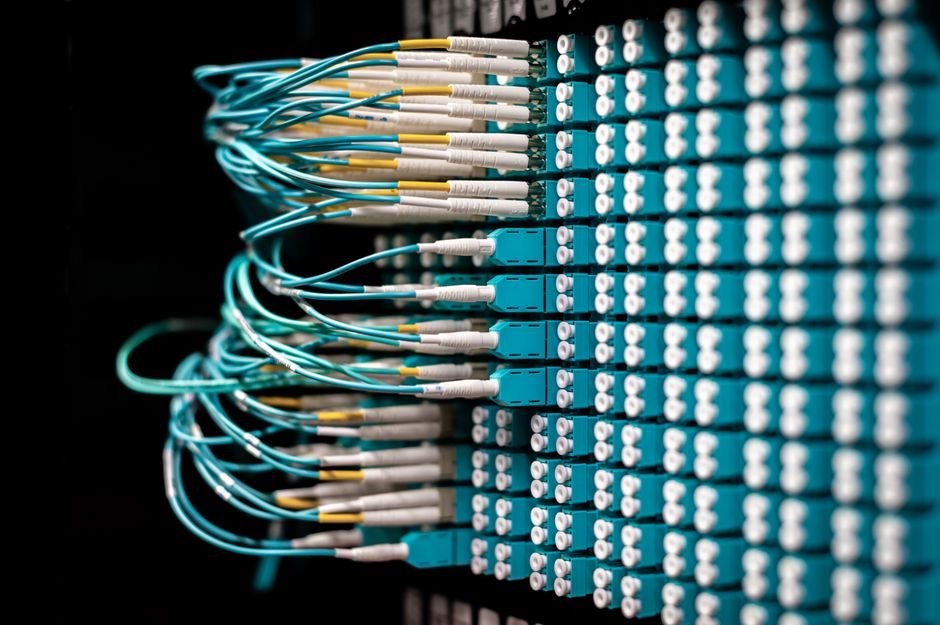
Laser distance sensors and fiber optic sensors are routinely cross-quoted in discrete-automation bills of materials, but they solve different physical problems: a time-of-flight laser returns an absolute distance value, while a fiber optic head acts as a remote optical switch routed back to an amplifier [S1][S2].
On the live OEM catalog side, ifm's OGD Precision and Dimetix D-series laser units publish 1 kHz update rates, +60 °C operating envelopes, and PROFINET/EtherNet/IP/EtherCAT options, while Keyence fiber optic heads are explicitly marketed for "extremely small targets" and "excellent environmental resistance" because no electrical current flows through the fiber cable [S1][S2][S4]. That distinction — measurement versus detection — is the single decision that drives the rest of the spec.
Core Operating Principle and What Each Device Actually Outputs
Laser distance sensors, including the ifm OGD Precision, use a PMD (photonic mixer device) on-chip time-of-flight core and "offer all the capability of a very precise measurement system" with "precise distance measurement to the nearest millimetre" and 2-colour on-sensor display plus IO-Link readout [S1]. The output is a continuous numeric distance in millimetres or micrometres, not a binary state.
Fiber optic sensors, by contrast, separate the optical head (a thin fiber bundle or single fiber) from the amplifier; the amplifier drives light into the fiber and looks for a returned or interrupted beam to trigger a discrete output [S2][S5]. The fiber itself is purely passive glass or plastic, so the only thing that survives in the sensing zone is the optical cable, which is why heat-resistant and chemically resistant fiber units exist for high-temperature and washdown zones [S2].
Dimetix's D-series datasheet confirms the laser class: "True measurement rate up to 250 Hz, 1 kHz update rate, temperature range up to +60 °C" with industrial Ethernet options including PROFINET, EtherNet/IP, and EtherCAT [S4]. The two architectures answer different questions — "how far?" versus "is it there?" — and conflating them in a BOM is a common source of late-stage design churn.
Range, Spot Size, and Target Geometry
Laser ToF devices in the commercial industrial class span tens of millimetres up to half a kilometre on reflective targets: Dimetix publishes the DEN-10-500 (500 m range) alongside the shorter DAN-30-150, both sold through the manufacturer's webshop at CHF 1,769 and CHF 2,337 respectively on the August 2024 price list snapshot [S4].
Beam spot behaviour matters more than headline range in dense fixtures. The OGD Precision is "available with an extremely small light spot at a 300 mm range to detect very small parts," paired with an M18 threaded housing and "background suppression" that lets it ignore surfaces beyond the set point [S1]. For diffuse-reflective laser triangulation, Zhizun's SKD series covers sawmill, mining-car, and silo applications where targets are large but the measurement distance is fixed by the installation [S3].
Fiber optic heads flip the problem: range is short (typically tens to a few hundred millimetres depending on fiber tip and amplifier gain), but the head diameter drops to sub-millimetre scales so the sensor can be routed "in limited spaces such as a space between machines" and detect "extremely small targets" that a laser spot cannot resolve reliably [S2]. When the target is a PCB fiducial, a transparent bottle, or a wire, fiber is the right geometry; when the target is a vehicle, a bulk silo level, or a mining car, laser is.
Environmental Resistance: EMI, Temperature, and Hazardous Areas

Fiber optic sensors have a structural immunity advantage: because "no electric current flows through the optical fiber cable, the sensor is unaffected by electrical noise" [S2], they survive next to VFDs, welding gear, and large solenoids without shielded cable or special grounding. The same physics lets the sensing head sit in temperatures that would destroy a PCB-based laser, and Keyence markets heat-resistant fiber units specifically for these zones [S2].
Laser distance sensors compensate differently. The OGD Precision publishes "excellent reflection resistance and background suppression, together with a high excess gain" for dirty or reflective production surfaces, and the Dimetix D-series is rated to +60 °C ambient with industrial-Ethernet outputs for noisy plant floors [S1][S4]. For hazardous-area deployment, the optical head of a fiber system is intrinsically safe by construction, while a laser unit typically requires a separately certified enclosure and a defined laser Class (Class 1 / Class 2) rating that the integrator has to verify per site.
Washdown and food-grade lines are the canonical fiber win: the head is small, sealed, and immune to the EMI from adjacent motors, so a single amplifier can serve multiple washdown zones through long fiber runs. For outdoor or long-range ranging, fiber is not even in the conversation — ToF or LiDAR wins on physics alone.
Output, Integration, and Cycle Time
Laser distance sensors ship as self-contained measurement transmitters. The OGD Precision offers "3-buttons or IO-Link" setup and broadcasts the distance value digitally, while the Dimetix D-series publishes PROFINET, EtherNet/IP, and EtherCAT over a 1 kHz update path so the value drops directly into a PLC without an analog card [S1][S4]. A 250 Hz true measurement rate at 1 kHz update is the throughput envelope most PLC scan budgets are designed around [S4].
Fiber optic systems are amplifier-centric: the fiber is the sensing element, the amplifier does the light driving, threshold setting, and discrete or analog output, and switching speed is set at the amplifier (fiber-specific amplifiers commonly run 20 µs to 1 ms response depending on mode). For high-speed counting and part-presence on a conveyor, that bandwidth is usually ample; for closed-loop position control, the laser distance sensor's continuous numeric output is what the controller actually needs. For a deeper purchasing checklist on fiber amplifiers and head variants, see the Fiber Optic Sensor Buying Guide 2026.
Decision Matrix: Laser ToF vs Fiber Optic on Four Criteria
On output type, laser ToF delivers a continuous distance value in engineering units over IO-Link or industrial Ethernet, while fiber optic returns a discrete or analog threshold signal at the amplifier [S1][S2][S4]. On target scale, laser spot sizes are sub-millimetre at short range (e.g. OGD Precision at 300 mm) and grow with distance, while fiber heads resolve sub-mm targets regardless of the surrounding geometry [S1][S2]. On range, ToF wins by two orders of magnitude — Dimetix publishes 500 m on the DEN-10-500 versus typical fiber detect distances under 1 m [S4][S2]. On environmental immunity, fiber wins where heat, EMI, or intrinsic safety rules out a powered laser head [S2].
Where Each Technology Is the Right Tool
Spec a laser distance sensor when the control loop needs an actual position value: stacker-crane positioning in a warehouse, mining-car spacing on a haul road, silo level profiling, sawmill log-set dimensioning, and AGV/dock-door distance safety zones are all live SKD and D-series application areas [S3][S4]. These are all "how far is the target from this fixed point" problems, and the answer feeds a PLC analog or fieldbus register.
Spec a fiber optic sensor when the problem is detection of small, fast-moving, hot, or electrically hostile parts: chip presence on a PCB, transparent bottle on a filler, tamper evidence on a blister pack, and part verification inside a welding cell are the canonical wins [S2]. For an O-ring presence check on a colour-independent M18 fit, the OGD Precision laser is a valid alternative because "the presence of parts, e.g. O-rings and their correct installation can be verified" with millimetre resolution — but only if the laser head can physically be mounted in the bore [S1].
Limits, Failure Modes, and Sourcing Footnotes
Laser ToF fails on transparent, highly specular, or low-reflectivity targets unless a dedicated reflector is added — Dimetix sells a 210 × 297 mm reflective plate as a catalog line item precisely for this case [S4]. The same ToF physics limits accuracy on shiny metal at oblique angles and on hot surfaces above the sensor's rated ambient; cross-check the published operating temperature (+60 °C for the Dimetix D-series) against the worst-case cabinet internal temperature, not the outside air [S4].
Fiber optic heads fail when the fiber tip is contaminated, when the fiber is bent below its minimum radius (typical 25 mm for plastic fiber, tighter for glass), or when the target is beyond the amplifier's optical budget. Long fiber runs also introduce light loss, so high-speed or long-throw applications often need glass fibers with a separate glass-rated amplifier, which raises unit cost versus commodity plastic fiber. For a complementary view on selection-by-spec, the Laser Marker vs Code Reader decision map walks a similar criterion-by-criterion comparison for marking and identification applications. A foundational reference for terminology is the laser distance sensor and fiber optic sensor encyclopedia entries.
Trackable signals for the next spec cycle: the Dimetix webshop's D-series price/availability page (last sampled 2026-08-03) and Keyence's fiber feature page (last sampled 2026-07-23) both remain live, and the LV-S31 fiber laser sensor used market is active on secondary channels (June 2026 listings at the USD 45 entry point) for engineers validating older plant retrofits [S2][S4][S7].
Spec-level background on the components involved: laser distance meter.