
Self-levelling laser levels project a referenced plane to within ±0.2 mm/m on the better consumer/light-commercial models and to within ±0.05 mm/m on rotary and line lasers sold for surveying and machine alignment, replacing the spirit level on most interior and exterior set-out work [S6]. Compared with a 600–1000 mm aluminium spirit level, a cross-line laser covers a whole wall plane in one shot, and a rotary laser sweeps a 360° horizontal or vertical datum around a tripod-mounted instrument.
The category is not a single product. The laser level family splits into dot lasers, line (cross-line) lasers, rotary lasers, and 3D / multi-plane (12-line, 16-line, 4D) units, and each has a different cost, accuracy, range, and indoor/outdoor balance. A wrong pick in this family usually fails the job in one of three ways — invisible beam in sunlight, no self-levelling on a bouncy floor, or no detector compatibility for long-range outdoor work.
What a laser level actually is, and the four sub-types on the market
A laser level is an optomechanical instrument that emits a referenced straight line or plane, using either a pendulum-compensated (self-levelling) mechanism or a manual vial, with the working beam supplied by a laser diode and a collimating lens [S6]. Modern self-levelling units compensate over a typical ±3° to ±4° tilt range; outside that window the beam blinks or shuts off rather than giving a false reading. The four sub-types are dot (single or multi-point plumb/square), line (cross-line for walls and ceilings), rotary (a spinning head that draws a 360° plane, used outdoors with a detector), and 3D / multi-plane (12-line, 16-line, or 4D units projecting simultaneous horizontal and vertical planes for room-perimeter set-out). For background on a related category used in different ways, see the laser marker selection map, which is a material-removal tool rather than a measurement tool.
The seven real advantages on a worksite
The first operational win is speed: a 3D / 12-line unit can lay out an entire room's floor, wall, and ceiling reference planes in one tripod set-up, replacing 20–40 minutes of spirit-level-and-chalk-line work with a single push of a button [S6]. The second is repeatability — once a datum is set, every wall, tile run, or suspended-ceiling grid line is referenced to the same plane, so cumulative error across a 30 m run is typically a fraction of what hand tools give.
The third is accessibility: a self-levelling beam projects onto ceilings, into corners, and across floors where no human can hold a spirit level steady, which is exactly the use case covered in our laser screed reference page for concrete flatwork. The fourth is operator skill — a one-button unit is teachable in five minutes, versus a 20–30 minute induction for a quality optical level. The fifth is documentation: with a detector or a digital readout on the receiver, the user can record the millimetre reading at each station, supporting QA paperwork on commercial fit-out and concrete pours. The sixth is range: a rotary laser with a detector can project a working datum 300–500 m in diameter on a calm site, well past the reach of any hand tool. The seventh is consistency in low light: a green-beam diode (typically 510–530 nm) is perceived up to four times brighter to the human eye than the equivalent red beam (635–650 nm) at the same power, which is why green cross-line lasers dominate the interior fit-out segment [S6].
The five honest disadvantages engineers run into
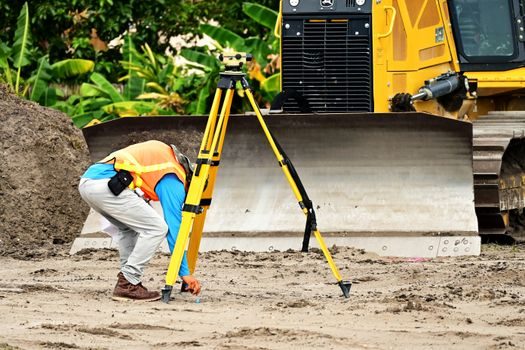
The first limit is line-of-sight and ambient light: a red beam at 1 mW becomes hard to read against sunlight beyond roughly 5–8 m, and even a green beam is hard to read without a detector past 15–20 m outdoors [S6]. The second is the self-levelling range itself: pendulums only compensate ±3° to ±4°, so on a bouncy floor slab or a heavily out-of-level tripod the unit refuses to emit rather than give a tilted line.
The third is detector dependency for long-range outdoor work. A rotary laser without a pulse-receiver-compatible detector is essentially a fair-weather tool; the receiver is a separate line item, usually one-third to one-half the cost of the laser itself. The fourth is power: a 12-line 4D unit pulling multiple green diodes can drain a 3000–4000 mAh Li-ion pack in 3–5 hours, and rechargeable cells hate cold jobsites below about −10 °C. The fifth is glass and mechanical fragility: pendulum-compensated optics do not survive a 1.5 m drop onto concrete, and the diode/lens assembly is field-repairable only at factory level, so a dropsied unit is effectively a write-off. For a comparison with a different marking technology that shares the same diode but a completely different duty cycle, see the industrial barcode scanner vs laser marker spec map.
Selection map: matching sub-type to job
Interior fit-out (cabinets, tile, partitions, ceilings) on runs under 30 m: a self-levelling cross-line or 12-line green-beam unit, accuracy ±0.2 mm/m or better. Exterior concrete set-out and earthworks: a rotary laser with a pulse-receiver detector, accuracy ±0.05–0.1 mm/m, range 300–500 m diameter. Single-point plumbing and squaring: a 5-point dot laser. Machine alignment and metrology: a dedicated laser tracker class of instrument, not a construction laser level, with sub-arc-second angular accuracy. [S2]
Comparison of the four sub-types on four decision criteria — beam range, indoor visibility, outdoor visibility with detector, and unit cost band: dot laser is 10–30 m / good / poor (no detector mode on most) / $40–150; line laser is 15–30 m / good (green) or fair (red) / fair with detector / $80–400; rotary laser is 300–500 m with detector / fair / excellent / $300–1500; 3D / 12-line laser is 20–40 m / excellent (green) / fair with detector / $150–600. Background reading on the rotary class is in our laser profiler encyclopedia entry, which is a different instrument but shares the rotating-optics principle.
Who a laser level is for, and who should not buy one

A laser level pays for itself for any tradesperson or engineer doing more than roughly 20 hours of set-out work per month, on surfaces where a projected plane is usable, and on sites with stable power for recharging [S6]. It is the right tool for tilers, drywall and ceiling installers, cabinet fitters, electricians and plumbers running parallel conduit or pipe, concrete contractors using a laser screed reference, surveyors doing rough set-out, and machine shops aligning shafts with a laser displacement sensor on the workpiece.
It is the wrong tool for legal survey boundaries (use a total station or GNSS), for sub-millimetre metrology (use a laser tracker or coordinate measuring machine), for vertical control deeper than 30 m where plumb lines or optical plummets are still standard, and for one-off DIY shelf-hanging where a 600 mm spirit level is faster and cheaper. It is also the wrong tool on a vibrating mezzanine or a freshly poured slab that is still moving — the self-levelling pendulum will refuse to lock, and the operator will blame the instrument rather than the substrate.
Failure modes and standards to anchor a spec on
Specifying a laser level comes down to four numbers: accuracy (in mm/m or arc-seconds), self-levelling compensation range (in degrees), working range with and without a detector (in metres), and laser class (Class 2 for visible-beam construction lasers, Class 3R for higher-power rotary units). The IEC 60825-1 laser safety standard governs the classification and labelling of every diode-based construction laser, and Class 2 / 3R units are the only legal consumer/light-commercial products in most jurisdictions. Accuracy should be checked against a known baseline over a 10–30 m run at commissioning, and re-checked after any drop; a 0.5 mm/m drift is enough to fail a commercial floor-tolerance spec. [S2]
The most common failure modes in the field are: pendulum lockout on out-of-level tripods (operator error, recoverable), dim or split beams from a dying diode (replace the unit, not the battery), false planes from a cracked compensator magnet (factory repair only), and detector interference from infrared-heavy work lights (switch detector frequency or shade the sensor). Battery and charger failure on cheap USB-C Li-ion packs in cold weather is a separate, predictable failure that resolves by carrying a backup 18650 cell or specifying a unit with user-replaceable cells. For a related data-driven article on cost drivers and total-cost-of-ownership across a laser class, see the laser marker price 2026 spec and TCO map.
Sourcing and the next decision node

The practical buy decision is between a $80–200 red-beam cross-line unit (interior DIY and light trade), a $200–600 green-beam 12-line or 4D unit (interior fit-out contractor), and a $600–1500 rotary laser with a matched receiver (outdoor set-out, concrete, landscaping). A verifiable next signal to watch is whether your preferred vendor publishes a per-axis accuracy figure, a detector-frequency figure in kHz, and a quoted IEC 60825-1 class on the datasheet — a vendor that hides any of these three is a vendor whose numbers will not survive an audit, and a unit whose spec sheet is missing the class number is one to send back. [S2]