
Laser markers in 2026 separate into three wavelength families — fiber (~1064 nm), CO2 (~10.6 µm), and UV (~355 nm) — each tuned to a specific substrate class and priced from roughly USD 1,000 for entry fiber units to over USD 4,000 for UV systems [S5][S7][S8].
The buying decision is rarely about wattage alone; beam quality (M²), pulse width (ns vs ps vs MOPA), and the controller/software stack drive both mark quality and lifecycle cost, with KEYENCE's 3-axis MD-F3120C and ML-Z9500W controller still setting the documented benchmark for XYZ-3-axis marking as of 2026-07 [S3][S4].
Wavelength-to-Substrate Map: Fiber, CO2, UV, and Green
Fiber (~1064 nm) markers absorb strongly in metals and most engineering plastics, which is why 30 W–100 W MOPA and Q-switched fiber units dominate metal part marking, stainless-steel engraving, and anodized aluminum branding [S1][S5]. CO2 (~10.6 µm) markers are the workhorse for organics — wood, leather, acrylic, paper, fabric — and remain the default for non-metal cutting and engraving lines at 80 W–280 W tube power [S1].
UV (~355 nm) markers use frequency-tripled Nd:YAG to cut heat input roughly an order of magnitude lower than fiber, which makes them the only realistic option for ultra-fine marking on cosmetics packaging, pharmaceutical bottles, food packaging films, and UV-cured polymer surfaces where thermal damage would be visible [S8]. Green (~532 nm) sits between UV and fiber and is sometimes quoted for reflective gold and copper that absorb poorly at 1064 nm, though the [S#] research did not provide a concrete 532 nm vendor model — flag this as a gap when specifying.
Power, Pulse Width, and Beam Quality: What Actually Changes Mark Quality
Average power alone is a weak predictor; pulse width and M² matter more. Q-switched fiber sources deliver nanosecond pulses and are the cheapest path to dark anneal marks on stainless steel, while MOPA fiber (Master Oscillator Power Amplifier) architectures add a separately controllable pulse duration — typically 2–500 ns — and are the units cited on 2026-06 listings as "100W 2.5D Ezcad3 JPT MOPA 100W Fiber Laser Engraver" with 60W MOPA variants alongside [S5].
For 3-axis / 2.5D work, KEYENCE's MD-F3120C and MD-F5100C document XYZ-3-axis marking, where the Z axis is used to keep focal distance constant on curved or stepped parts; the same series' "wide area" designation covers larger working windows than the standard models [S3][S6]. Beam quality factors are typically published as M² ≤ 1.5 for quality fiber markers, and lower M² means smaller spot size at the same working distance — directly translating to higher character density per mm².
Industrial vs Desktop vs Handheld: Who Should Pick What
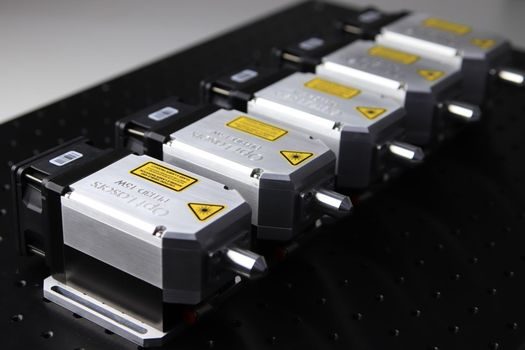
For high-mix production lines running >2 shifts, the spec floor is an IP-rated industrial head, a separated controller (rack-mountable), and fieldbus / Ethernet I/O — KEYENCE's ML-Z9500W lists a 3-axis XYZ marking style with separated ML-Z9510W head and MC-P1 console, and its older generation MD-F5100C is a documented standard-area contactor-spec unit [S4][S6].
For low-volume shops and job shops, entry fiber units in the USD 1,000–2,000 bracket with integrated controllers and 110×110 mm scan lenses are the cost-efficient floor — examples on the 2026-06 AliExpress listing show 30 W and 50 W Raycus-based units, and a 100 W MOPA configuration at USD 1,034–1,853 [S5]. Portable / handheld fiber markers (e.g., the "no consumable" portable units advertised on GoldSupplier) target on-site logo marking and field engraving, but trade marking speed and beam stability for mobility [S9][S10].
Desktop UV markers above USD 2,000 sit in a different decision space entirely — they are picked because the substrate requires cold marking, not because they are cheaper than fiber [S7][S8].
Total Cost of Ownership: Laser Source Life, Optics, and Chiller
Quoted prices across the 2026-05–2026-07 window cluster as follows: entry fiber 30–50 W at roughly USD 1,000–2,000; industrial 100 W MOPA fiber at USD 1,800–4,000; UV markers at USD 2,000–4,200; and CO2 cutting-class systems starting at USD 2,600 [S5][S7][S1]. These headline numbers exclude the peripherals that decide three-year TCO.
Three line items drive TCO: (1) the laser source itself — fiber diodes typically carry a 30,000–100,000-hour rating but degrade in pulse energy; CO2 tubes are consumable-class with 4,000–10,000-hour life; UV DPSS pumps are the most service-intensive. (2) F-theta and field lenses — replace when contamination or thermal lensing appears, typically every 1–3 years. (3) Cooling — the [S7] industrial-chiller listing shows a 2,000–4,200 USD air-cooled chiller dedicated to laser marking, 3D printing, and welding, and most 100 W fiber units and all UV units will not run reliably without one. Facility power (single-phase 220 V for desktop, three-phase 380 V for industrial) and extraction (CO2 and UV on plastics / cosmetics produce fumes) round out the cost ledger.
Standards, Safety, and Compliance Gates
Every industrial laser marker falls under IEC 60825-1 for laser product safety classification, and Class 4 systems (the industrial norm) require interlocked enclosures, keyed switches, and beam shutters specified at install. For medical or pharma traceability work, marks may need to satisfy UDI (Unique Device Identification) durability and contrast criteria; for automotive and aerospace, IPC and OEM-specific mark-content standards apply on top of the laser safety standard. [S8]
The discontinued MD-F5100C product page explicitly notes "Compliance with the certification standard is ensured as of the time of shipment from our [S6] factory" — a useful contractual pattern: insist on a shipment-date certificate of compliance rather than a generic CE / FCC sticker when audit trails matter. CE marking under the EU Machinery Directive and the Low Voltage Directive still applies to the complete machine when sold into Europe, and the controller's supported OS list on legacy units (e.g., Windows 7/Vista/XP) is a real cybersecurity flag for 2026 procurement — KEYENCE's ML-Z9500W controller lists those older Windows releases as supported, which means plan for an OS-refresh or vendor-supplied controller before 2027 if the unit is going into a connected plant [S4].
Selection Criteria Comparison: Fiber vs CO2 vs UV on 4 Gates
Lining the three main options up against four binding gates makes the decision auditable. (1) Substrate: metal / hard plastic → fiber; organics → CO2; heat-sensitive polymer / glass / pharma packaging → UV. (2) Mark fineness: fiber at M² ≤ 1.5 routinely hits 0.1 mm character height; CO2 lands at 0.2–0.3 mm; UV goes below 0.05 mm with cold ablation [S3][S5][S8]. (3) Source life / TCO: fiber rated longest, CO2 tube shortest, UV DPSS in between and most service-intensive [S1][S5][S7]. (4) Entry CapEx: fiber is the cheapest starting point in 2026 listings, with 30 W units around USD 1,000; CO2 cutting-class gear starts near USD 2,600 for the machine alone, excluding extraction; UV markers price above USD 2,000 even for desktop [S5][S7][S1].
Who should NOT pick the mainstream (fiber) option: any application involving transparent or semi-transparent polymer, glass marking, or cosmetics / pharma surface codes — fiber at 1064 nm passes through or thermally damages these substrates, and a UV or green source is the only defensible choice [S8]. Who should not pick UV: high-throughput metal part shops — UV's slow ablation rate and pump cost make it uneconomical when a 50 W MOPA fiber will mark stainless at three to five times the throughput [S5].
Software, Vision, and 3-Axis Integration

The controller and its software are where industrial markers earn their keep. The MD-F series (e.g., MD-F3120C wide-area) and ML-Z9500W controller integrate with PC-side "MARKING BUILDER 2" and "Logo designer" packages and accept standard 2D CAD input, and the 3-axis capability on the MD-F family is the spec that lets a single head follow a stepped or cylindrical surface without re-fixturing [S3][S4]. For plants already running machine vision, the analog partner to a laser marker is a laser profiler for in-line mark verification and a laser level for fixture alignment — pair the marker with a vision controller sized to your cycle time, and the spec sheet on the linear guide carrying the part becomes the binding tolerance for mark placement, not the laser's resolution.
Shortlist logic for a 2026 buyer: lock the wavelength first from the substrate map; then pick pulse architecture (Q-switched vs MOPA) from the required mark contrast and character size; then size the scan field (standard vs wide area) from the largest single part; then pick the controller and software stack from the plant's existing PLC / SCADA integration — the cheapest machine that fails on software integration is the most expensive one. Track 2026-09–2026-12 vendor release notes for any UV-source life rating updates and any IEC 60825-1 amendment cycle.
Background reading: Thermostat Price & Cost Guide 2026: Snap-Action Switch Cost Drivers.