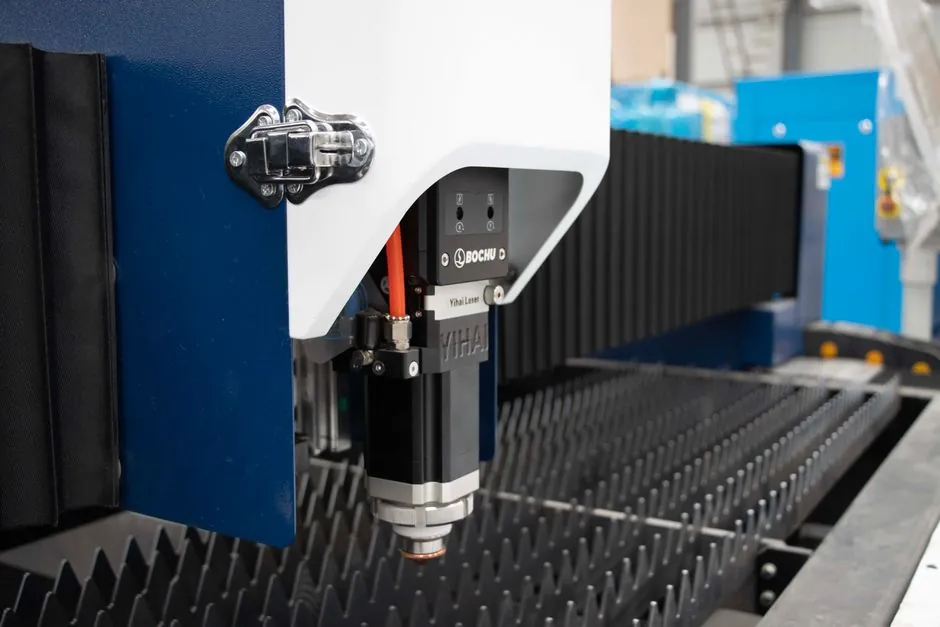
A laser marking station bundled with an inline machine vision verifier and an MES data link is the dominant 2026 architecture for direct part marking, because it produces a permanent, machine-readable Data Matrix code, grades it against ISO/IEC 15415, and writes a serialized record for every part on the same cycle [S1][S8].
Cycle times fall in the 0.5–8 s window depending on mark method and content density, Data Matrix down to roughly 2 mm, OCR/OCV grading, and data hand-off via OPC UA, MQTT, or SQL into the MES [S1]. Marking sources in active integrator stacks include KEYENCE MD-X, TRUMPF TruMark, IPG, Datalogic AREX, Coherent, and Telesis, with Cognex, OMRON, and KEYENCE covering the verification side [S1][S5].
How a laser + vision traceability station is actually built
Four subsystems are non-negotiable in any serious build: a marking head (fiber 1064 nm, CO₂ 10.6 µm, UV 355 nm, or dot peen), a vision controller-driven verifier that grades the code per ISO/IEC 15415 / 15416, hardened fixturing or a vision-located nest, and a controls layer that pulls payload data from MES/ERP and logs serialized results back [S1][S2]. The station sequence is barcode or RFID part identification, recipe lookup, payload generation, mark, verify, sort, and timestamped log, with a pass/fail split that re-marks or quarantines a bad code rather than letting it through [S1].
Two-axis galvo scanning with optional 3D dynamic focusing is the mechanism that lets the same head place a consistent mark on parts that arrive with positional or curvature variation, which is the same vision-locate-then-mark closed loop that makes the mark trustworthy downstream [S3]. Add a machine vision ID reader at the outfeed, and the same station that marks the part also proves the mark survives handling.
Marking methods compared on engineering criteria
Specifiers normally choose among four methods; the table below lines the common options against the four criteria that actually drive a buying decision [S1][S3].
Beam focus is typically a spot in the microns to tens-of-microns diameter range, which is why a single laser source can render fine Data Matrix cells, micro-text, and even covert anti-counterfeit features inside the same mark window [S3]. For an FDA / UDI, MIL-STD-130 IUID, or AIAG B-17 program, fiber or UV on metal and UV or CO₂ on polymer are the practical pairings; dot peen is the answer when the mark has to survive post-mark grit blasting or outdoor exposure [S1][S4][S8].
Vision verification: grading, OCR, and the read-back that closes the loop
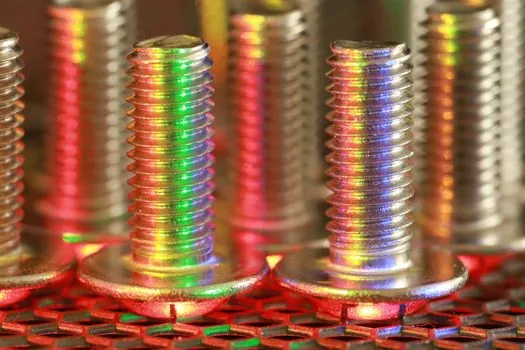
Inline vision imaging verification is what turns a marking station into a traceability station, because it converts a cosmetic mark into a quality-of-record result. Verifiers grade the Data Matrix per ISO/IEC 15415 (2D) or ISO/IEC 15416 (1D), check text legibility with OCR/OCV, and confirm mark position against a registration feature before the part is allowed downstream [S1][S2].
The verifier is normally paired with a structured vision light source selection (red, IR, or UV ring/dome/bar lights) tuned to the mark contrast, which is the single biggest determinant of a stable C-grade or above on reflective metal. OMRON packages marking, marking inspection, and appearance inspection into a single finder-option cell for EV subassembly, illustrating the consolidator trend where one cell owns both the write and the grade [S5].
Data layer: OPC UA, MQTT, and MES integration
Writing the mark is half the job; getting the part, the mark, and the grade into the MES on the same cycle is the other half. A current spec calls for serialized payload pulled from MES/ERP, including GS1 application identifiers for lot, serial, and date, then logged back as a timestamped result with the verification grade attached [S1][S2].
KEYENCE's published guidance is explicit that laser markers no longer sit on an isolated serial port, they sit on a controls network with the PLC, the MES, and the vision system sharing state, with protocol options commonly including OPC UA, MQTT, and SQL writes depending on what the plant already runs [S2]. For an end-of-line test cell that already uses barcode recipes and closed-loop DAQ, the same data pattern applies: recipe in, serialized result out, and a bar-code-tied record the auditor can find later, as laid out in hydraulic EOL test stands with barcode recipes and MES records.
Standards, codes, and who the architecture is for
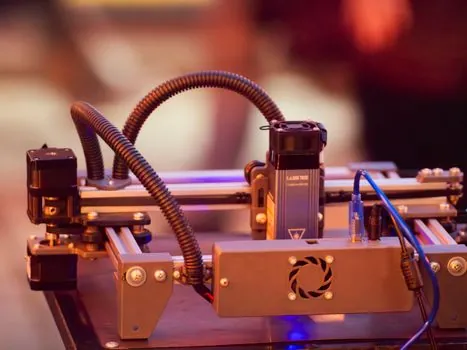
The compliance frame a traceability station has to satisfy is concrete: ISO/IEC 15415 and 15416 for code grading, MIL-STD-130 IUID for DoD UID marks, AIAG B-17 for automotive traceability, GS1 for supply-chain identifiers, and Data Matrix ECC 200 as the dominant 2D symbology on metal and plastic parts [S1][S8]. OCR/OCV is added when human-readable text must be verified, not just the 2D code [S1].
This architecture fits medical devices, aerospace, automotive (including EV subassembly and battery cells), electronics, and any heavy-industry casting or forging that has to survive downstream coating [S1][S4][S5]. It is the wrong tool when a part is too soft or too small for any permanent mark, when the only requirement is human-readable lot identification, or when line cycle time is below roughly 0.3 s and a non-contact ink or laser mark cannot physically resolve a code at the needed cell size [S3][S4].
Limits, failure modes, and what still breaks in 2026
Even a well-built station fails in predictable ways. The most common are: under-powered marks that read on a verifier but fail after a wash or coating step, vision verifier lighting that is tuned once and then drifts as the LED ages, recipe-to-recipe payload mismatches when MES changes a field length, and dot peen marks that pass ISO/IEC 15415 but do not survive a downstream grit-blast [S1][S3][S8].
UV at 355 nm is the right answer for many heat-sensitive parts, but it is slower than fiber and the beam is more sensitive to focus drift, so a station that promises UV throughput at fiber cycle times is usually misquoted [S3]. Coherent notes that wavelength and pulse duration can be chosen to minimize the heat-affected area, which is the engineering lever when a part is delicate, not cycle-time tuning [S3].
Two trackable signals to watch: the share of new EV and battery-cell subassembly lines that specify one consolidated marking-plus-inspection cell (OMRON's stated direction) over a separate mark station and separate vision station [S5], and the rate at which MIL-STD-130M and AIAG B-17 audits accept laser-marked Data Matrix as the primary IUID carrier over legacy plate-etched UID [S8].