Data center lightweight partition selection now resolves into four material families, ACM, polycarbonate, HPL honeycomb, and FRP/fiberglass, with hot/cold aisle containment as the dominant use case [S2][S3][S6][S7].
Specifying partitions for hyperscale white space, edge micro-sites, and modular retrofits requires aligning fire rating, ESD behaviour, panel mass per m², and air-leakage targets before locking a vendor [S6][S7].
Defining the Scope: Partitions vs Enclosures vs Raised-Floor Panels
Data center "partitions" cover hot-aisle and cold-aisle containment walls, HAC rack-to-ceiling panels, and floor-to-ceiling room dividers, distinct from server racks, mesh cages, and raised-access floor tiles [S3]. The Kingspan/Tate containment line defines HAC as the gap-sealing member between the top of a rack and the structural ceiling, while walls run the full floor-to-ceiling height with supplied brackets for pre-assembly [S3].
Adjacent infrastructure uses the same lightweight panel vocabulary but serves different loads: perforated metal and bar grating are specified for raised flooring, equipment enclosures, and catwalk grating on mechanical platforms [S1]. FRP/fiberglass grating is non-conductive and corrosion-resistant, which is why it appears in electrical infrastructure areas inside data centers rather than in the IT hot zone [S1].
Material Options and Core Trade-offs
ACM (aluminum composite material) provides a rigid, lightweight skin with a clean finish, and is the typical specification for both functional and visible aisle-containment walls [S2]. It is composed of two aluminum sheets bonded to a core, giving a panel that is easier to cut and route on site than steel sandwich panels, at the cost of lower impact resistance than solid polycarbonate.
Polycarbonate partitions are the specifier's choice when fire rating, ESD safety, and optical clarity are needed together; they are used for cold-aisle containment, rack-aisle separation, and M/E room screens [S7]. Compared with glass, polycarbonate weighs roughly half as much per m² at equivalent thickness, which is the lever for retrofit jobs where the existing raised floor cannot accept heavy dead load [S7].
PP (polypropylene) flame-retardant partitions are entering the conversation because liquid-cooling and fibre upgrades happen while racks stay live, and PP supports on-site fabrication with low spark and low particulate generation [S6]. HPL honeycomb panels, an aluminum honeycomb core faced with high-pressure laminate, are positioned as a structural-strength solution with the fire performance of the laminate skin [S8]. FRP/fiberglass is reserved for areas where non-conductivity and corrosion resistance outweigh optical clarity, such as electrical rooms and outdoor plant [S1].
Decision Criteria: Fire, ESD, Air Leakage, and Mass

Four criteria dominate partition selection in white space: flame spread / smoke developed index, surface resistivity (ESD), air-leakage rate at the rack-to-ceiling interface, and panel mass per square meter. Polycarbonate can be supplied fire-rated and ESD-safe in the same panel, a combination that is harder to hit with ACM unless the core is specified FR-grade [S7]. PP flame-retardant grades are typically rated to UL 94 V-0 class behaviour, with the exact rating tied to the specific compound datasheet rather than to PP as a generic material.
Air leakage at the HAC interface is the variable that pushes designers toward custom-fabric panels rather than stock sizes. Kingspan/Tate explicitly note that partitions are customised for every job to minimise air leakage, and the product line is supplied pre-assembled with brackets for fast install [S3].
Panel mass sets the retrofit ceiling. As a working envelope, polycarbonate partitions land near 2.4–4.8 kg/m² at 3–6 mm thickness, ACM sits near 3.0–5.5 kg/m² at 3–6 mm total thickness, and HPL honeycomb climbs to 7–12 kg/m² at 10–25 mm panel depth [S2][S7][S8]. Where raised-floor load class is a constraint (typical 1000–1500 kg/m² static for data-hall tiles), the lighter polycarbonate and ACM envelopes give the most headroom.
Comparison Matrix: Four Material Families on Five Criteria
Across the four dominant materials, specifiers should rank on these five axes: flame rating, ESD safety, optical clarity, mass per m², and on-site fab ease. ACM scores high on finish and fab ease, moderate on mass, and requires an FR core for the strictest flame ratings [S2]. Polycarbonate scores high on flame rating (FR grades available), high on impact, high on clarity, moderate on mass, and moderate on fab ease because it needs correctly tuned tooling to avoid cracking at fastener holes [S7]. PP FR scores high on fab ease and chemical resistance, moderate on flame rating, and is opaque [S6]. HPL honeycomb scores high on structural strength and flame rating, but the heavier mass and the harder field-fab process push it toward new-build rather than retrofit [S8].
For a 50 m cold-aisle run with full HAC seal, the practical weight order is: PP FR < ACM ≈ polycarbonate < HPL honeycomb < FRP sandwich. For a 200 m² retrofit on a legacy 800 kg/m² raised floor, PP FR and 3 mm ACM are the safest mass picks, while 6 mm polycarbonate trades mass for impact and clarity [S6][S7].
Where Each Material Fits: Use-Case Mapping
ACM is the default for visible cold-aisle walls in colocation halls where finish and corporate branding matter [S2]. Polycarbonate is the specifier's pick for fire-rated rack-aisle separation and for M/E room screens where inspectors ask for sight-through verification of equipment status [S7]. PP FR partitions fit the live-retrofit scenario where cutting, drilling, and welding must happen next to operating servers without hot-work permits [S6]. HPL honeycomb is the choice for full-height structural walls where the partition doubles as a column-line stiffener [S8]. FRP/fiberglass is restricted to electrical-infrastructure areas, generator platforms, and outdoor plant where non-conductivity and corrosion resistance are the load-bearing requirements [S1].
Limitations, Failure Modes, and What These Panels Are Not For
Lightweight partitions are not load-bearing walls and must not be used as fire-rated structural enclosures for the data hall itself; the structural fire compartment is the slab, column, and rated ceiling assembly, not the internal partition [S3]. Polycarbonate partitions scratch faster than glass-clad alternatives and require anti-abrasion film or specified coating in high-traffic rows [S7]. PP FR has a lower continuous-service temperature than ACM or polycarbonate, which matters next to CRAC return paths where local air can run 35–45 °C.
ACM with a PE core is combustible and will not pass a UL 94 V-0 requirement; specifiers must call out an FR mineral core by name, not just "ACM". FRP grating panels are not intended for IT hot-zone use because they shed fibres and do not seal airflow, so the right role is cable-tray covers and equipment platforms, not containment walls [S1]. HPL honeycomb field-fab is slow; if the install is on a 4-week retrofit schedule, plan for shop-prefab or accept longer site time [S8].
Supporting Hardware and Adjacent Spec Items

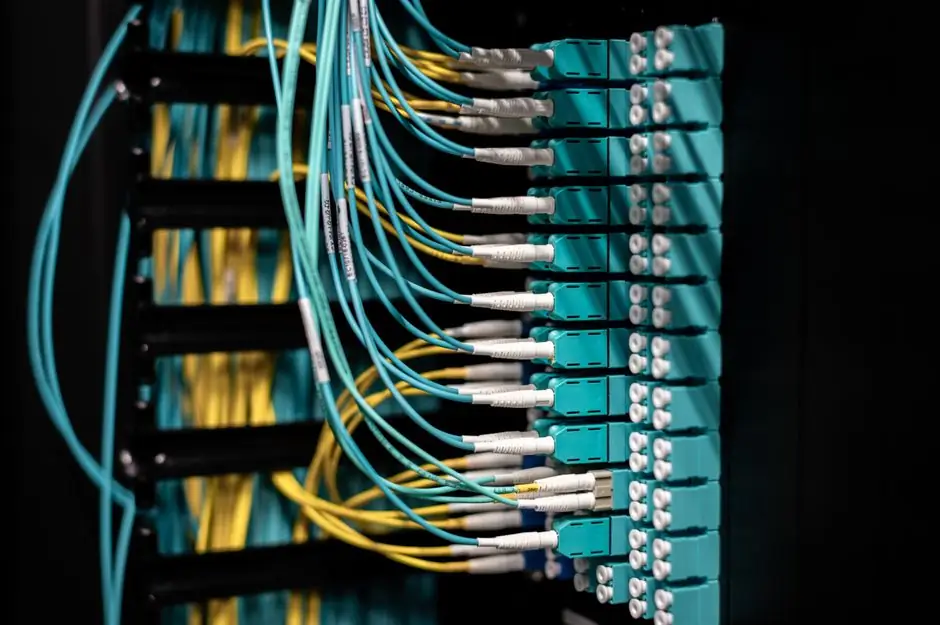
Partition selection is tightly coupled to two adjacent spec families. Containment door specification (single hinged, single sliding, dual sliding) and the data-hall HMI panel integration both depend on the same wall thickness and bracket pattern [S3]. Inside the rack, the cabling layer uses high-density patch panel and slim 1U/2U/4U MPO frames, where a 1U slim frame holds 12 MPO cassettes and up to 144 fibres, 2U reaches 24 cassettes / 288 fibres, and 4U hits 48 cassettes / 576 fibres, with 1U equal to 44.45 mm [S5]. Power and control around the partition line is built per IEC 61439-1 and IEC 61439-2, with IEC 61439-3 on distribution boards, IEC 61439-6 on busbar trunking interfaces, and device coordination per IEC 60947-2 (ACBs/MCCBs) and IEC 60947-4-1 (motor starters) [S9].
Sourcing and Verification Signals
Track these signals when qualifying a panel vendor for a 2026 data-hall build: published flame-spread and smoke-developed index on the FR-grade datasheet, surface resistivity in ohms per square for ESD claim, on-site fab method statement (cold-cut only, no spark), and a HAC air-leakage test report from a prior install. Kingspan/Tate publishes up to 25-year limited warranty on the Reuse Panel (steel-encapsulated wood core reclaimed panels) when installed with a new pedestal system by their contracting team, which is a useful benchmark for vendor-backed durability on adjacent raised-floor components [S3].
Detailed specification references: lightweight partition panel.
See also our earlier report, Polyurethane Elastomer Selection for General Fabrication: Hardness, Service Envelope.