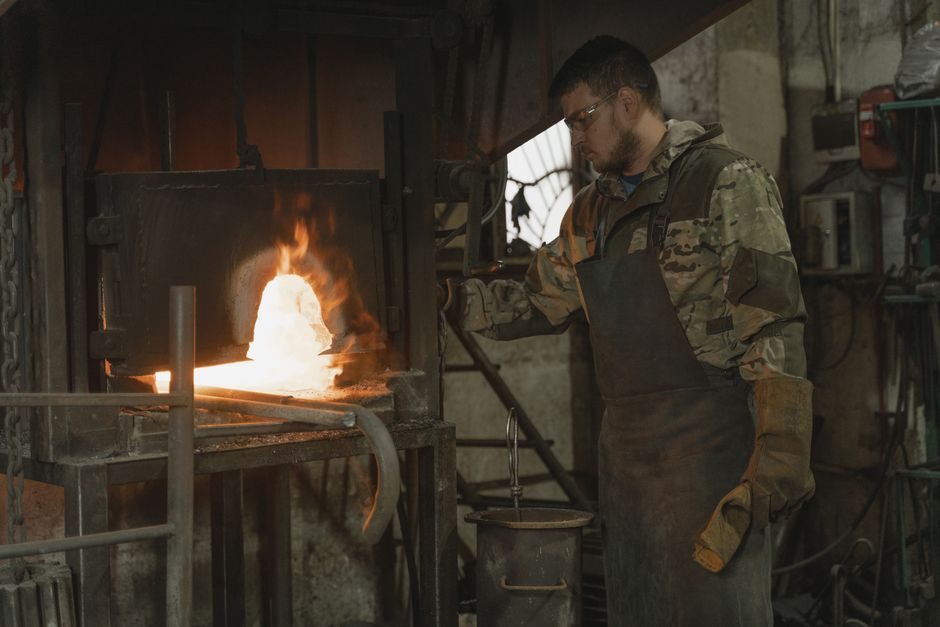
Line frequency induction furnaces — also called mains-frequency or 50/60 Hz coreless induction furnaces — are priced primarily on nominal melt capacity in metric tons, with a 2026 turnkey range of roughly $8,000 to $15,000 per ton for steel scrap melting duty, a band that scales non-linearly below 3 t and above 20 t.
The equipment itself is distinct from medium-frequency and high-frequency units: it draws three-phase mains-frequency AC directly through a balancing transformer and capacitor bank, producing eddy currents in the charge at the supply frequency itself, and is most commonly deployed for melting cast iron, steel scrap, and large-tonnage ferroalloy heats where the slower stirring and lower power density are acceptable [S3].
Capacity, Frequency Class and Typical Price Bands
Capacity is the single largest cost driver: a 1-ton LFF for foundry iron melting typically lands at $15,000-$30,000 for the bare furnace body, while a 10-ton steel-scrap melting system ships at $90,000-$180,000 before civil works, and a 20-ton unit stretches into the $250,000-$400,000 band [S1][S3].
Frequency class matters less than most buyers expect on a line-frequency build: because the operating frequency is fixed at 50 or 60 Hz, the inverter and rectifier stack that dominate medium-frequency pricing are absent, and the cost premium versus a similarly rated medium-frequency furnace is offset by the need for a heavy balancing/furnace transformer plus a large capacitor bank sized in the megavar range [S3].
Useful detail: a 10 t/h line-frequency melting furnace operating on 50 Hz supply at 1,000 kW absorbed will draw roughly 1,900-2,200 kVA at 0.45-0.55 power factor uncorrected, which is why power-factor correction capacitors routinely add 8-15% to the turnkey figure on industrial builds [S3].
What Is In the Turnkey Price — and What Is Not
A published LFF turnkey figure almost always includes the furnace shell, water-cooled copper coil, tilting hydraulics, refractory pre-install, balancing transformer, capacitor bank, and the basic PLC/HMI control cubicle; it almost never includes scrap handling, dust collection (typically $40,000-$120,000 extra for a baghouse sized to 10-20 t/h), ladle preheating, water-cooling tower, or HV connection fees [S3].
For a complete reference frame on the wider equipment family including medium-frequency and crucible furnaces, see the induction furnace 2026 price & cost guide, which carries the per-ton breakdown across frequency classes.
Comparing LFF, Medium-Frequency and Channel Furnaces on Cost
The decision pivots on duty cycle: for batch melting with long holding periods and high scrap throughput on a 50/60 Hz supply, LFF wins on capex and on simplicity of the control system; for high-mix, fast-tap cycles with tight temperature control, MFF is the more common pick despite the rectifier/inverter premium.
Buyers evaluating LFF as a long-term capex should also run the line frequency induction furnace selection: 7 gates before RFQ checklist alongside this cost guide, because coil copper mass, water-cooling flow in m³/h, and scrap-class compatibility swing the final delivered price by another 10-20% once the engineering gates are passed.
Who LFF Is For — and Where It Is the Wrong Pick
LFF is the right pick for ferrous foundries melting 5-30 t per shift on cast iron or steel scrap, for forge shops needing a holding furnace, and for ferroalloy producers running near-continuous melts on a 50/60 Hz grid with adequate short-circuit capacity at the Point of Common Coupling. [S1]
It is the wrong pick for non-ferrous melting above aluminum's 660 °C pour point where melt-loss economics dominate, for any duty below 1 t/h where a medium-frequency crucible furnace delivers better specific energy consumption (typically 530-580 kWh/t for iron in a well-tuned MFF versus 600-680 kWh/t for an LFF), and for sites with weak grids where the LFF's inrush and VAR demand will trip upstream protection; a soft-start or STATCOM option adds 6-12% to the turnkey number and should be priced in upfront when the supply is marginal [S3].
Standards, Ratings and Sourcing Levers
Electrical build typically follows IEC 60079-series zoning where the furnace body is treated as a Zone 1 or Zone 2 area near the pour spout, with the coil and water-cooled leads rated IP54-IP65; the balancing transformer is usually oil-immersed and tested to IEC 60076, and the capacitor bank is dry-type or oil-filled per IEEE 18 / IEC 60871 for shunt power-factor correction duty [S3].
Sourcing levers that move the 2026 number the most: Chinese OEM supply (Shandong, Henan, Liaoning clusters) at $7,000-$10,000/ton for 5-15 t ratings, Indian OEM supply at $9,000-$13,000/ton, and European OEM supply (Italy, Germany) at $14,000-$22,000/ton with longer lead times of 6-9 months versus 60-120 days from Asian OEMs; the spread is large enough that freight, customs duty, and on-site commissioning must be netted into the comparison before the RFQ goes out [S1].
Verification, Lead Time and Acceptance Test Costs
A 2026 LFF order typically carries a 30-40% deposit at PO, 30% at FAT (Factory Acceptance Test) video or in-person witness, and 30% after SAT (Site Acceptance Test) at cold and hot commissioning; FAT is usually included for the main transformer and capacitor bank, while SAT cold commissioning adds $5,000-$15,000 and hot commissioning with first-pour acceptance adds another $10,000-$25,000 depending on crew size and travel. [S2]
Buyers who have not yet pinned the duty profile should circle back to the broader induction furnace family overview and the molding line context before signing a P.O., because the cost of changing furnace size or coil voltage class after FAT is significantly higher than choosing correctly the first time.
For component-level specifications, see line frequency furnace.