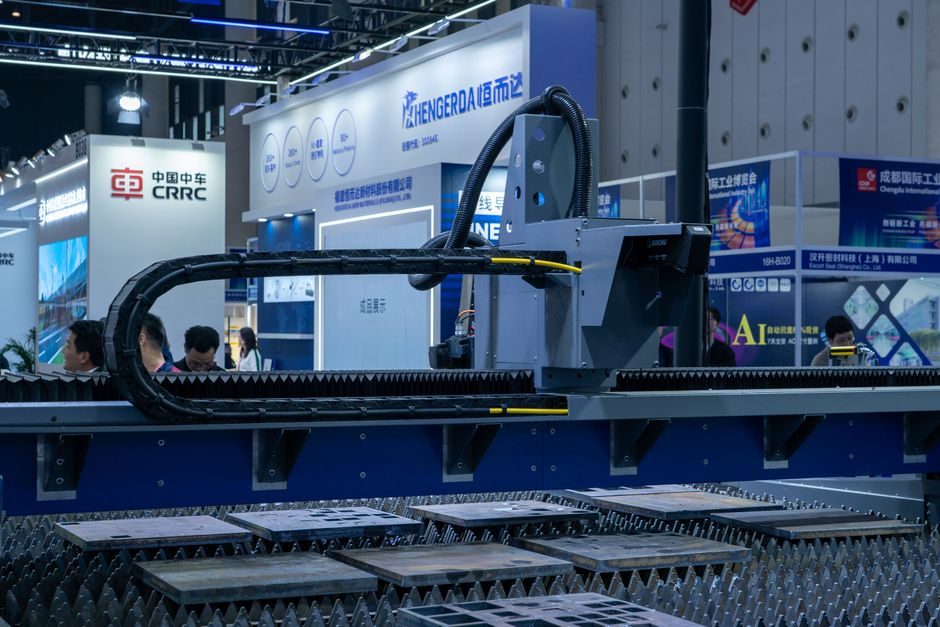
A linear module is a single-axis positioning unit that converts rotary motor input into controlled linear motion, with vendor catalogs from Bosch Rexroth [S3], LinMot [S6], PI [S8], and Rockwell [S7] anchoring the current taxonomy into three primary slices: drive mechanism, guideway technology, and axis configuration.
Light-duty belt- or screw-driven modules like the MGN9C ship with 100–2000 mm rail lengths, chrome steel with stainless or aluminum alloy bodies, HRC 58–62 hardness, and ISO 9001:2008 certification at the supplier level [S1]. Heavy-duty Rexroth MKK/MKR/MLR modules scale up to MKK-165 with ball-rail guideways, while LinMot's DM-series direct-drive linear motors reach 695 mm strokes and 255 N peak force [S6].
Drive Mechanism: Ball Screw, Belt, Linear Motor, Pneumatic, Hydraulic
Drive type is the first selector because it sets speed, thrust, accuracy, and maintenance interval; Rexroth's MKK family uses ball screw (K), MKR uses belt (R), and MLR pairs a cam-roller guide with screw drive for higher load ratings [S3][S4].
Ball-screw modules are the workhorse for medium-to-high thrust at moderate speed and best repeatability (typically ±0.01 mm class on MGN/MGW blocks) [S10]. Belt-drive modules win on long stroke at high speed (commonly 1–3 m/s) at lower cost, while direct-drive linear-motor stages like PI's V-855 hit 4 m/s with a 107 mm profile width and 800 mm travel [S8]. Pneumatic and hydraulic modules fill low-precision, high-force niches; the GAOJ classification explicitly groups them as electric, pneumatic, or hydraulic [S5].
Guideway Technology: Ball Rail, Cam Roller, Crossed Roller, Linear Bearing
Guideway choice dictates load capacity, rigidity, and life; Bosch Rexroth's MKK/MKR use the ball-rail K-guide, while MLR switches to a cam-roller L-guide for higher moment loads [S3][S4]. HiWin's MGN/MGW blocks cover the miniaturized end (sizes 5, 7, 9, 12, 14, 15) with options for outer-recirculation modules and bottom seals on MGN/MGW 9 through 15 [S10].
For miniature linear motion, the linear guide family splits into ball-rail profile rails (MGN/MGW/HGH/HSR), crossed-roller slides, and shaft-type linear bearing sets on supported shafts. Selection is driven by the moment-load envelope: cam-roller guides like the MLR design carry higher overturning moments than equivalent-size ball-rail blocks, which is why Rexroth offers MLR as a distinct catalog line rather than a ball-rail option [S3].
Axis Configuration: Single Axis, XY, XYZ, Gantry
Beyond single-axis modules, suppliers stack them into multi-axis assemblies; Keyang's catalog lists XY (XY-G-ATB, XY-A-ATH) and XYZ (XYZ-P, XYZ-M, XYZ-G-ATB, XYZ-A-ATH-DG) combinations alongside combined-type and gantry formats [S2].
Multi-axis integration is typical in dispensing, welding, assembly, and pick-and-place cells, where stroke coordination, cable management, and cross-axis moment loading become dominant constraints. For full-machine design, these modules typically integrate with the broader linear actuator ecosystem and downstream linear motor or servo sizing.
Load, Stroke, and Speed Comparison Across Types
On a side-by-side criteria basis, light-duty screw modules (MGN-class) suit loads under ~10 kg and strokes to 2000 mm [S1], LinMot DM-series direct-drive modules reach 255–572 N peak force with 275–695 mm strokes and 15–40 kg payload [S6], Rexroth MKK-110 with ball-rail and ball screw handles industrial-class loads in the 110 mm size bracket [S3], and PI L-812 stages carry 50 kg at 610 mm with a precision ball screw [S8].
On a like-for-like basis, ball-screw modules lead on thrust-to-size and repeatability, belt-drive leads on long-stroke speed-per-dollar, and linear-motor stages lead on dynamic bandwidth, zero-backlash, and maintenance-free operation at the cost of higher controller complexity. The Rockwell Kinetix MPMA-xBD cable-track modules and center-stacked X/Z stages (catalog KNX-TD002H-EN-P) illustrate the high-end X/Z integrated envelope for synchronized motion [S7].
Selection Criteria and Sizing Boundaries
Specifying a module starts with four numbers: stroke length, payload mass, peak velocity, and positioning repeatability, with rigidity and moment-load capacity as gating constraints for cantilevered or vertical-mount use cases [S3].
For closed-loop positioning, New Scale's M3-L Smart Module integrates a linear encoder-class position feedback path driven through SPI from the Pathway PC software toolchain, which matters for embedded precision stages where the host controller cannot tolerate stepper open-loop drift [S9]. Vertical-mount applications on the L-812 require the holding-brake option, since back-driving a ball-screw under gravity is a real failure mode [S8]. Miniaturized pick-and-place often defaults to fully integrated linear module units in the MGN-size block class with outer-recirculation lubrication modules on MGN7, 9, 12, and MGW9, 12 [S10].
Standards, Compliance, and Supplier Signals
Module-level standards are thinner than for instruments, but the MGN9C supplier lists ISO 9001:2008 certification, a precision P-grade designation, and HRC 58–62 block hardness, which is the typical spec-data block buyers should expect on any catalog page [S1].
HiWin's MGN/MGW catalog documents block-type nomenclature (T, H, W variants) and explicit constraints such as "MG5 is only supplied with outer recirculation module" and "no interchangeable offer of MG2 and MG3" [S10], which is the kind of compatibility footnote that determines whether a planned retrofit stays a drop-in or becomes a redesign. For robot-cell integration downstream of module selection, see Industrial Robot Production Line Design: Subsystem Specs, Layout Stages and Cell-Type and the Industrial Robot Cost Breakdown: BOM, Integration, and TCO Drivers reference for the integration-cost side of the same decision tree.