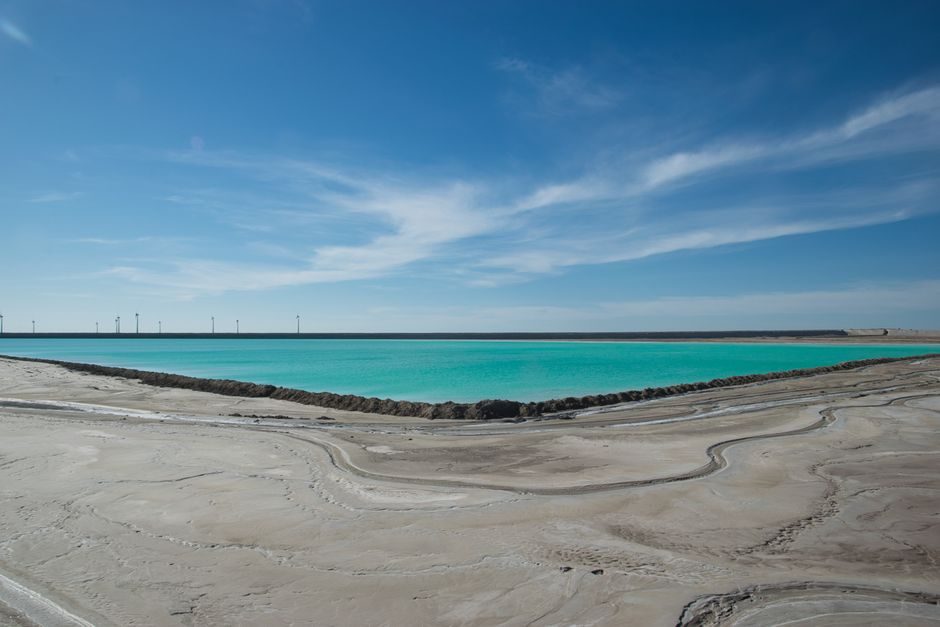
Battery-grade lithium hydroxide monohydrate (LiOH·H2O, CAS 1310-65-2) traded on 2026-06-01 at international China-origin spot bands tracked by CBCIE, with the supplier directory refreshing active anhydrous and monohydrate offers through 2026-07-26 on ChemNet [S1][S3].
Industrial-grade monohydrate 56.5% LiOH content remains a separate spec lane from battery-grade, and the offer list now shows fewer active 56.5% slots than the battery-grade count, signalling a grade-mix rather than a total-tonnage squeeze [S3][S4]. Buyers sourcing for high-purity cathode precursor (LiPF6 chain), CO2 scrubbing in sealed environments, or grease synthesis face three different sub-markets, and only one of them — industrial monohydrate 56.5% — is showing thin depth [S2][S3].
Material definition and grade boundaries buyers must pin down first
Lithium hydroxide is a white tetragonal crystalline alkali, density 1.46 g/cm³, melting at 450°C, decomposing at 924°C; the monohydrate (LiOH·H2O) is monoclinic, density 1.51 g/cm³, and more water-soluble than the anhydrous form (22.3 g/100 g at 10°C vs. 12.8 g/100 g at 20°C for anhydrous) [S2]. Decomposition at 924°C releases toxic fumes, and the substance is classified as R35 (causes severe burns), R20/22 (harmful by inhalation and ingestion), and R52/53 (harmful to aquatic organisms) under EU risk phrases, with first-aid rules under S45, S36/37/39, S26, and S22 [S2].
For procurement the practical spec split is four-lane: battery-grade monohydrate (LiOH·H2O ≥ 56.5%, low Na/Ca/Fe/SO4, low magnetic异物), industrial-grade monohydrate (56.5% LiOH content, broader impurity envelope), anhydrous LiOH (used in greases and certain catalyst routes, density 1.46 g/cm³), and high-purity monohydrate for laboratory and CO2-absorber use [S2][S3]. The same molecule sits behind very different contracts; treating it as a single commodity is the first spec error [S2].
2026 supply concentration and verified offer rotation
ChemNet's 2026-07-26 supplier snapshot shows active offers concentrated at BEYOND INDUSTRIES (CHINA) LIMITED (anhydrous, three slots, last refresh 2026-07-26) and Hangzhou Colorific Chemicals (monohydrate, 2026-07-26), with Hangzhou Ocean Chemical still listing monohydrate from 2026-02-03 and anhydrous from the same vintage [S3]. ECHEMI's page 27 index on 2026-07-17 lists 370 lithium hydroxide sale postings dominated by monohydrate, with industrial-grade and battery-grade markers explicitly tagged in the listing headers [S4].
The pattern of fresh refresh dates 2026-07-24 through 2026-07-26 at two Chinese suppliers, with most other vendors on offers dating 2024 or earlier, is the practical signal: the active supplier set is narrower than the directory size suggests [S3]. For a sourcing engineer that translates to a smaller set of RFQ targets than the headline count, and to longer quote-validity windows when China-origin industrial-grade 56.5% monohydrate is the target [S3][S4].
Selection criteria and decision rules for each use case
For NMC cathode precursor production, the binding constraints are Na, Ca, Fe, SO4, and magnetic-particle counts, not headline LiOH content — battery-grade monohydrate (≥ 56.5% LiOH basis, low trace metal envelope) is the only qualified lane, and 2026-07-26 China offers meet the spec [S1][S3]. For high-temperature grease synthesis, anhydrous LiOH (low water, density 1.46 g/cm³, insoluble in ether, slightly soluble in alcohol) is the required form; the BEYOND INDUSTRIES anhydrous listings dated 2026-07-26 cover this lane [S2][S3].
For CO2 absorption in sealed environments (submarines, spacecraft, mine refuge chambers, rebreather loops) the working chemistry is the strong-base reaction with CO2 to form Li2CO3, and the relevant physical limit is that LiOH aerosol reaches harmful airborne concentrations quickly when dispersed as dust, so sealed-handling or pelletized/dust-free grades are operationally mandatory [S2]. ECHEMI's 2026-07-17 listing and the ChemNet directory show dust-free monohydrate grain and non-dusting monohydrate as distinct SKUs from Chengdu Liruida (2024-06-19) and EHYUN INDUSTRIAL (2024-01-05), and the staleness of those listings is itself a risk flag — re-quote required before placing a CO2-scrubber contract [S3][S4].
For laboratory and analytical use, the high-purity LiOH·H2O lane runs through Western Minmetals (last listed 2020-11-13) and similar specialty houses; long quote-validity cycles are normal and not a substitute for current CoA verification [S3].
Comparison of main commercial forms against procurement criteria
Across the four commercial forms the decision matrix is: (1) Battery-grade monohydrate — 2026 China spot available, multiple active suppliers 2026-07-24 to 2026-07-26, premium pricing, low impurity envelope, primary use NMC precursor [S1][S3]. (2) Anhydrous LiOH — 2026 China active offers present, single dominant supplier (BEYOND INDUSTRIES, three slots 2026-07-26), use grease/catalyst, hazard profile identical to monohydrate [S2][S3]. (4) Dust-free / non-dusting monohydrate grain — 2024 offer dates only, refresh needed, but operationally critical for sealed CO2-scrubber cells where airborne particulate cannot be tolerated [S2][S3].
No form is interchangeable: monohydrate and anhydrous differ by ~0.05 g/cm³ in density and a 0.5–1× water-solubility band, and a 56.5% LiOH content is a content marker, not a purity grade [S2]. Cross-substitution between battery-grade and industrial-grade without requalification is the most frequent spec error in 2025-2026 RFQ cycles [S2][S3].
Failure modes, transport constraints, and operational hazards
LiOH is a strong base, hygroscopic, and decomposes at 924°C with release of toxic fume; it corrodes aluminium and zinc, reacts violently with acids, and reacts with oxidizers [S2]. Container discipline is consequential: spilled material must be collected in dry containers, residue flushed with copious water, and the substance must not enter the environment; full encapsulating suit with self-contained breathing apparatus is the documented PPE level for spill response [S2].
For Q3 2026 ocean freight, LiOH·H2O is classed as a corrosive solid (UN2680, Class 8), moisture-barrier liner mandatory; the hygroscopic uptake in transit shifts the LiOH assay downward on landed weight, and that is where industrial-grade contracts without independent CoA lose value. The S-phrases S22 (do not breathe dust) and S26 (flush eyes immediately) are the minimum handling spec, and any supplier offering without an SDS referencing CAS 1310-65-2 and the R35/R20/22/R52/53 risk set should be disqualified at the audit gate [S2].
Who is exposed, who is not, and what to track through 2026-Q4
Exposed: buyers with single-source CO2-scrubber LiOH supply on 2024-vintage contracts, buyers locking 2026-Q4 NMC precursor at thin offer count from the active 2026-07-26 set, and any operator still running an industrial-grade 56.5% specification that drifted into dust-free monohydrate use without re-qualifying the supply chain [S3][S4]. Not exposed: buyers running multi-source battery-grade monohydrate RFQs across 5+ active Chinese suppliers, and buyers on long-dated Western Minmetals laboratory-grade contracts with CoA-on-shipment terms [S3].
For perspective, the broader 2022-2026 demand-vs-supply trajectory for the underlying lithium feedstock is well documented in industrial press, with chronic under-supply against EV-battery demand running through the entire window [S5][S6]. The 2026 question is not whether LiOH is scarce in absolute terms but whether a specific grade-and-form lane is currently offered by a verified, audit-ready supplier [S3][S4].
Sourcing signals and reference standards
Referenceable technical anchors include the CAS number 1310-65-2 for the anhydrous substance and the LiOH·H2O monohydrate chemistry, the ACGIH TLV status (not established as of 2005), the EU R/S classification set, and the documented decomposition temperature of 924°C [S2]. A wider sourcing map and grade-banding perspective is available in the lithium hydroxide supply chain 2026 reference, which cross-references the same supplier set against purity tier.
For buyers whose LiOH chain feeds into adjacent industrial commodities, the related fluoropolymer resin 2026 sourcing map covers another Asia-origin spec-driven market, and the magnesium die-casting supplier map 2026 covers the parallel light-metal feedstock question.
Trackable signals for the next 60 days: (1) ChemNet refresh dates for anhydrous LiOH offers from non-BEYOND INDUSTRIES suppliers, (2) ECHEMI page-27 industrial-grade 56.5% posting volume, (3) any 2026-Q3 spot quote revisions from CBCIE for international battery-grade LiOH, and (4) restocking of dust-free monohydrate grain SKUs at Chengdu Liruida or EHYUN [S1][S3][S4].
The underlying component specifications are covered under dc power supply, switching power supply, and industrial ups.