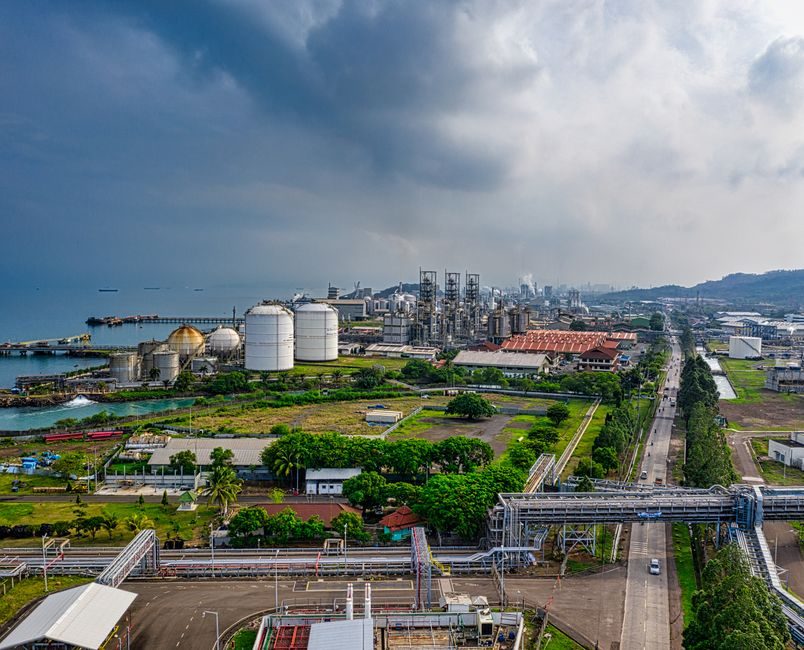
2026 marks the first structural inflection in the global LNG market since 2020: net new liquefaction capacity reaches roughly 40.7 Mt/yr in 2026, with a cumulative 2026-2030 addition of about 202 Mt, a 40% jump over 2025 levels and an average annual growth rate near 6.8% [S4].
For the first time in this cycle, supply growth systematically outruns incremental demand, pushing the market into a real-terms loose balance, although the "peak looseness" window is now pushed back into 2027-2028 because Golden Pass, LNG Canada, Costa Azul and the North Field expansion slipped their schedules [S4].
Concentration has tightened sharply: of the 2026-2030 incremental volumes, the US accounts for 46.6%, Qatar 23.8%, Canada 7.6%, the UAE 4.8% and Argentina 3.0%, reshaping the supply map from a multipolar base into a "US-Qatar dual-core" structure [S4]. Russian piped-gas share is sliding toward 40% of global gas, which mechanically lifts LNG's share of cross-border trade [S4].
2026-2030 Capacity Build-Out by Year
The five-year delivery schedule is front-loaded: 2026 +40.7 Mt, 2027 +52.65 Mt, 2028 +53.24 Mt, 2029 +38.60 Mt, 2030 +16.47 Mt, summing to 202 Mt of new nameplate liquefaction [S4]. The 2027-2028 step-change is the largest single capacity pulse in the industry's history and is concentrated in US Gulf Coast trains and Qatar's North Field expansion debottlenecking.
Because the supply ramp is sharper than the demand ramp, the market is moving from scarcity-pricing toward hub-driven pricing on JKM, TTF and Henry Hub spreads, with arbitrage windows between Atlantic and Pacific basins compressing on average. This is the same dynamic that the 2026 LNG Market Inflection: Capacity Surge, Demand Catch-Up and the New Pricing Anchor analysis tracks in closer detail, including the Henry Hub–JKM basis behaviour and charter-rate response.
US, Qatar, Canada: How the Anchor Trio Compares
Decision-relevant comparison across the three anchor suppliers: project financing model, offtake contract structure, feedgas cost, and ship-loading flexibility. US Gulf Coast projects run on Henry Hub-indexed, large-volume DES (delivered ex-ship) or FOB (free on board) contracts with Henry Hub-linked feedgas in the $2-5/MMBtu band typical of 2025-2026 strip pricing; Qatar's North Field expansion runs on long-term oil-indexed SPA (sale and purchase agreement) structures with state-backed offtakers and a single loading port (Ras Laffan); Canada's LNG Canada Phase 1 ships FOB from Kitimat with Asian utility offtake [S4].
On the four standard buyer-facing criteria, the picture is: (1) contract price index — US: Henry Hub-linked, lowest spot exposure; Qatar: oil-indexed, medium index lag; Canada: hybrid Brent/JKM, higher volatility; (2) shipping flexibility — US and Canada allow FOB with multi-port optionality, Qatar is single-port FOB; (3) carbon intensity — US Gulf Coast averages roughly mid-cycle on methane intensity with improving flare-management, Qatar is heavily electrified with CCS (carbon capture and storage) under study, Canada benefits from BC (British Columbia) grid hydro baseload; (4) project delivery reliability — US EPC (engineering, procurement and construction) schedule overruns averaged 6-12 months in this cycle, Qatar and Canada ran closer to nominal. These criteria map directly into buyer-side decisions on pressure transmitter and flow meter specifications for new terminal instrumentation, where custody-transfer accuracy drives offtake disputes.
Demand Side: Asia and Europe Pulling in Opposite Directions
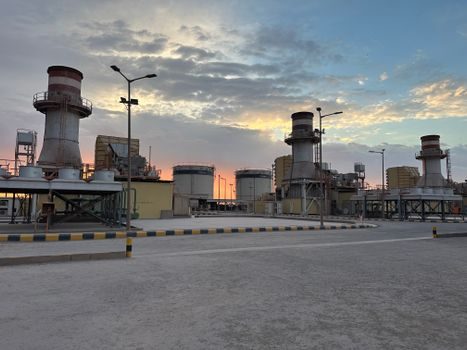
China is structurally accelerating LNG terminal construction at coastal sites, with receiving capacity in a "quantity and quality both rising" phase that breaks historical monopoly patterns and shifts China from pure buyer toward partial price-influencer [S5]. Domestic unconventional gas (shale gas, coalbed methane) is rising, and domestic liquefaction plants are clustering near inland gas source regions, raising self-sufficiency buffer against international price spikes [S5].
Europe's demand is reshaped by the staged Russian gas sanctions regime: Russian piped-gas share is sliding toward 40% of global gas, and each tightening step pulls more LNG into Northwest Europe, especially into Dutch TTF (Title Transfer Facility) and Northwest European regas terminals. For facility builders, the result is rising orders for industrial valve packages — cryogenic globe and ball valves, ESD (emergency shutdown) blocks, and LNG bunker-specific designs — with body materials shifting toward 304/316L stainless and low-temperature carbon steel rated to -196 °C service.
Instrumentation and Control Load-Out for New LNG Trains
A standard 5 Mt/yr LNG train typically carries 2,000-4,000 measurement points, dominated by pressure, temperature, level and flow on the liquefaction, fractionation and storage blocks. Specifying these requires a tight chain: a pressure sensor on a refrigerant compressor suction/discharge line must be HART (Highway Addressable Remote Transducer)- or FOUNDATION Fieldbus-enabled for remote diagnostics, with wetted parts in 316L stainless and a low-temperature rating to -196 °C where the sensing point sits in cryogenic service. [S1]
On the storage side, LNG tank instrumentation layers radar level gauges, servo and displacer level instruments, multi-point thermocouples for ullage temperature profiling, and tank-side pressure transmitter pairs on the inner and outer tank. The inner-tank transmitter typically carries a higher accuracy class (often ±0.075% of span or better) because it drives custody-transfer and Boil-Off Gas (BOG) accounting; redundancy is standard, usually 1oo2 (one-out-of-two) or 2oo3 (two-out-of-three) voted architectures. The outer-tank transmitter is a lower-accuracy, higher-reliability device focused on leak detection between the two tank walls.
For regasification terminals, the process-critical loops move to the vaporizers and send-out skids, where flow meter selection drives revenue. Ultrasonic meters dominate new high-pressure send-out lines for non-intrusive custody transfer, while Coriolis meters handle LNG bunker truck loading and bunkering ship applications where density and mass flow are reported directly. For floating storage regasification units (FSRUs), compact skid-mounted packages with FOUNDATION Fieldbus backbones are now standard, reducing the PLC I/O (input/output) count and shortening commissioning windows by 4-8 weeks on typical deliveries.
Terminal Construction, Conference Calendar and Engineering Bottlenecks
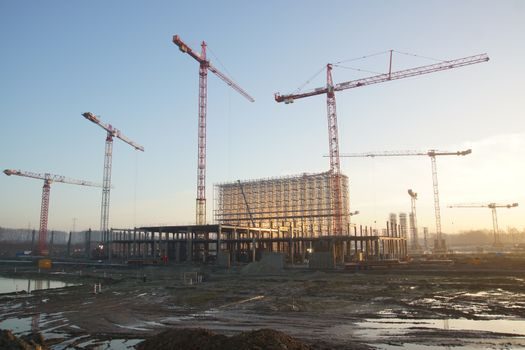
The engineering bottleneck in this cycle is no longer the liquefaction block — technology is mature — it is the regasification and receiving-side capacity that is racing to absorb the supply. This is visible in the LDC Gas Forums 2026 schedule, which runs Southeast, Northeast, Rockies & West, Mid-Continent and Gulf Coast events across 2026, with the Southeast edition already penciled for April 13-15, 2027 [S1]. The spread of regional forums tracks where new midstream and regas capacity is actually being sited rather than where liquefaction is being built.
On the demand-research side, the global large-scale LNG terminals market is being tracked by Allied Market Research as a Technology × End-User matrix (Liquefaction, Regasification × Residential, Commercial, Industrial), with the February 2026 update framed as a share and trend report rather than a single-point forecast [S2]. The matrix matters because industrial end-users (power generation, petrochemicals, bunkering) are now the marginal demand setter in Europe and parts of Asia, displacing residential and commercial heating as the swing factor.
Limitations, Failure Modes and What to Watch
Three failure modes are tracking with the 2026 build-out: (1) EPC slippage on the 2027-2028 step-change, where 6-12 month delays cascade into commissioning bunching; (2) feedgas constraint on the US side, where Henry Hub price spikes erode the cost-advantage of Henry Hub-linked LNG against JKM, narrowing arbitrage windows; (3) regas-side permitting and FSRU availability, where shipyard slots are tight through 2027 and a delay of one quarter in FSRU delivery can push a terminal back to the following winter peak. [S2]
Trackable signals for the next 6 months: Golden Pass and LNG Canada first-cargo timing (currently scheduled for late 2026 / early 2027 but slipped from earlier targets), Qatar's North Field expansion train-by-train ramp (the 49 Mt/yr total is the single largest addition in the cycle), and China's coastal receiving-capacity commissioning log, which has been the most reliable demand-side signal since 2024 [S4][S5]. Conference-side signals: the LDC Southeast 2027 forum (April 13-15, 2027) will be the first full industry checkpoint after the 2026 capacity wave lands [S1].