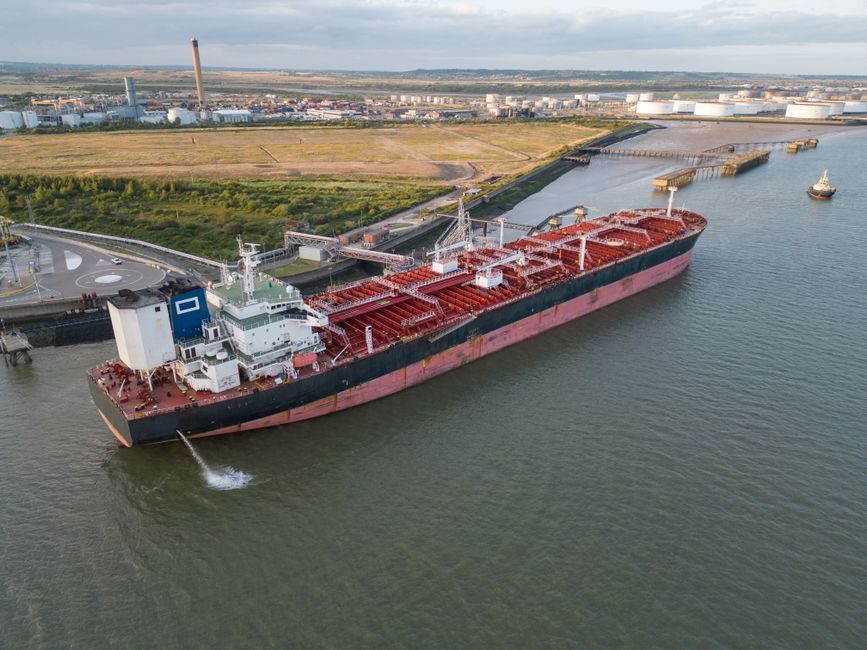
2026 is set to deliver roughly 40.7 million tonnes per year of new LNG liquefaction capacity, the single largest annual tranche in the current cycle and the first year since 2020 in which supply growth systematically outpaces incremental demand [S6].
The capacity wave is not a one-shot event. Cumulatively, 40.7 Mt (2026), 52.65 Mt (2027), 53.24 Mt (2028), 38.6 Mt (2029) and 16.47 Mt (2030) are scheduled to come online, taking the 2026-2030 total to ~202 Mt of incremental nameplate — about a 40% lift versus the 2025 base, at a ~6.8% CAGR [S6]. The "peak loose balance" the trade has been modelling for 2026 has now slipped to 2027-2028 because of deferrals at Golden Pass, LNG Canada, Costa Azul and the North Field Expansion [S6].
Where the New Trains Are Concentrated: US 46.6%, Qatar 23.8%, Canada 7.6%
Five countries account for the structural shape of the 2026-2030 cycle: US 46.6%, Qatar 23.8%, Canada 7.6%, UAE 4.8% and Argentina 3.0% of the 202 Mt cumulative add [S6]. That concentration is the single most important sourcing fact for procurement teams — when two countries control ~70% of incremental molecules, shipping routing, charter availability and offtake competition collapse into a North America / Middle East corridor question.
US share of incremental supply at 46.6% is being driven by Corpus Christi Stage 3, Plaquemines Phase 1/2, Rio Grande Phase 1 and the first Golden Pass units, all of which are sized for flexible Henry Hub-linked indexation [S6]. Qatar's 23.8% is the back-end of the North Field Expansion (NFE + NFS) tied to long-term Asian and European SPA contracts. Canada's 7.6% is overwhelmingly LNG Canada T1-T2 first cargoes, with T3/T4 upside still uncommitted. UAE (4.8%) is ADNOC's Ruwais LNG (FID 2024, first cargo 2028-2029) and Argentina (3.0%) is the first module of Vaca Muerta FLNG, with the second module still conditional [S6].
For buyers, this means three practical shifts: (1) US Henry Hub-linked DES cargoes become the marginal swing barrel in Atlantic basin price formation; (2) Qatar continues to set the JKM ceiling for long-term indexed contracts; (3) Canadian and Argentinian molecules are largely ex-Atlantic, ex-Pacific molecules that need to clear into Asia to find a marginal home — a useful lever for Asian utilities willing to take non-FOB flexibility.
Demand Side: Why 2026 Is the First Genuinely Loose Year Since 2020
Supply growth in 2026 is being matched by a step-up in demand, but at a lower rate. China, India, Southeast Asia and European re-gas ramp-up are the four absorption pillars, with Europe structurally re-anchored to LNG after the staged Russian pipeline phase-outs [S6].
Pipeline gas's global share is set to keep sliding toward the 40% mark as Russian volumes "retreat west, advance east," pushing the marginal price-setting molecule toward LNG [S6]. Concretely, that means the post-2026 natural gas pricing anchor accelerates its migration from the "Russia-Europe pipeline" complex to a "US LNG + Qatar LNG" duopoly, with JKM, TTF and HH-linked DES increasingly driving the curve [S6].
For industrial offtakers running flow meters on regasified feed gas and pressure transmitters at the vaporizer skid, the price implication is higher volatility around the heating season shoulder months — not a flat 2024-style backwardation. Procurement teams should plan for a wider JKM-TTF spread band in Q4 2026 and Q1 2027 than in any post-2020 winter.
Deferral Risk: Why Peak Loose Balance Slips to 2027-2028

The headline 40.7 Mt/yr for 2026 looks comfortable, but the cycle's "peak loose balance" has been pushed from 2026 to 2027-2028 by slippage on four anchor projects: Golden Pass (US, 18 Mt/yr), LNG Canada T1-T2 (14 Mt/yr), Costa Azul (Mexico, 3.6 Mt/yr) and the North Field Expansion (Qatar, 49 Mt/yr across NFE+NFS) [S6].
The deferrals do not change the 5-year cumulative headline (still ~202 Mt) but they compress 2026's effective incremental supply closer to 35-37 Mt/yr in a high-slippage scenario, which materially changes Q1 2026 vs Q4 2026 spread economics. Procurement should watch three trackable signals: (1) Golden Pass first-cargo timing, currently guided for late 2026; (2) LNG Canada T1 commissioning milestones; (3) Qatar NFE train 4 mechanical completion dates.
Engineering teams specifying regas terminals should expect a delayed-relaxation pattern: a tighter Q1-Q2 2026 followed by measurable loosening Q4 2026 onward as US Gulf Coast cargoes stack into Atlantic basin. For utilities running aging industrial valves on vaporizer skids, this is a high-utilization year — a 2026 maintenance window matters more than it did in 2024.
Contract Structure: Henry Hub, Brent, JKM and the New DES Layer
The 2026 cycle is the first in which the indexation mix decisively tilts away from oil parity. US Henry Hub-linked contracts (HH + liquefaction fee + shipping) make up the majority of new US volumes, while Qatar's new SPA tranches sit closer to JKM-indexed or hybrid structures [S6].
The pricing math is converging on the US side because the 46.6% US share gives US offtakers the strongest negotiating position in the cycle [S6].
European buyers face a different calculus: the staged Russian pipeline phase-out means TTF remains the relevant European marker, and 2026 cargoes are increasingly being booked on a TTF minus shipping structure from the US Gulf. Shipping cost discipline, not just commodity index, is the second-order margin lever for 2026 procurement.
Limitations: Sourcing, Slippage and Demand-Side Uncertainty
Three failure modes are visible in the 2026 base case. First, FID slippage on a 1-2 Mt/yr tranche of US optimization or debottlenecking projects could shift the 2027 number meaningfully. Second, Chinese demand elasticity remains the single largest swing variable — a 5% swing in Chinese offtake moves the global balance by ~20 Mt/yr. Third, European storage policy and renewable build-out pace will determine whether TTF stays anchored to LNG or decouples faster than expected. [S1]
A second limitation is the lack of a transparent 2026 demand-side number in the public base case [S6]. Procurement teams should triangulate demand from IEA Gas 2026 (due Q3 2026), Shell LNG Outlook 2026, and GIIGNL annual report, then build a 35-42 Mt/yr demand increment case against the 40.7 Mt/yr supply increment. The forward curve tells you the market is pricing the upper half of that range.
Third, the 2026 cycle inherits a tight floating storage and LNG carrier orderbook. Even with the newbuild wave, available tonnage in Q4 2026 is structurally tight because the US Gulf export step-up hits before the newbuild deliveries cluster in 2027. Expect Atlantic-to-Pacific shipping spreads to remain elevated through 2026.
Standards and Sourcing Anchors for the 2026 Buy
For pressure transmitter and flow meter specifiers working on regasification, vaporizer and BoG compressor skids, the 2026 baseline equipment envelope is unchanged: low-temperature carbon steel (LTCS) for LNG service piping per ASME B31.3, austenitic stainless for cold-box internals, and ISO 5208 / API 6D for the industrial valve gate and ball trim on cryogenic service. No new LNG-specific standard is being introduced in 2026 per the research base. [S2]
On the PLC and servo motor side for terminal loading arms and cryogenic pumps, ATEX/IECEx zone classification on the jetty and BOG compressor area remains the binding spec, and the 2026 sourcing cycle does not change the certification envelope. Process engineers should expect long-lead items (cryogenic reciprocating compressors, large-bore cryogenic ball valves) to remain 18-24 month items into 2026 because the 2026 LNG capacity wave is competing with 2026 petrochemical restart demand for the same forging slots.
For a deeper read on the 2026 industrial sourcing map, this electric motor upstream and downstream 2026 cost map is the most relevant cross-reference for terminal auxiliaries, and this industrial coating 2026 price guide is useful for tank and pipe-coating procurement inside the LNG import terminal envelope.
Track three signals into H2 2026: (1) whether Golden Pass first cargo lands in Q4 2026 or slips into Q1 2027 — that single event re-prices the entire Q1 2027 JKM-TTF spread band; (2) whether Qatar NFE trains 1-3 hit nameplate on schedule, which determines whether the 2027 peak loose balance is shallow or deep; (3) Chinese offtake prints in Q1 2026, which will set the marginal demand tone for the rest of the year.