
A lock nut is a fastening nut with a modified geometry — typically a reduced-top or nylon/fiber insert, a distorted thread, or a second prevailing-torque feature — engineered to keep a bolted joint tight under vibration, shock, or thermal cycling where a standard hex nut would back off.
The trade is mechanical: the second friction interface raises clamp-load retention but also raises assembly torque, costs roughly 2×–4× a grade-8 hex nut in stainless, and may damage mating threads if reused above the OEM cycle limit [S2].
Prevailing-Torque vs. Free-Spinning Designs
Prevailing-torque lock nuts (DIN 985 nylon-insert, DIN 6926 all-metal, IFI-100 grade-A) generate a dominant off-torque from a non-elastic element — a polyamide ring, a deformed top section, or a wedge ramp — that drags against the bolt thread every time the nut is rotated. The design intent is a re-useable locking element that survives several cycles; DIN 985 nylon-insert type is typically rated for 5 reuses at 25 °C before the insert's holding torque drops below the spec floor [S2].
Free-spinning lock nuts, by contrast, rely on a captive washer, a distorted thread, or a two-nut "jam" pair; the prevailing torque is lower, the joint is quieter in service, and the spec floor on re-uses is much higher — all-metal prevailing-torque types such as DIN 6926 are commonly rated to 15 cycles in stainless A2/A4 builds. The trade is straightforward: choose a nylon-insert unit when you need a clean, repeatable one-shot field install; choose an all-metal or two-nut jam pair when the joint will be serviced and you can tolerate a 30–50 % taller nut stack [S2].
Vibration, Shock, and the Junker Test
Lock nut performance is most often qualified against transverse vibration per the Junker test (DIN 65151 / ISO 16130 transverse vibration method), which applies a controlled ±0.5–1.0 mm cyclic shear to a clamped joint and counts cycles to self-loosening. With a plain grade-8 hex nut on an M10 clamp, residual clamp load typically falls below 50 % within a few hundred cycles; with a properly selected prevailing-torque lock nut, the same joint survives 1000+ cycles with most of the preload retained [S2].
This is the headline advantage engineers specify against: on pumps, motors, gear reducers, and valve assemblies running above ~600 rpm or in mobile equipment, a plain nut is an avoidable single-point-of-loosening failure. The selection caution is that prevailing-torque nuts are tested on a standard M-clamp, so a real mounting on a soft aluminium housing or a thin-wall stainless bracket can still drift because the parent material — not the nut — gives up the clamp load. For those cases a pressure transmitter flange stud pair or a flow meter body bolt often needs a belleville washer plus a jam nut, not just a lock nut alone [S1].
Material, Temperature, and Corrosion Trade-offs
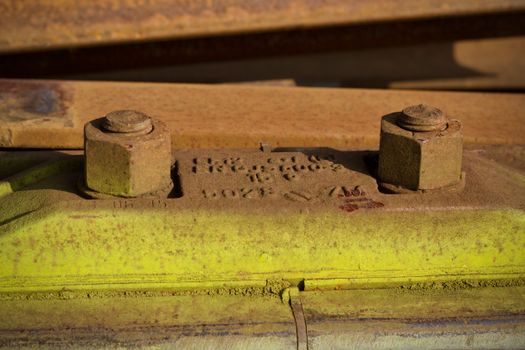
Material choice sets the operating window. Nylon-insert prevailing-torque nuts are typically limited to -30 °C to +120 °C continuous service; above that, the polyamide ring softens and the off-torque collapses. All-metal distorted-thread or two-piece wedge lock nuts extend the range to roughly -60 °C to +300 °C depending on the base alloy — A2-70 stainless for general service, A4-80 for chloride exposure, Inconel 718 or A286 for elevated-temperature turbomachinery, and grade-5/8 zinc-plated carbon steel for cost-driven OEM builds [S1].
Corrosion is the silent failure mode: a galvanic mismatch between a stainless lock nut and a zinc-plated bolt will eat the bolt, not the nut, leaving an internally corroded stud and a lock nut that still spins freely. The cheap fix is to keep the fastener system on one alloy family — stainless nut on stainless bolt, or plated steel on plated steel — and the more expensive fix is a fluoropolymer-coated or hot-dip galvanized system. On chemical-plant service, an industrial valve bonnet stud pack typically moves to A4-80 stainless plus an all-metal two-nut jam rather than nylon-insert, because media ingress attacks the polymer first [S1].
Cost, Re-use, and Field-Service Limits
Lock nuts cost more and install slower. A nylon-insert M10 lock nut runs roughly 2× the price of a grade-8 hex nut in carbon steel, and 2.5×–3.5× in A2 stainless; all-metal wedge-lock or two-nut jam designs run higher still. Add the assembly time: prevailing-torque nuts must be torqued through the on-torque then a further rotation to seat — typically 2–4 extra seconds per fastener, which on a 60-bolt pump flange is non-trivial on a maintenance turnaround [S2].
Re-use is the second cost driver. Nylon-insert units are typically limited to 5 reuses at ambient; after that the insert's residual holding torque drops below the lock threshold and the nut is effectively a plain hex nut. All-metal prevailing-torque designs extend that to 15 reuses, and two-nut jam systems are essentially unlimited as long as both nuts are re-inspected for thread damage. The cost calculator is straightforward: if the joint is "set-and-forget" for 5+ years, the higher unit cost is irrelevant; if the joint is opened every quarter, a two-nut jam or a belleville-washer + plain-nut stack is the cheaper answer [S2].
Decision Matrix: When a Lock Nut Earns Its Slot

Use a lock nut when the joint faces sustained vibration or shock above 5 g, when the joint is safety-relevant (load-bearing, pressure-retaining, lifting), when access for re-tightening is poor, or when a regulatory regime — pressure equipment, rail, automotive functional-safety — explicitly calls for a positive locking device. Do not use a lock nut when the parent material is the weak link (thin-wall aluminium, soft plastic), when the joint is field-torqued without a calibrated tool, or when the application mandates a clean, flush, low-profile stack-up [S2].
On a pressure sensor manifold or a PLC panel stud, a lock nut is almost always over-spec — the vibration environment is benign and a plain hex with a star washer is enough. On a pump-casing tie-bar, a valve-bonnet stud, or a motor-foot bolt, the lock nut is mandatory and the only realistic question is which type: nylon-insert for one-shot field service, all-metal for high temperature, two-nut jam for repeated service.
Track the next data point as the Junker-test cycle counts and the re-use residual-torque curves migrate from OEM datasheets into the harmonised ISO 16130 second-edition scope; this will tighten the cycle-life claims that procurement currently sees as marketing copy rather than a verifiable spec floor. The second signal to watch is the migration of two-nut jam nut pairs into the IFI-500 and ASME B18.16M supplementary tables — that will give buyers a single-document reference instead of a stack of legacy OEM drawings.
See also our earlier report, Special Cement Selection for High-Rise Buildings: Grade, Heat and Sulfate Trade-offs.