A modern lost foam casting line is best judged by four coupled specifications: pre-expanded bead density, refractory coating viscosity and dry-film weight, negative-pressure sealing in the sand flask, and shake-out/cooling throughput matched to pour weight. The process — where a polymeric foam pattern is coated, embedded in unbonded sand under vacuum, and replaced by molten metal — is documented as a near-net-shape route for low-carbon steel, ductile iron, and complex iron housings, with peer-reviewed work on carbon contamination and defect mitigation appearing in China Foundry (2018-09) [S3].
Selection is a capital decision, not a catalog choice: the line must keep CO₂/carbon pickup inside the steel-grade window, hold pattern geometry to ±1.0-1.5 mm across the flask, and cycle fast enough that the automatic molding line feeding it is not the bottleneck. Chinese suppliers — including Ningbo Tongda with 17 years of casting experience and ISO 9001 / IATF 16949 certification — continue to lead the OEM side of lost foam and lost-wax supply chains as of 2026-06 [S4].
Foam Pattern Density and Bead Selection
Pattern density is the single largest handle on carbon pickup in lost foam castings. Expanded polystyrene (EPS) is the dominant pattern material, with typical pre-expanded bead densities quoted in the 0.015-0.025 g/cm³ range for steel and iron pours; the China Foundry study (2018-09) used four foam variants to quantify how bead chemistry drives carbon contamination in low-carbon steel, ranking denser foams and higher-purity EPS grades as lower-defect [S3].
Foundries pouring ductile iron frequently specify STMMA copolymer resin patterns rather than plain EPS, with Castchem — founded 1999 — positioning itself as the pioneering manufacturer of STMMA copolymer resin for direct-pour ductile iron, claiming lower residual carbon and cleaner ferrite/pearlite structure versus conventional EPS [S2]. The trade-off is per-pattern cost: STMMA is typically 2-4× EPS by mass, so it is justified only where defect scrap on critical ductile-iron nodes outweighs pattern spend.
For carbon steel and low-alloy pours, pattern density below ~0.020 g/cm³ tends to increase lustrous-carbon and slag-inclusion risk; densities at the upper end (0.022-0.025 g/cm³) improve dimensional stability during coating and drying but raise gas evolution per cubic centimetre, so vacuum and venting have to be sized accordingly. Pattern shrinkage compensation is usually set in the 0.2-0.4% range for EPS, applied in the tooling stage rather than at the line.
Refractory Coating: Viscosity, Solids and Dry-Film Weight
Refractory coating is the gate between a clean casting and a slag-inclusion reject. The China Foundry paper (2018-09) explicitly uses refractory coating thickness and composition as a controlled variable in its carbon-contamination matrix for low-carbon steel lost foam work [S3], and industry guidance on lost-foam iron highlights coating uniformity as the first lever in microscopic-slag-inclusion preventive measures (2026-04) [S5].
Working viscosity for a lost-foam coating is typically 25-45 seconds on a #4 Zahn cup at 25 °C, with solids content in the 55-65% range for water-based refractory slurries using mullite, alumina, or fused-silica fillers. Dry-film weight on the foam surface usually lands at 0.8-1.6 kg/m² of pattern area; below ~0.7 kg/m², micro-inclusions rise sharply, and above ~1.8 kg/m², gas permeability of the coating drops and defects shift from slag to gas porosity.
Drying is a separate specification, not a footnote. Foam patterns are typically dried in forced-air ovens at 45-55 °C for 6-10 hours, with humidity kept below 30% RH in the final two hours to drive off bound water. Foundries that shortcut drying on thick-wall sections tend to see steam blows at pouring — a defect that is more expensive to diagnose than the oven fuel saved by rushing the cycle.
Vacuum System, Sand Flask and Negative-Pressure Holding
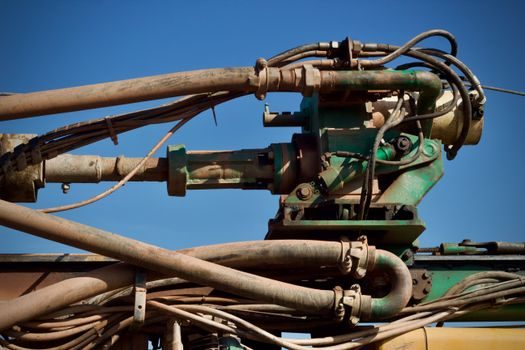
Vacuum is what makes lost foam a usable process at production rates, not just a laboratory curiosity. The sand flask must hold negative pressure in the -0.04 to -0.06 MPa window (roughly -300 to -460 mmHg) from the moment the coated pattern is buried in resin-sand line-style unbonded silica sand until solidification is complete. Loss of vacuum mid-pour is the most common root cause of collapsed sections and veining defects. [S1]
Dry, sharp silica sand (AFS 50-70) is the standard media; fines above 3% on a 200-mesh screen collapse permeability and force the operator to push vacuum harder than the pump can sustain.
Modern lines integrate the vacuum table with vibration compaction (typically 30-50 Hz, 0.5-1.2 g amplitude) so the sand consolidates around the pattern before pouring. Lines that omit the vibration stage routinely get skin defects on the cope surface — a problem that looks like sand burn but is actually unbonded sand that was never packed against the coating.
Pouring, Shake-Out and Sand Reclamation
Pouring temperature and cooling rate are grade-driven rather than line-driven, but they set the throughput the line must absorb. Ductile iron on a lost foam line is commonly poured at 1380-1450 °C with a carbon equivalent of 4.2-4.5%; low-carbon steel sits at 1600-1650 °C with tighter deoxidation practice to manage residual oxygen from foam pyrolysis [S3]. The pour rate (kg/s) has to be matched to foam decomposition kinetics — too slow and the foam collapses ahead of the metal front, too fast and gas pressure overruns the coating.
Shake-out and sand cooling on a conveyor sorting line-integrated lost foam cell is where the real throughput constraint lives. Burned sand after pouring sits at 200-400 °C and must be cooled below 60 °C before it re-enters the flask; the simplest plants use ambient air on a vibrating cooler, which limits a single flask to roughly 8-12 cycles per shift on heavy iron pours. Plants targeting 20+ cycles/shift install a fluidized-bed cooler or water-mist quench with baghouse dust control, accepting a small moisture penalty that has to be re-evaporated on the next cycle.
Sand reclamation on a lost foam line is mechanically simpler than on a chemically bonded system — the sand is unbonded, so classification and dedusting are the main steps, not thermal attrition. Magnetic separation plus a vibrating screen at 16-20 mesh removes tramp metal and foam fragments, and a thermal reclaimer is usually uneconomic below ~30 t/day throughput. Foundries below that volume typically run a 20-30% sand makeup rate and accept the landfill cost.
Selection Criteria Compared: Manual, Semi-Automatic, Fully Automatic

For buyers comparing three common line configurations, the decision comes down to four criteria: pour-weight envelope, dimensional tolerance, cycle time, and per-piece labour hours. A manual flask-and-bench cell suits prototyping and parts under ~50 kg; a semi-automatic line with pattern dipping robots and PLC-controlled vacuum covers the 50-500 kg bracket that dominates Chinese OEM ductile-iron housing work [S4]; a fully automatic line with a molding line interface and conveyorized cooling covers automotive structural castings above 500 kg and is the only configuration that can hold ±0.8 mm repeatability on a 24/7 schedule.
Manual cells cap at 15-25 castings per shift with 2-3 operators and tolerate pattern variation poorly. Semi-automatic cells reach 60-100 castings per shift with the same headcount and add dipping-robotic consistency, which is the single largest driver of coating-weight uniformity. Fully automatic cells reach 150-250 castings per shift, but require the upstream pattern shop to deliver dimensionally identical foam — if pattern variability is more than ±0.5 mm on critical features, the line's metrology advantage disappears.
Capex bands move with this: a manual cell for iron pours under 100 kg typically lands at USD 80,000-180,000 turnkey, semi-automatic at USD 250,000-600,000, and a fully automatic line interfacing with an automatic molding line and shake-out at USD 800,000-2,000,000 depending on flask size, pour-weight crane rating, and sand-handling capacity. Buyers should also budget 8-15% of capex for installation, dust collection, and the first 12 months of pattern tooling, which is a cost line that is easy to underestimate on a line where the foam itself is a consumable.
Standards, Defects, and What to Verify in the FAT
There is no single ISO or ASTM standard that governs a lost foam line end-to-end; instead, a buyer ties the line to the casting-grade standard (e.g. ISO 1083 for ductile iron, ASTM A27 for carbon steel) and to the OEM quality-management scheme (ISO 9001, IATF 16949) that the foundry already runs [S4]. The relevant defect taxonomy is internal: lustrous carbon, micro-slag inclusions, subsurface porosity, and veining — each tied to a specific process variable rather than to the line as a whole.
The factory acceptance test should quantify four numbers, not just visual acceptance: (1) vacuum holding pressure decay over 60 s with the flask loaded, (2) dry coating weight uniformity across at least ten sample points per pattern, (3) pour-weight repeatability across 30 consecutive cycles, and (4) shake-out temperature profile and sand-cooling time. A supplier that cannot produce those four numbers from a recent FAT should be treated as unproven, regardless of catalogue experience.
Useful cross-references for buyers also looking at adjacent capital decisions include this automatic molding line cost guide for 2026, which covers the upstream flask-and-sand equipment the lost foam line has to interface with, and the static pressure molding machine cost guide for the alternative green-sand path that some foundries run alongside lost foam for non-geometry-critical work.
Trackable signals to watch: STMMA copolymer resin adoption in Chinese ductile-iron OEM work (Castchem and a small number of domestic competitors), and the migration of 200-500 kg housing work from manual cells to semi-automatic cells with robotic dipping — both of which will move per-piece labour and reject rates in measurable ways over the next 12-18 months [S2][S4].