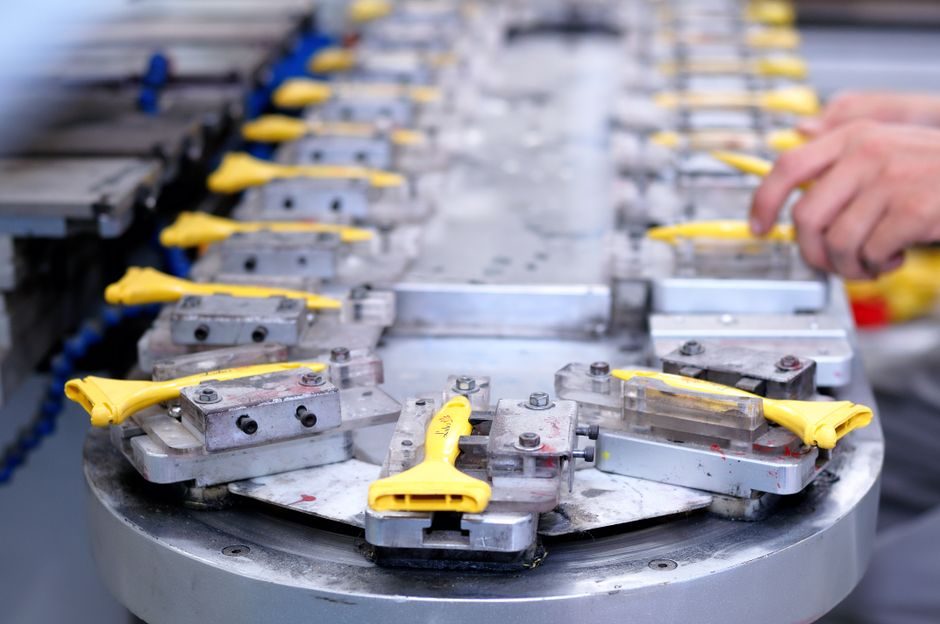
The 2026-06 wholesale OEM catalog of Shandong Hq Precision Technology still defines the segment by five machine families — CNC lathes, CNC machining centres (VMC650/850/1160/1370), EDM, drilling machines and power presses — with 3- to 5-axis vertical machining centres listed at US$18,000–40,000 per piece FOB China [S5]. On the assembly side, Sharp Industries of California continues to ship manual knee-type mills, bed-type mills and vertical/horizontal mills alongside CNC product lines from the same plant footprint, confirming that the manual-plus-CNC mix is still the default for small-batch North American job shops [S1].
Tool-condition monitoring, in turn, is now treated as part of the manufacturing process rather than an aftermarket add-on: ScienceDirect's overview of end-milling tool monitoring — covering acoustic emission, spindle current, vibration and force signatures — is the most-cited process reference for detecting tool wear and breakage during milling, and it sets the baseline for what a 2026 cell must instrument [S4]. The shape of the process flow that follows is anchored on those two anchors: a physical build chain (castings → guideways → spindle → assembly → geometric acceptance) and a digital/control chain (CAM → NC code → servo loop → in-process monitoring).
Stage 1 — Cast iron, steel forgings and weldments: how the machine frame is actually made
A machine tool's static stiffness, damping and thermal stability are set by the bed, column, saddle and slide; the standard route is still grey or ductile cast iron (commonly EN-GJL-250 / GG25 / FC250 class, with pearlitic matrix and flake or nodular graphite) stress-relieved before machining, because cast iron damps vibration roughly 6–10× better than welded steel of equivalent stiffness and costs less to rough-machine at the 500–6,000 kg bed scale typical of a 650 mm VMC [S3][S5]. Welded steel fabrications show up in larger frames (gantry mills, press columns) where the casting tooling cost is uneconomic; in both cases the supplier controls carbon content, cooling rate and a stress-relief cycle (typically 550–600 °C soak on castings) before any datum face is cut, otherwise the machine will walk geometrically within the first 6–12 months of service [S3].
For high-speed spindles and ball-screw nuts, the route shifts to alloy steels (e.g. 40Cr, 20CrMnTi case-hardened to 58–62 HRC for gears; SUJ2 / 100Cr6 for bearing races), and the heat-treatment sequence — normalize → quench → temper → sub-zero → temper — is what ultimately limits spindle speed and rated load. The same Shandong Hq VMC datasheet quoted in 2026-06 lists a maximum machining diameter of Φ420 mm on a 550 mm-class lathe, which only holds if the spindle bearing preload, thermal growth budget (typically ≤ 10 µm at the tool point over a 8 K warm-up) and slide flatness are all in spec [S5].
Stage 2 — Rough and finish machining of structural parts
Once castings are stress-relieved, the build sequence is fixed: rough-mill the foot pads and main datum, semi-finish the slide ways, finish-grind or hand-scrap the contact surfaces, then mate sub-assemblies. Traditional builders still hand-scrape guideways (16–25 points per 25×25 mm, surface roughness Ra ≤ 0.4 µm on precision slides) for ultra-precision surfaces; volume builders have moved to linear roller or linear guide packs (e.g. 35 / 45 / 55 mm rail widths on 3-axis VMCs), which trade a small amount of damping for faster assembly, lower scrap rate and predictable friction coefficients below 0.005 [S1][S5].
Tool-steel choice for the cutting tools that machine the castings matters just as much as the casting choice; the same family of tool and die steels that holds a milling-cutter geometry also limits spindle power draw and surface finish on the part. The 2026-06 Alibaba supplier profile for Nantong Lecroy Machine Tool shows the same basic OEM/ODM split — the Chinese mid-tier plant supplies cast-and-assemble frames, gear boxes and spindles to brand customers rather than selling the finished CNC under its own name [S2].
Stage 3 — Spindle, drives and the assembly line
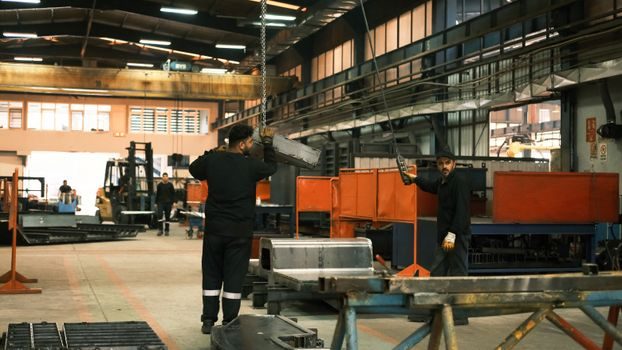
The spindle sub-assembly is the most tightly specified core machine node in the build: preloaded angular-contact or cylindrical-roller bearings (commonly 7014 / 7016 AC series, ABEC-5 or P4 class), a motor coupling (belt-drive, gear-drive or direct-drive depending on speed band — direct-drive dominates below 12,000 rpm, built-in motor spindles dominate 12,000–40,000 rpm, and high-frequency spindles with HSK or HSK-style taper go above 40,000 rpm), and a drawbar or hydraulic tool-clamper (typically 8–25 kN drawbar force at the taper). The 2026-06 OEM datasheets for VMC650/850/1160/1370 platforms all quote a 8000–12000 rpm mechanical spindle as standard and a 20,000–24,000 rpm direct-drive spindle as the upgrade option, with the larger 1160/1370 frames also accepting a through-coolant 30-bar spindle for aluminium aerospace work [S5].
Drive and control assembly is now the longest section of the build. A 3-axis VMC integrates three servo motors (typically 7.5–22 kW for the spindle, 1.8–3 kW per axis for X/Y/Z feeds), a 3-axis or 4-axis CNC controller (FANUC, Siemens SINUMERIK, Mitsubishi M80/M800, or a domestic equivalent), ball screws (C3 / C5 grade, 32–50 mm OD), and a lubrication / coolant manifold. Sharp Industries' 2026 product tree still positions manual mills and lathes as the entry node and CNC mills, lathes and machining centres as the higher-ASP node, but the assembly hall layout is the same: a sub-assembly line (spindle unit, ATC magazine, ATC arm), a main-assembly line (column on bed, saddle, headstock) and a final test bay [S1]. The automation that drives CAM-side output in those cells is increasingly an additive and subtractive hybrid workflow where the same machine deposits near-net-shape and finishes critical features, and the post-processing cell follows the same dispatch logic as a CNC cell — fixture ID, NC program, in-process inspection.
Stage 4 — Geometric acceptance test, test-cut and CE/UL sign-off
Every machine tool leaves the line with three acceptance layers: a geometric test to ISO 230-2 or VDI 3441 (positioning accuracy, repeatability, straightness, squareness, rotary axis tilt), a test cut on a defined specimen (typically a 45 ° slant, a circle, a face-mill step, and a bored hole) to confirm contouring accuracy, surface finish and spindle health, and a safety / EMC sign-off for the destination market (CE Machinery Directive 2006/42/EC plus EN 60204-1 for the EU, UL 2011 / NFPA 79 for the US, GB 17120 for China). Builders commonly quote positioning accuracy of ±0.005 mm and repeatability of ±0.003 mm on 3-axis VMCs over full travel; the same datasheets quote a rapid traverse of 36 m/min and a cutting feed of 10 m/min, both of which are verified during the test-cut window [S5].
The acceptance test is also where the tool-condition monitoring stack is first calibrated: each spindle, ATC and pallet changer is run through a burn-in cycle, vibration and current baselines are captured, and the resulting threshold table is shipped to the customer. From a builder's standpoint, this is the gate that decides whether the machine gets a serial plate and a packing list or goes back for rework; missed datum-flatness, out-of-tolerance ball-screw preload or a noisy ATC are the three most common reasons a VMC fails its own acceptance test and is rerouted into the rework loop [S3][S4].
Stage 5 — In-process monitoring: the four sensing modalities that actually work
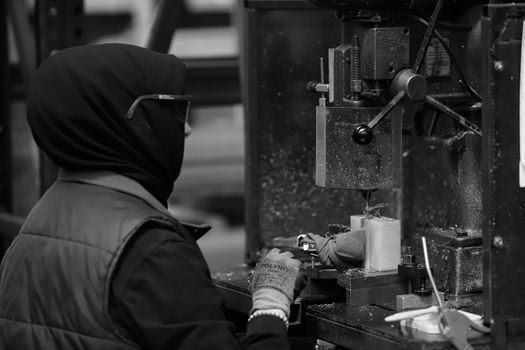
Prickett & Johns' review of end-milling tool monitoring — the reference work that the 2026 process-engineering community still cites — groups the practical approaches into four sensing channels: spindle motor current (cheap, indirect, slow), vibration / accelerometer on the spindle housing (kHz-band, catches chipping and insert loss), acoustic emission (100 kHz–1 MHz, catches flank wear and rubbing), and cutting force (dynamometer, ground-truth, expensive). For a typical cell on a VMC650 platform, the practical stack is vibration + spindle current for breakage detection and AE for progressive wear, with the AE threshold set against a clean reference cut at the same tool, material and DOC [S4].
That monitoring loop now feeds back into the same MES / SCADA layer that the broader smart-manufacturing cell architecture uses for PV and battery lines, and the in-process data is correlated with the same vision and laser-inspection nodes that decide pass/fail. For a 2026 builder, the practical move is to spec vibration and current on every new VMC, reserve AE for finishing cells and grinding, and route all sensor streams to the same OPC-UA / MQTT broker that the rest of the plant already runs — not to a proprietary vendor stack.
Comparison: which machine family fits which job
The 2026-06 OEM catalog maps cleanly onto four decision axes — typical part envelope, lot size, material hardness, and surface-finish target — and a 3-axis VMC, a CNC lathe, a 5-axis machining centre, a wire EDM and a power press occupy distinct slots [S1][S5]. A 3-axis VMC (VMC650/850) handles prismatic parts in aluminium, mild steel and cast iron up to ~1,000 × 550 × 500 mm in lot sizes of 1–500; a CNC lathe (RA-550MY class, Φ420–580 mm swing) covers rotational parts in the same materials and lot sizes; a 5-axis VMC (1160/1370) extends the envelope and the geometry mix at roughly 2–3× the price; a wire EDM (typically 0.25–0.005 mm kerf, surface Ra ≤ 0.2 µm) handles hardened tool-steel dies and aerospace ribs that the mills cannot finish in one setup; a power press (45–2,000 ton) covers sheet-metal forming that is fundamentally a different process, not a finishing step. Tool-condition monitoring stacks scale the same way: current-only on a lathe, vibration + current on a VMC, AE on EDM and grinding [S4][S5].
Limits, failure modes and what the 2026 process map still doesn't solve
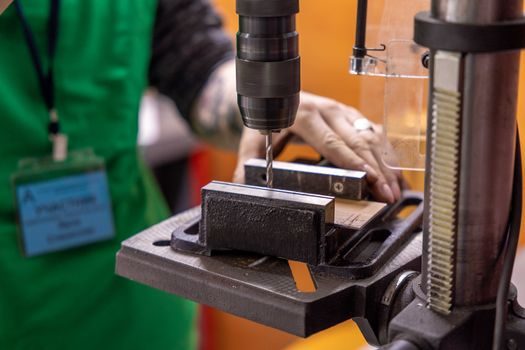
The physical build chain has not changed in its bones, but two failure modes have hardened into spec-sheet issues that the buyer must police: thermal drift on long production runs (typical budget ≤ 10 µm at the tool point over 8 K of warm-up, exceeded in many low-end VMCs) and ATC reliability (mean cycles between failure commonly quoted at 1–2 million for a production magazine, far below that on cheap castings). The 2026 OEM datasheets still under-specify ATC MTBF, drawbar force, lubrication intervals and the actual geometric test report that ships with each serial number, so a buyer's audit has to read the test-cut plate, not the catalogue [S5].
The control chain, by contrast, has shifted: open-architecture controllers (FANUC Series 0i / 31i, Siemens ONE, open CNC stacks on Linux + EtherCAT) are now the default, and a builder's cost of supporting MTConnect, OPC-UA and a vendor-agnostic monitoring stack is lower than it was in 2022. The remaining gaps are the same ones that any machine-builder spec cut highlights — safety-PLC integration, motion-controller selection, and the choice between a Safety PLC and a dedicated motion safety module — and they belong to the cell-level design, not the machine-level build.
For buyers scoping 2026 capacity, the practical next node is the spindle/bearing MTBF and the geometric-test report from the OEM, not the brochure-level rapid-traverse number; the second is whether the machine will accept a 30-bar through-coolant spindle and a probe + tool-length-offset workflow from day one, which determines whether the cell can later be retrofitted for unattended lights-out operation. The Shandong Hq VMC catalog and the Sharp Industries product tree are the two reference data sets to pin both gates against on 2026-06-28 [S1][S5].