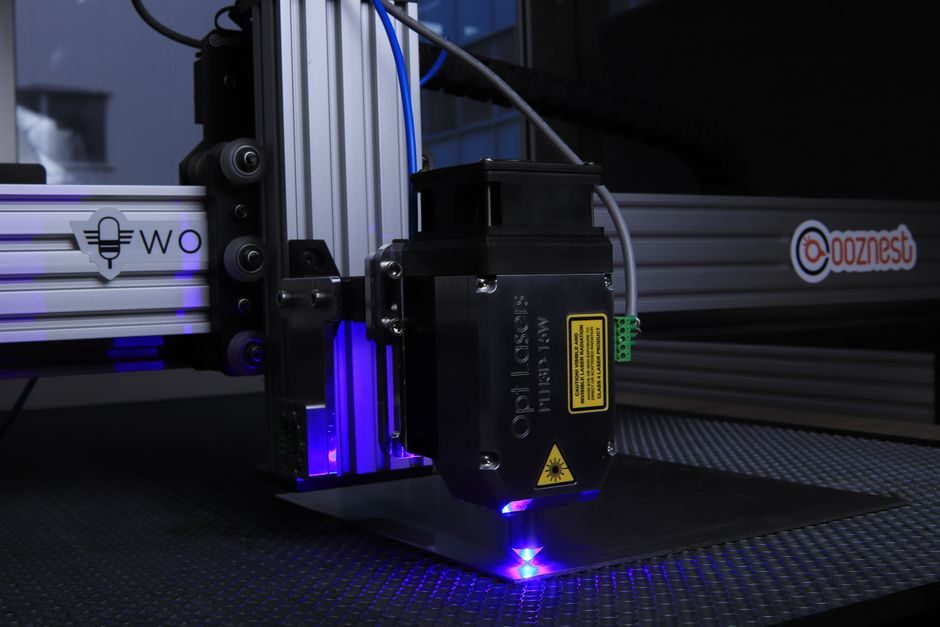
Machine vision in a smart-manufacturing cell is no longer a stand-alone inspection station — it is a layered stack of 2D smart cameras, 3D point-cloud sensors, industrial PCs, and AR/SCADA software that feeds closed-loop control back to the line [S2]. A 2023 peer-reviewed study demonstrated that a markerless AR + machine-vision pipeline can identify plant devices and stream their state into a National Instruments LabVIEW SCADA model without altering either the AR app or the SCADA, provided the data array indices match [S1].
Documented field outcomes back the architecture: a snack-factory deployment of a manufacturing digitalization platform produced a 6% lift in Overall Equipment Effectiveness (OEE), while Indonesian state fertilizer producer Petrokimia Gresik closed an employee skill gap in six months by rolling out 64 AR/VR training modules [S2]. These are the same building blocks — image acquisition, model inference, and human-machine visualisation — that show up on any machine vision system reference design sheet.
2D vs 3D Vision: Spec Trade-Offs for Cell Builders
2D area-scan cameras remain the default for presence/absence, barcode and OCR checks on conveyors, where frame rate, shutter type and lens mount dominate the BOM; they pair naturally with a smart camera form factor that bakes lighting, lens and inference into a single IP67 block. 3D cameras — structured-light, laser-line, or time-of-flight — are specified when the application needs a complete point cloud of the part, not a flat silhouette. [S1]
Zivid, a 3D-camera vendor, lists four failure modes it designs around: incomplete point clouds on densely stacked parts, specular reflection on shiny metal, occlusions in bin picking, and slow cycle times on welding cells [S3]. Its product line spans the Zivid 2+ Classic, the Zivid 2+ R-series, and the Zivid 3, with Zivid Motion and the Zivid SDK handling hand-eye calibration and path planning [S3]. Buyers comparing 2D against 3D should score four criteria side by side: cycle-time budget (typical 2D inspection: sub-100 ms; structured-light 3D: 0.3–2 s per capture), tolerance to reflective or dark surfaces, the six degrees-of-freedom pose the downstream robot actually needs, and per-station cost — a 2D smart camera commonly lands at one-third to one-half the price of an industrial 3D unit.
AR + Vision + SCADA: Closing the Loop Without Re-Engineering
The Springer / Augmented Human Research paper proves the integration point: a machine-vision detector (trained on plant-device imagery) feeds bounding boxes and class labels into an AR overlay, and a parallel data channel pushes the same state vector into a LabVIEW SCADA via array index, leaving both applications unmodified as long as the index scheme is agreed up front [S1]. That condition — index compatibility — is the single most common reason a vision+SCADA PoC stalls, because tag databases on brownfield sites use plant-specific numbering.
For a cell retrofit, the practical recipe is: (1) fix the SCADA tag dictionary and array index first, (2) build the vision model against a frozen output schema, (3) wire the AR layer as a read-only consumer of the same array [S1]. The same pattern shows up in the vision measuring machine class, where non-contact optical measurement replaces touch probes and the resulting coordinates flow to the same MES/SCADA stack that traditional CMMs fed.
Where It Pays: Documented 2025–2026 Use Cases
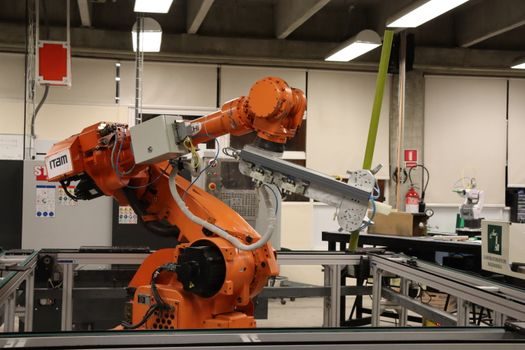
Indonesian integrator Machine Vision Indonesia publishes three reference deployments on its Industry-4.0 platform: a snack-factory line that improved OEE by 6% after digital data collection on the shop floor; a global nutrition company that reports "billions every month" in savings from an Energy Monitoring System; and Petrokimia Gresik, which built 64 AR/VR modules in six months to close its workforce skill gap [S2]. These are not isolated pilots — they are repeatable patterns: vision + AR for training, vision + data platform for OEE, and energy monitoring as a side-product of the same sensor fabric.
On the robotics side, 3D vision is now routinely specified for nine discrete manufacturing tasks: assembly, bin picking, depalletization, inspection, machine tending, parcel induction, piece picking, surface finishing, and welding [S3]. Bin picking and depalletization are the two that most aggressively fail on incomplete point clouds, because the robot has no a-priori map of what is in the tote [S3]. Specifying engineers should treat point-cloud completeness — not raw camera resolution — as the first acceptance criterion, then validate against a worst-case part mix before sign-off.
Selection Criteria: When to Pick What
Pick 2D smart-camera inspection when the defect is a surface feature, a print, or a label, and the part is presented to the camera in a known pose. Pick 3D structured-light when the robot must grasp, finish, or weld an arbitrarily oriented part, or when the part is dark, shiny, or both — typical industrial 3D cameras publish working-range figures in the 0.3–1.5 m band and point-cloud accuracies in the 0.1–1 mm range. Pick 3D laser-line profilers for in-line scanning of continuous features (weld beads, extruded profiles) where the part moves past the sensor on a conveyor. [S2]
Pick line-scan over area-scan for webs, cylinders, and any object that is longer than the camera's field of view. Pick monochrome over colour unless colour is a true inspection variable, because monochrome sensors typically have 2–4× higher native sensitivity at the same pixel pitch. Skip 3D entirely on the first pass if the defect library is still being built — a 2D system with a good lighting kit and a modern CNN will catch a larger fraction of cosmetic defects per engineering hour, and the machine vision system page in this encyclopedia walks through the component stack to budget for.
Failure Modes and Constraints Buyers Hit in 2026
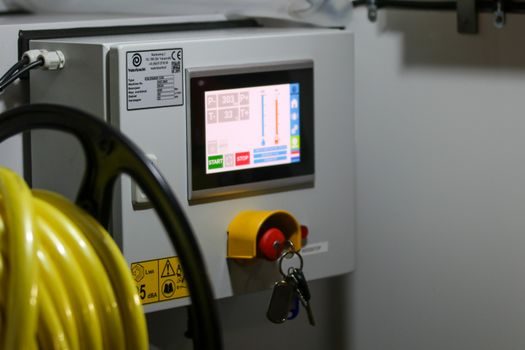
The four most common reasons a 2026 vision cell underperforms are: (1) lighting drift between FAT and SAT, (2) incomplete point clouds on reflective parts, (3) SCADA tag/array mismatch that blocks the closed loop, and (4) operator training gap on the AR/VR interface [S1][S3]. The Petrokimia Gresik case is the counter-evidence: 64 AR/VR modules, six months, and the gap closed [S2]. Budget at least 8–12 weeks for lighting re-tuning and SCADA tag harmonisation on a brownfield retrofit — this is where most PoCs die, not in the algorithm.
Specifying a deterministic Ethernet transport (e.g. GigE Vision, USB3 Vision, or 10 GigE for high-bandwidth 3D streams) and an industrial PC with a GPU matched to the inference workload is now table-stakes. For 3D cells, buyers should also require a point-cloud completeness acceptance test on the actual part mix, not on vendor demo parts — this is the single spec that separates a working bin-pick cell from a permanently-tweaked one [S3].
Standards, Sourcing, and Trackable Signals
No single IEC or ISO standard governs a complete vision cell; instead, a stack of standards applies to its parts — GigE Vision and USB3 Vision for camera transport, OPC UA for the SCADA/MES interface, IEC 61508 for safety-rated vision used in SIL loops, and ISO 13849 for the robot-side guarding. The Cognex "Introduction to Machine Vision" reference, cited inside the AR/SCADA paper, remains a practical entry point for engineers writing cell-level functional specifications [S1].
Two near-term signals to track into the second half of 2026: (1) declining price points on industrial 3D cameras, which push more 2D bin-pick retrofits into 3D; (2) tightening integration between AR-overlay vendors and mainstream SCADA platforms, which removes the array-index hand-off that the Springer paper flagged as the lone source of integration pain [S1]. The wider sourcing map for these components — and how they slot into a 2026 machine vision system cell — is laid out in the Machine Vision System Manufacturing process map. For a parallel read on how vision and AR drive workforce upskilling in adjacent industries, see the NAND flash smart manufacturing 2026 fab automation breakdown.