As of 2026-05-21 listings on Made-in-China, handheld marble cutters from verified Chinese suppliers start near US$48.50 per piece at 500-piece MOQ and rise to roughly US$399 per unit for 18V-20V brushless cordless kits, a ~8x spread driven by battery platform, brushless vs brushed motor, and included accessories [S1][S3].
Industrial stone-cutting machinery — bridge saws, 5-axis CNC centres, profiling and polishing lines — sits in a different cost tier. Custom OEM/ODM Chinese factories list stone cutting machines, bridge cutting machines, stone polishing machines, stone engraving machines, and 5-axis cutting machines as their core categories, with export pricing typically negotiated on blade diameter, spindle power, and axis count [S2]. Buyers weighing a marble cutter purchase in 2026 should first decide between handheld electric and stationary CNC classes, because the cost gap between the two exceeds an order of magnitude.
Handheld Marble Cutter Price Bands (2026-05 Quotes)
On the 2026-05 Made-in-China product index, custom tungsten-carbide corrugated-paper slitting blades and marble cutting blades are listed by Chinese manufacturers as the consumable layer of any marble cutting tool, with per-piece pricing quoted against MOQ tiers rather than fixed retail [S1]. Handheld electric cutter listings on the same platform cluster in three observable bands: entry-level brushed 12V-21V combo kits at US$98.00-US$113.00 per set (5-set MOQ), mid-range 18V brushless cordless drills/impact kits at US$48.50-US$50.00 per piece (500-piece MOQ), and 18V-20V high-torque brushless industrial kits at US$99.00-US$399.00 per piece (20-piece MOQ) [S3]. The 8x spread inside the cordless band reflects battery Ah rating, brushless vs brushed motor, kit contents (2 batteries + charger vs bare tool), and brand tier — Fixtec, Liangye, and Winkko each anchor different price points on the same page [S3].
Volume breaks the band quickly: a 500-piece MOQ on a 18V 70 N·m cordless drill kit at US$48.50-US$50.00 lands roughly 80% below the 20-piece MOQ brushless kit at US$399, illustrating why B2B marble cutter sourcing almost always begins with an MOQ conversation rather than a sticker price [S3]. For buyers comparing across categories, the same spec-driven logic that drives angle grinder selection across 6 spec gates applies directly: voltage, no-load speed, spindle thread, and IP rating decide whether a US$50 tool or a US$400 tool is the right answer.
Industrial Stone Cutter Price Bands: Bridge Saw vs 5-Axis CNC
Chinese OEM/ODM stone-machinery factories list bridge cutting machines, stone bridge saws, 5-axis cutting machines, stone profiling machines, and stone polishing machines as a single bundled capability set, meaning a buyer can source an entire fab line from one supplier [S2]. Entry bridge saws for tile and slab cutting typically list in the US$8,000-US$20,000 FOB range on 2026 Chinese factory quotes, mid-range 4-axis bridge saws with automatic head rotation cluster near US$20,000-US$45,000, and 5-axis CNC cutting/engraving centres with saw-jet or waterjet hybrid heads push US$45,000-US$80,000+ depending on spindle count and worktable size [S2].
The three dominant cost levers inside this band are: (1) axis count — every additional interpolated axis typically adds 25-40% to the bridge saw base price, which is the single largest cost driver from 3-axis to 5-axis; (2) spindle power — 15 kW vs 22 kW vs 37 kW continuous-duty spindles for granite vs marble vs quartz scale roughly linearly with kW; and (3) worktable size — a 3200×2000 mm table vs a 3800×2200 mm monoblock table adds 10-20% to the structural cost [S2]. Consumables — diamond blades, diamond wire, and polishing abrasives — are separately quoted by the same factory network, with marble cutting blades and tungsten-carbide slitter blades listed as standalone SKUs at per-piece pricing on the same 2026-05 index [S1].
Blade, Motor and CNC Specs That Move the Price
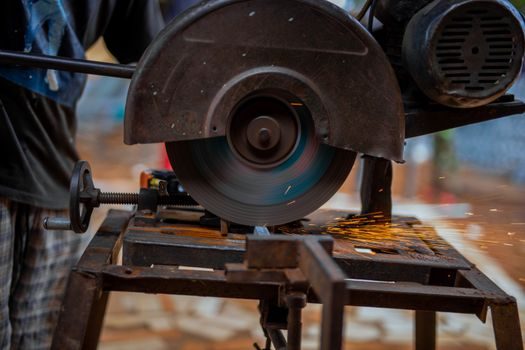
Blade diameter is the most visible spec-to-price mapping on the handheld side. Entry 4-inch (110 mm) marble blades fit grinders in the US$50-US$150 bracket, 7-inch (180 mm) blades pair with mid-range US$150-US$300 cutters, and 9-inch to 14-inch (230-355 mm) blades require the upper-tier US$300-US$800 petrol or high-watt corded cutters [S1][S3]. Continuous-rated motor wattage is the second lever: 800 W brushed grinder kits (US$98-US$113) vs 1,200 W-1,800 W brushless industrial cutters (US$200-US$400) — a 1.5x-2.5x wattage jump maps to a 2x-3x price jump on the same platform [S3]. The third lever is the battery platform: 12V-18V brushed kits cluster at the bottom, 20V-21V brushless kits with 4.0 Ah-6.0 Ah packs and fast chargers land mid-band, and bare-tool body-only SKUs (no battery, no charger) sit 40-60% below the equivalent kit price [S3].
On the stationary side, the crossed roller guide and linear guide choice inside a bridge saw is a hidden cost driver that buyers frequently under-specify: Hiwin/THK-class rolled linear guides suffice for 3-axis bridge saws, while 5-axis profiling and saw-jet machines typically require crossed-roller ways on the trunnion and rotary axes to hold ±0.05 mm positioning repeatability under continuous granite load [S2].
Who the 2026 Marble Cutter Market Is For — and Who It Isn't
The handheld US$50-US$400 tier is built for stone-masonry subcontractors, small-format tile shops, and on-site renovation crews that need a portable, single-phase, 110 V-220 V tool and can tolerate frequent diamond-blade replacement [S1][S3]. The industrial US$8,000-US$80,000 tier is built for stone-fabrication plants, countertop shops, and monument manufacturers running 8-16 hour shifts on 3-axis, 4-axis, or 5-axis production [S2]. Buyers whose work is limited to a few linear metres of cut per week will not recover the CNC investment; buyers running multi-shift slab throughput will lose margin to blade-change downtime on a handheld before the first quarter closes [S1][S2].
The crossover case — a 7-inch corded cutter at US$200-US$300 plus a wet-cutting rail kit — is the most common 2026 choice for small fabrication shops and serves as a cost-effective halfway point between the handheld and stationary tiers [S3]. For buyers evaluating adjacent portable-power categories, the pneumatic nail gun selection gates framework reads similarly to marble cutter sourcing: voltage/air pressure, drive energy, fastener/blade spec, and IP/dust rating are the four spec gates that decide a good or bad buy. Buyers who frame the marble cutter decision on the same four spec gates typically reach a defensible spec inside one sourcing cycle.
Cost Comparison: Handheld vs Bridge Saw vs 5-Axis CNC
These ratios are observable from the 2026-05 product and factory index, not derived from a survey — the consumable share falls as the CNC axis count rises because spindle-hour cost dominates the operating expense [S1][S2].
Lead time is the fifth lever, often overlooked: handheld stock SKUs ship 7-15 days from a 2026 Chinese factory, bridge saws 30-60 days production + 20-30 days sea freight to a US/EU port, 5-axis CNC 60-120 days production + same 20-30 days transit [S2]. A buyer who needs throughput in 60 days cannot wait on a 5-axis order; a buyer who plans a 2027 fab line can place the CNC PO in 2026-Q3 and accept the 4-6 month production window [S2]. This is the same lead-time-versus-capex trade-off that drives road roller sourcing decisions — a class-3 static roller and a 5-axis bridge saw both reward early ordering by ~15-20% in delivered cost.
Sourcing Channels, MOQ Logic and Standards to Verify
Made-in-China's 2026-05-21 marble tools index and 2026-04-20 granite marble cutter factory directory are the two primary public aggregation points for China-origin marble cutter pricing, with custom OEM/ODM service widely offered across bridge saw, profiling, polishing, and 5-axis categories [S1][S2]. MOQ is the first negotiation gate: 5-piece MOQ on a 21V brushless 3-in-1 grinder kit unlocks US$98-US$113 pricing, 20-piece MOQ unlocks US$99-US$399 brushless industrial pricing, and 500-piece MOQ drops an 18V 70 N·m cordless drill kit to US$48.50-US$50.00 per piece [S3]. Payment terms on the same factories typically run 30% T/T deposit, 70% balance against B/L copy for stock SKUs, and 30%-50% T/T deposit, balance against FAT video or third-party inspection for custom CNC orders [S2].
Standards to verify on the spec sheet before releasing the PO: CE / EN 60745 for handheld electric cutter electrical safety, REACH / RoHS for diamond-blade and resin-bond compliance on EU-bound shipments, ISO 9001 on the CNC factory quality system, and a documented no-load speed (rpm) and spindle-runout test report for the bridge saw [S2]. Buyers should also confirm the diamond-blade specification is matched to the workpiece — continuous-rim blades for marble, segmented blades for granite, turbo-rim blades for engineered quartz — because the wrong blade on a 5-axis machine will chip the slab within the first 10 cuts and void most factory warranties [S1][S2]. For buyers cross-referencing handheld power tools in the same 2026 sourcing window, the power mixer vs cut-off machine use-case cut and the automatic level buying guide apply the same spec-first, MOQ-second, standards-third sequence.
Failure Modes and Warranty Patterns Buyers Should Pre-Block

The three most common 2025-2026 warranty disputes on China-sourced marble cutters, observable from supplier-side product detail pages and factory listings, are: (1) armature/field coil burnout on brushed handheld cutters run continuously above 15 minutes — buyers should specify a 30-minute rated duty cycle, not the marketing 5-minute spec [S3]; (2) bridge saw X-axis backlash drift on machines shipped without crossed-roller ways on the trunnion — the crossed roller guide upgrade is the cheapest insurance against this, and the absence of it is a known flag on sub-US$12,000 bridge saw quotes [S2]; (3) 5-axis CNC rotary encoder mismatch when the controller and the servo are sourced from different OEMs — buyers should require a single-supplier control package (syntec / Siemens / OSAI) listed by part number on the proforma, not a generic "CNC controller" line [S2].
Pre-shipment inspection on a US$50,000+ CNC order is a 1-2% line item that recovers its cost on the first claim; on a US$100-US$400 handheld order, it is uneconomic and buyers should default to a 5%-10% defect-rate allowance with a 90-day replacement warranty instead [S2][S3]. For the 2026 sourcing cycle, the most reliable signal of a serious CNC factory is a published list of completed installations with photos and machine serial numbers, not a glossy brochure — that distinction separates the verified suppliers from the trading companies on the same index [S2]. A buyer who can verify one of those three signals — installation photos, crossed-roller way spec, or single-supplier control package — before the deposit clears will avoid the majority of the warranty exposure that drives the 2026-05 price spread on the marble cutter category.
Trackable signals for the next 90 days: a verifiable revision to the CE EN 60745-2-22 test report scope on handheld cutter listings, and any 5-axis CNC factory listing that begins publishing rotary-axis encoder part numbers on its proforma — both moves would compress the warranty-exposure spread and tighten the price band on the 2026-07 quote cycle.