Chinese portable marble cutter production is concentrated in Yongkang, Zhejiang, where factories including Zhejiang Jingli Tools and ZheJiang DongQiang Motor list marble cutter, angle grinder and rotary hammer as co-located main products, with 110mm handheld units rated 1400W at 12000 rpm no-load on 220V/50-60Hz supply commonly offered for OEM export [S1][S3][S5].
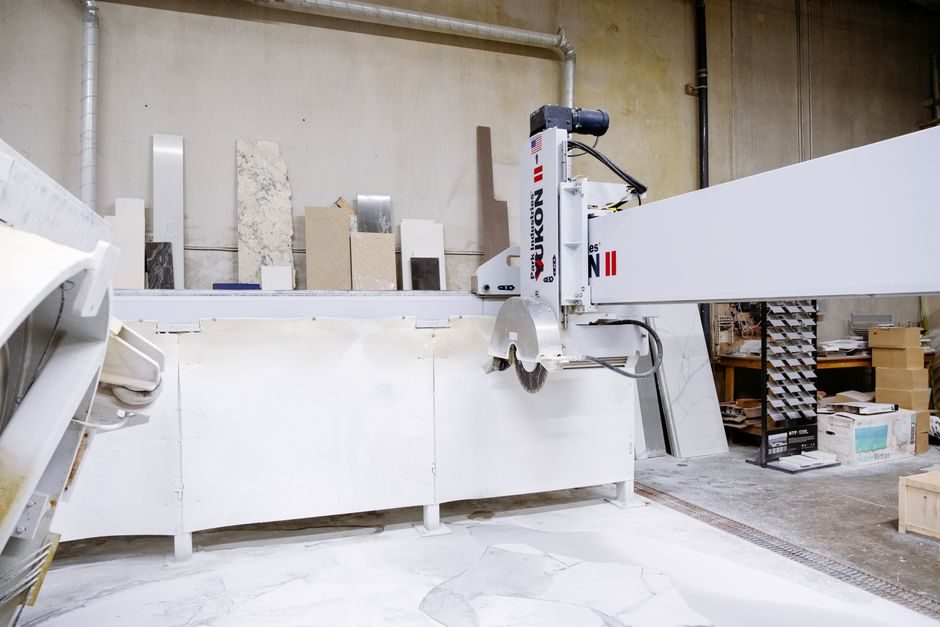
For stone-fabrication shops the other half of the category is the stationary CNC bridge saw and 5-axis cutting machine, with Made-in-China directory listings clustering around Fujian and Guangdong stone-machinery specialists offering OEM/ODM custom granite marble cutter lines [S4]. Diamond-segment consumables from Jiangxi Linxing and similar Jiangxi/Segdong suppliers complete the cutting stack with MOQs as low as 50 pieces per diamond-segment grade [S9].
110mm Handheld Marble Cutter: Reference Spec Window
The de facto export-spec 110mm electric marble cutter runs at 220V/50-60Hz rated input, 1400W rated power, 12000 rpm no-load speed, with a 110mm blade diameter and a typical CN01104 model code prefix; the listing carries CE certification per the certificate line, which is the baseline expectation for EU and Middle East OEM buyers [S3]. A separate Okorder product page lists a 110mm "stone cutting machine marble cutter" with min-order terms of TT or LC against China-main-port loading, indicating that trading-company MOQs are negotiable down to sample-lot quantities rather than fixed [S2].
Handheld-class cutters share the 110mm blade format with the angle-grinder SKUs listed by Zhejiang factories, which is why the same Yongkang workshop can ship a marble cutter SKU and an angle-grinder SKU off a common armature and gearbox platform [S1][S5]. The handheld class is NOT the right tool for slab-sizing in a marble processing plant, where daily kerf volume and straightness tolerance force buyers up to a bridge saw or 5-axis machine class; over-spec'ing a 110mm portable for shop duty burns through diamond blades and overruns labour cost.
Main Supplier Types: Trading Hub, OEM Factory, Stone-Machinery Specialist
The Made-in-China 110mm marble cutter supplier search returned zero hits for that exact phrase on the page snapshot dated 2025-12-28, which is itself useful intelligence: handheld marble-cutter sourcing in China now lives in multi-product power-tool factories rather than in dedicated cutter-only vendors, so the right RFQ path is a Yongkang/Zhejiang multi-line power-tool OEM rather than a single-SKU cutter maker [S8]. Zhejiang Jingli Tools, ZheJiang DongQiang Motor and similar Yongkang-registered companies explicitly list marble cutter alongside impact drill, demolition hammer, sander and Li-ion impact wrench, confirming the multi-line OEM model [S1][S5].
For larger-format cutting the supplier split flips: stone-machinery specialists on Made-in-China list bridge cutting machine, 5-axis cutting machine, stone profiling machine, stone polishing machine and stone engraving machine as their core catalog, and they typically run as factory-direct OEM/ODM rather than trading-company relisters [S4]. Trading platforms such as Okorder carry the handheld SKU at request-price (RFQ) terms, while Made-in-China lists audited Gold and Diamond Members for higher-value machinery [S2][S4]. A practical rule: 110mm handheld below roughly 200 USD factory-FOB points to a Yongkang OEM; bridge saws and 5-axis machines in the 4500-5220 USD range per piece tracked on the diamond-segment page reflect a different equipment class altogether [S9].
Selection Criteria: Blade Size, Power, Duty Cycle, Cooling
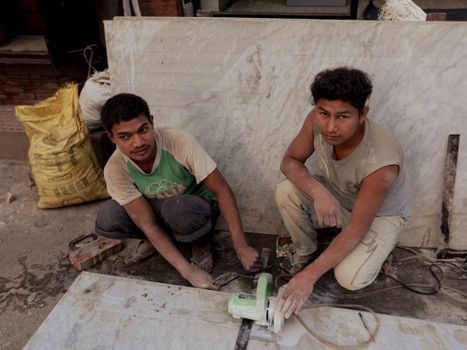
For a 110mm handheld the decision tree is short: 110-125mm blade diameter is the portable range, with 1400-1500W input typical; below 1200W the motor stalls on thick granite, above 1500W the tool crosses into a wall-chaser weight class the operator cannot hold on a vertical cut [S3]. No-load 12000 rpm is standard, but rated-load rpm under load is what matters for cut quality, and Chinese OEM data sheets usually publish only no-load figures, so buyers should request load curves before signing PO [S3].
For shop-floor bridge saws, decision criteria shift to axis count, table size, spindle power and CNC controller brand; the Made-in-China stone-machinery category tags bridge cutting machine, 5-axis cutting machine and stone bridge saw as separate listings, with 5-axis commanding a premium for curved sculpture and countertop work versus straight-line bridge saws for slab sizing [S4]. Reference comparison: 110mm handheld 1400W ~12000 rpm at 220V for site work; bridge saw 5-axis for fabrication shops; diamond-segment consumables as a recurring MOQ-50 replenishment line [S3][S4][S9]. A common sourcing error is buying a bridge saw sized for granite when the shop runs 70% marble; marble's lower hardness lets a smaller spindle and softer bond segment run longer, so the segment-supplier spec sheet should be matched to the stone rather than defaulted.
Who This Category Is FOR vs NOT For
Handheld 110mm marble cutters are FOR tile installers, interior fit-out contractors, stonemason site-trim crews and rental-fleet buyers who need a portable dry-cut tool; they are NOT FOR a marble processing plant expecting 8-hour-shift slab production, where a bridge saw pays back in labour savings within months [S3][S4]. CNC bridge and 5-axis saws are FOR stone-fabrication shops cutting countertops, tombstone blanks, sculptures and architectural cladding; they are NOT FOR a small tiling job, where transport, foundation and three-phase power are unjustified [S4].
Related cross-reference: a 110mm-class marble cutter shares its blade-arbour geometry with the circular saw sizing and selection guide, so buyers sourcing both categories can standardise on a single diamond-blade supplier and consolidate container loads. For the upstream raw-material side of stone processing, stainless steel sizing and selection and alloy steel supplier mapping are relevant where machine frames and tooling jigs specify 304/316 or alloy grades.
Standards, Certification and Quality Signals
CE marking is the baseline EU-market gate for handheld marble cutters, and the 110mm 1400W reference SKU explicitly carries a certificate line, which is the single most-checked document at EU customs clearance [S3]. For Middle East and African buyers, SONCAP (Nigeria), SASO (Saudi Arabia) and PVOC (Kenya/Tanzania) typically apply on top of CE, and Chinese OEM factories in Yongkang usually hold these as multi-year certifications rather than per-lot [S1][S5].
For the diamond-segment consumable that actually does the cutting, the segment bond hardness (soft / hard / mixed) must match the stone: soft-bond for hard granite, hard-bond for soft marble, mixed-bond as a compromise; the Jiangxi Linxing listing on Made-in-China tags "Marble Segments Mixing Cut for Soft and Hard Marble" as a deliberate dual-purpose SKU, with a 50-piece MOQ [S9]. Reference to a plasma cutter is useful only as a process contrast, since marble cutting is abrasive-mechanical, not thermal, and the two should not be confused when sizing workshop airflow and dust extraction.
Sourcing Levers: MOQ, Lead Time, Payment, Audit
MOQ bands visible in the research: handheld 110mm marble cutter sample-lot negotiable under TT/LC at Okorder [S2]; diamond-segment consumables at 50 pieces MOQ from Jiangxi suppliers [S9]; bridge saws and 5-axis machines typically 1-piece MOQ at factory-FOB on Made-in-China audited-supplier listings [S4]. Payment terms split between T/T (telegraphic transfer) and L/C (letter of credit), with L/C preferred on first orders above roughly 30000 USD as a balanced-risk instrument; OKorder's platform trade assurance and Made-in-China's Audited Supplier / Diamond Member / Gold Member tiers are the practical proxy for supplier credit on these platforms [S2][S4][S6].
Lead-time lever: Yongkang handheld OEM runs roughly 30-45 days for a confirmed SKU at container quantities, with a 20-25 day sea window from Ningbo to most major ports; bridge-saw lead times extend to 45-60 days because of CNC commissioning and test-cut acceptance. The 110mm search snapshot returning zero dedicated suppliers as of late 2025 confirms that procurement should target multi-line power-tool factories rather than single-SKU cutter vendors [S8]. For buyers mapping adjacent cutting categories, the CNC machine supplier map covers the same Guangdong/Fujian stone-machinery clusters that show up in the bridge-saw listings.
Failure Modes and Operating Constraints Buyers Should Pre-empt

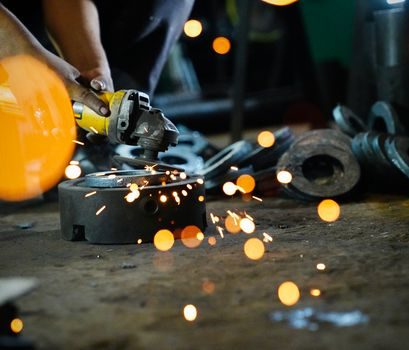
Three failure modes recur in handheld marble-cutter field service: armature bearing failure from dust ingestion (mitigated only by dry-cut dust extraction, not by the tool itself), diamond-blade segment loss from overheating on deep cuts without water feed, and gearbox failure from repeated stall-reverses on hard granite [S3]. The CE certificate does not cover any of these operating duty cycles, so warranty terms and on-site service parts stocking are the buyer's responsibility at OEM hand-off [S3].
For bridge-saw class machines, the recurring constraints are: three-phase 380V power availability (a single-phase 220V shop cannot run a bridge saw without a phase converter), CNC controller spare-parts lead time (a Siemens or FANUC controller board is typically 4-8 weeks air-freight from Europe or Japan), and foundation flatness (a bridge saw on an uneven floor loses cut tolerance within months). Operator PPE for both classes includes respiratory protection for crystalline-silica dust exposure, a regulated hazard in the EU under workplace exposure limits rather than under the CE machinery directive.
Trackable signals to watch over the next sourcing cycle: any new Yongkang OEM migrating handheld marble-cutter SKUs to brushless DC motor platforms, which would shift spare-parts stocking from carbon-brush replacement to electronics; any Jiangxi or Fujian stone-machinery specialist adding 5-axis waterjet hybrid models; and any platform-level MOQ loosening on Okorder or Made-in-China that would let smaller fabricators buy a single bridge saw under a 1-piece MOQ at negotiable price. Diamond-segment bond formulations specifically tagged for engineered quartz versus natural marble are also a watch-item, since quartz-vinyl composite cutoffs wear soft-bond segments faster than natural stone does.
For component-level specifications, see marble cutter, and rebar cutter.