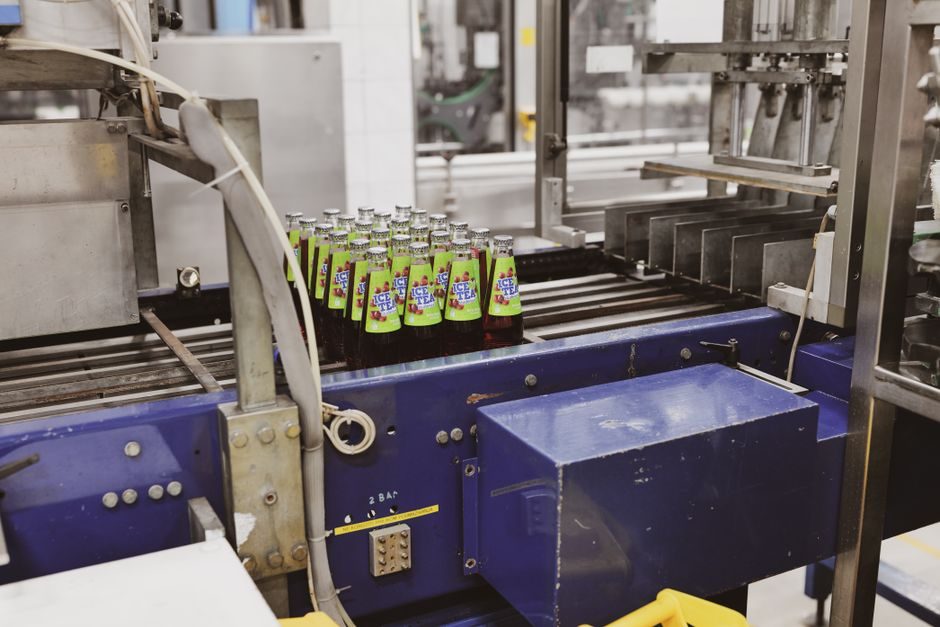
Air-cargo handling cells need mesh belt conveyors sized to ULD contour rather than pallet length, with T304 stainless balanced-weave mesh running on 1.5–3.0 kW VFD-controlled drives as the dominant narrow-body specification window [S1][S2].
Most Chinese-origin fabricators (Shuke Metal, meshbelt.cn-class mills) catalogue T304 stainless balanced-weave mesh, welded-edge side chains, and spiral cross-rod construction as their default air-cargo and light-industrial offering, which is the same product line the integrated logistics providers re-quote into airline tenders [S2].
Belt Weave Type and Why It Matters for Bag Handling
Balanced-weave mesh with welded edges is the standard specification for air-cargo cells where bag diameters run 50–200 mm and contamination from belt shedding cannot be tolerated [S2]. The balanced spiral/cross-rod construction keeps the belt surface flat under partial ULD load, so inclined booster sections do not throw loose luggage off the line.
For heavier mainline cells handling 250–500 kg/m² ULD transfer, flat-wire or rod-reinforced weave grades are typically upgraded rather than the lighter balanced-weave pattern; the T304 stainless wire remains the base material with side chain in carbon steel for cost-side economy [S2]. Material uprates to T316 are reserved for de-icing-chemical exposure zones, not general terminal ambient.
Stainless Grade and Air-Cargo Corrosion Envelope
T304 stainless is the baseline wire material in 9 of 10 Chinese-fabricated balanced-weave mesh belts shipping into air-cargo applications, with cross-rod and edge wire identical grade for consistent galvanic behaviour [S2]. The carbon-steel side chain is the deliberate cost-side choice — it carries the tensile load while the stainless mesh carries the product-contact surface.
De-icing fluid splash zones and outdoor apron conveyors see T316 upgrades; the upgrade is justified by chloride pitting risk, not general humidity. For more on the mesh material grades used in adjacent port and terminal service, see the related port logistics spec map — the weave-grade logic carries over from seaport parcel handling to narrow-body air cells.
Width, Speed, and Drive Duty
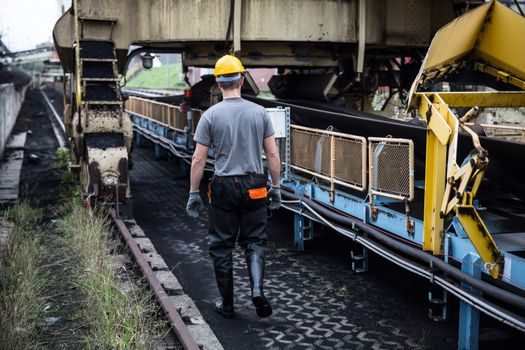
Belt width in an air-cargo cell is sized to the largest single-piece bag dimension plus 100–150 mm clearance, not to the ULD footprint, which produces typical widths of 600, 800, and 1000 mm across narrow-body, mid-body, and mainline cells. Belt speed stays in the 0.3–1.2 m/s window for manual-bag cells, climbing to 1.5 m/s on automated tilt-tray sorter feeds where bag spacing is controlled. [S1]
Drive duty for these widths maps to 1.5 kW (600 mm), 2.2 kW (800 mm), and 3.0 kW (1000 mm) VFD-controlled gear motors, sized for 200% starting torque against a loaded belt. The VFD pairing is the single most common spec gate in 2026 cargo-terminal retrofits, since soft-start stops bag spillage at the merge points into X-ray or dimensioning stations. For the matching motor selection gates see the VFD-duty motor spec gates.
ULD Interface and Ergonomic Geometry
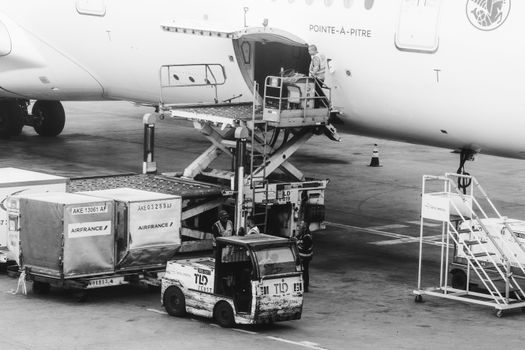
Conveyor height at the ULD interface should sit 50–100 mm below the standard airline pallet rail height (typically 1580 mm for LD-3 contours) so loose-loaded bags slide without a free-fall drop, which is the dominant wear-out mechanism on legacy roller decks. Infeed and outfeed rollers at the cell entry are 50–89 mm diameter rubber-lagged to absorb ULD-edge impact. [S1]
Inclined booster sections in air-cargo cells run at 12–18° maximum, above which bags with low-friction jacket materials begin to slide back under load; the figure is the same envelope used in parcel and post-cell sortation, where belt surface finish (rather than belt type) is the controlling variable. For weight-in-motion cells feeding the belt, the load-cell and idler scale gates in conveyor-cell filling scale selection apply directly.
Selection Criteria Comparison Across Air-Cargo Cell Types
Four reference cell archetypes cover nearly all narrow-body and mainline air-cargo installations: (1) 600 mm manual-bag cell, balanced-weave T304, 1.5 kW VFD, 0.5 m/s, 200 kg/m² peak; (2) 800 mm mixed-bag cell, balanced-weave T304, 2.2 kW VFD, 0.8 m/s, 350 kg/m² peak; (3) 1000 mm ULD-transfer mainline, flat-wire T304, 3.0 kW VFD, 1.0 m/s, 500 kg/m² peak; (4) 1000 mm apron/de-icing cell, balanced-weave T316, 3.0 kW VFD, 1.2 m/s, 500 kg/m² peak with chloride exposure.
Selection pivot points across the four options are belt weave (balanced vs flat-wire), stainless grade (T304 vs T316), drive kW (1.5 / 2.2 / 3.0), and ULD-contour clearance (50–100 mm). Cells 1 and 2 are interchangeable on weave and grade — the gate is width and kW; cells 3 and 4 diverge on weave, grade, and peak load together.
Standards, Documentation, and Sourcing Channels
Chinese mesh-belt fabricators serving air-cargo tenders typically hold ISO 9001 quality-system certification and ship FOB Shanghai or Ningbo; lead times run 25–35 working days for balanced-weave T304 stock patterns and 45–60 days for T316 or non-standard widths [S1][S2]. Third-party inspection at the mill gate (SGS or Bureau Veritas) is standard for orders above 500 m of belt length.
Logistics integrators such as Expeditors (founded 1979, Bellevue WA, public on NASDAQ: EXPD) coordinate the freight-forwarding, customs brokerage, and warehousing layer that moves the finished belt from Chinese mill to integrator's regional MRO hub, with a brand portfolio that includes trade-compliance systems used at the cargo-terminal interface [S3]. The integrator layer does not specify belt metallurgy — that gate stays with the OEM and the airline's air-cargo engineering team.
Failure Modes and Maintenance Gates
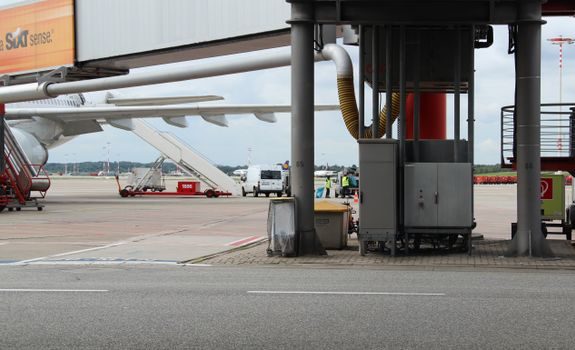
Three failure modes dominate the first 24 months of service: edge-wire fatigue at the welded side-chain joint (caused by chronic off-centre loading), cross-rod migration in the spiral (caused by under-tensioned take-ups), and surface galling on T304 under chloride exposure (caused by apron run-off without wash-down). Each is addressable in the spec gate rather than the maintenance schedule. [S2]
Edge-wire fatigue drives the recommendation of welded edges over clipper-style hooks for any cell running above 0.8 m/s or above 300 kg/m² peak load [S2]. Cross-rod migration drives the recommendation of automatic take-up units rather than manual screw take-ups on any 800 mm or wider belt. Surface galling drives the T316 upgrade gate for outdoor apron cells.
Spec-level background on the components involved: belt conveyor, and steel mesh.