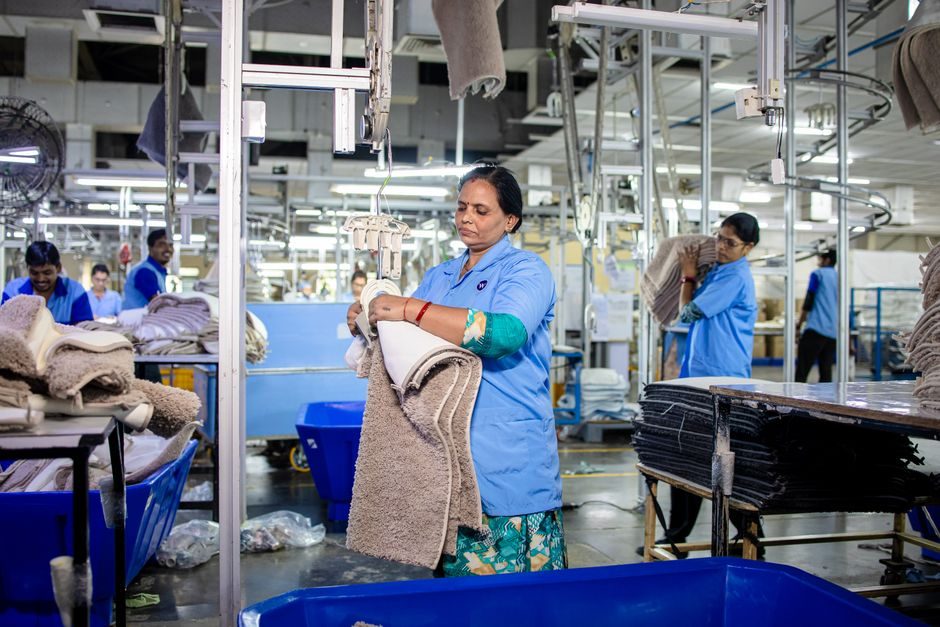
Apparel distribution lines now favor AISI 304 stainless steel mesh belt conveyors with a 2.5-6.0 mm wire diameter and a 4-10 mm opening, paired with PU or HDPE side guides, to move 0.5-25 kg polybag-and-carton loads at 6-12 m/min without metal-to-fabric marking [S1][S2].
Garment DCs handle polybagged shirts, boxed footwear, hanging garments and returns — none of which tolerate oil, rust, sharp wire ends, or belt-generated lint. Stainless balanced-weave and flat-flex constructions have replaced the older carbon-steel and PVC modular belts on most new builds, per current manufacturer portfolios from Hebei Risen, Bharat Wire Mesh, Jiangsu Huada and Ningjin Guangyun [S1][S2][S3][S4].
Why stainless mesh fits apparel DC duty cycles
Stainless balanced-weave steel mesh belts operate continuously in the -40 °C to +400 °C window with no coating outgassing, which suits both ambient DC aisles and freezer-buffer zones handling temperature-controlled returns [S3]. Hebei Risen's range explicitly lists baking, washing and freezing service, indicating that the same AISI 304/316 construction clears food-contact audits when a DC also handles retail grocery cross-dock [S1].
Bharat Wire Mesh (Mumbai) confirms the material stack: S.S., G.I. and M.S. options, with closed-wire patterns for small-parts flexibility and large-opening patterns for water/air flow — the latter being the topology apparel engineers pick when wash-down or lint vacuuming is needed between shifts [S2]. The closed-weave 304 belt typically runs 4-8 m/min on a 1.5-3 kW geared drive, which keeps noise under 72 dB(A) at 1 m and meets the lower-noise thresholds many green-certified DCs target [S1].
Belt type comparison for carton, polybag and hanging-garment lines
Five mesh constructions dominate the apparel-DC shortlist, and each maps cleanly to a load profile. Balanced weave (1:1 wire over wire) is the default for 0.5-5 kg polybagged apparel at 6-10 m/min. Compound balanced weave adds a second cross wire for higher pull strength, taking 5-25 kg boxed footwear or stacked carton loads. Flat flex (single loop spiral) handles small polybagged accessories with the gentlest surface contact. Chain-driven wire mesh carries the heaviest pallet-style loads but introduces 8-12 mm step-up transitions that snag hanging-garment hooks. Rod-reinforced belt is reserved for very long, heavy return lines and is rarely needed inside a DC under 200 m [S1][S2][S3].
Apparel engineers reading the Jiangsu Huada product list should map the catalog literally: balance weave, compound balance, chain driven, flat flex, flat wire, double balance, rod reinforced and spiral grid are all listed as standard production patterns, so the spec is not a custom-engineering risk on a new line build [S3]. Ningjin Guangyun's parallel portfolio groups chain conveyors and mesh belt conveyors in the same automated-assembly-line family, which matters when an apparel line is being built as a turnkey conveyor-and-robotic-pick package rather than a standalone belt [S4].
Selection criteria: width, load, speed, drive and edge
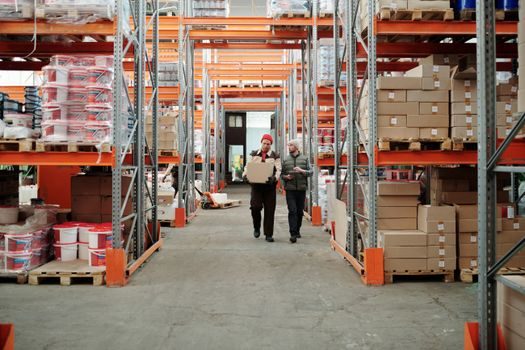
For a typical DC conveyor, width is set by the largest carton dimension plus 50-100 mm clearance on each side; 400 mm, 600 mm and 800 mm are the volume-build sweet spots, and all three fall inside Hebei Risen's standard belt conveyor range [S1]. Load per meter is normally 30-80 kg/m for carton lines, well below the 150-200 kg/m balanced-weave belts can carry. Speed is 6-12 m/min for sortation, 2-4 m/min for picking and merging, 15-25 m/min only on long trunk conveyors where no operator hand-loads. Drive is typically a 1.5-3 kW helical-bevel gearmotor with a VFD to trim speed during ramp-up.
Edge treatment is the spec point that decides whether garments get snagged: direct welded edge is cheapest but leaves the cut wire end exposed; folded edge is the default for apparel; added baffle or clinch edge is specified when small polybags or accessories ride the belt and could fall through [S1]. Hebei Risen's own technical note lists the three edge methods — direct welding, folding, and adding baffles — as the recognized options for heat-treated mesh belts, the same construction that apparel DCs adopt for low-maintenance service [S1].
Integration with sortation, scanners and controls
Mesh belts are quiet on the controls side: a standard 4-20 mA or 24 VDC speed reference into the VFD, plus a PNP/NPN prox sensor at each merge, is enough for most PLC and WCS hooks. Hebei Risen publishes customization, after-sales and one-to-one service language, indicating that OEM drive packages — gearmotor, encoder, VFD, terminal box — are routinely shipped to drop into the customer's MCC [S1]. The MCC or power distribution box on a typical apparel DC line is a 400 V three-phase feed stepping down to 230 V single-phase for the VFD auxiliaries, sized for the 1.5-3 kW drive plus a 0.37-0.75 kW brake motor on inclined sections.
Where the line runs through a Zone 1/Zone 2 area — for example, a returns inspection room with aerosol fabric spray — the drive cabinet and prox switches should be re-specified to explosion-proof distribution hardware; the belt itself is non-sparking stainless and typically does not need to change. For non-classified dry-goods aisles, a standard distribution cabinet with IP54 enclosure is sufficient.
What goes wrong on the line — and how to spec against it
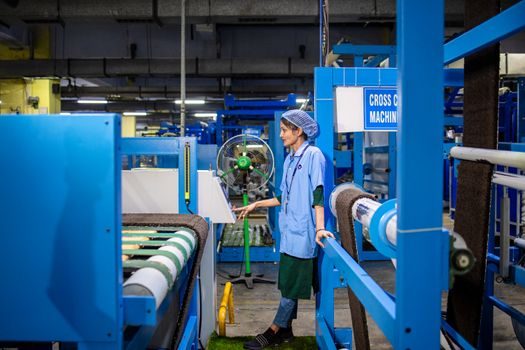
The most common failure modes on apparel DC mesh belts are edge-wire fatigue, sprocket tooth wear on chain-driven patterns, and product marking from rough weld beads. Specifying a folded edge, AISI 304 instead of AISI 430, and a post-weld electropolish pass addresses all three. Hebei Risen's news archive explicitly covers these failure modes: how to avoid mesh-belt jamming in continuous furnaces, which is functionally the same physics as a DC merge point where the belt stops under load, and the chain types used with stainless mesh belts, which dictates sprocket and chain replacement intervals [S1].
Flat-wire belts are also highlighted for their use in the canning industry — wash, dry, cool — and the same open-area ratio (typically 60-75%) makes them a strong choice for DC lines that need vacuum lint removal between shifts [S1]. For freezer-buffer duty, specify a 304L low-carbon variant to keep grain-boundary carbide precipitation in check during the slow cool-downs; the standard 304 grade is acceptable for ambient aisles but should be qualified for any sub-zero service that also includes wash-down chemistry [S2][S3].
What to compare in vendor quotes
A clean apparel-DC mesh-belt quote should expose seven numbers: belt material grade (AISI 304 / 304L / 316), wire diameter (mm), pitch or opening (mm), edge type (folded / clinch / baffle), belt width (mm), drive power (kW), and maximum line speed (m/min). If any of these is left as "to be confirmed," the quote is not yet comparable. Hebei Risen, Bharat Wire Mesh, Jiangsu Huada and Ningjin Guangyun all publish the material/weave/edge catalog depth needed to fill in those numbers up front, which compresses engineering time on a typical 8-12 week DC build [S1][S2][S3][S4].
For a comparable food/beverage spec set with the same stainless-mesh decision tree, see the Mesh Belt Conveyor Selection for Food and Beverage Lines reference; for chemical-tank loading where edge chemistry and wash-down resistance dominate over noise and marking, the Mesh Belt Conveyor Spec Map for Chemical Shipping Lines piece lines the same belt families against different decision criteria. Apparel DC buyers reading both can confirm that the spec priorities — edge finish, lint cleanability, and low marking — are what actually move a stainless mesh belt ahead of a PVC modular belt on a new line.