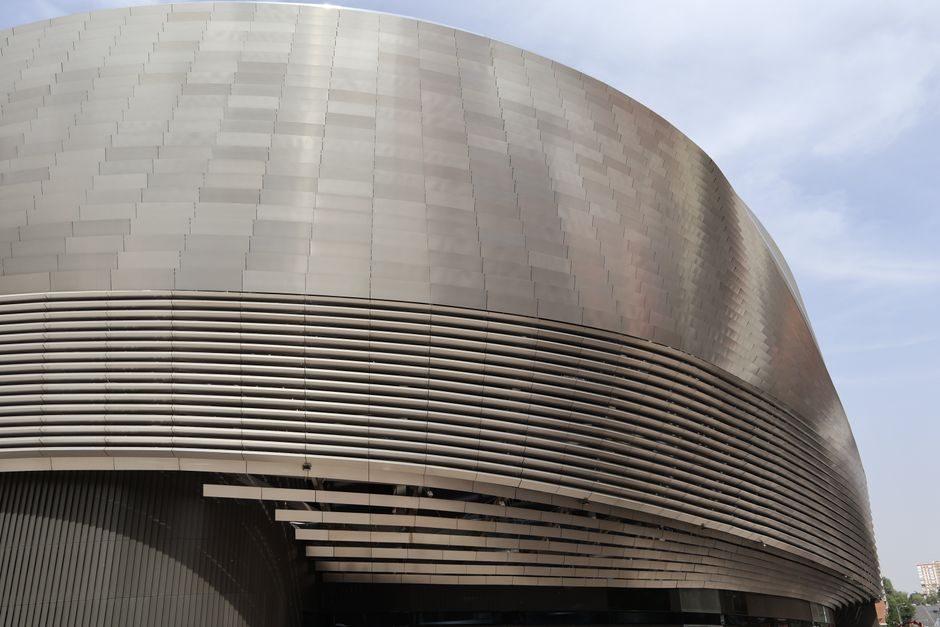
The single highest-leverage choice on a 2026 commercial envelope is the metal curtain wall panel spec: aluminium dominates at roughly two-thirds of new metal-clad façades, with zinc, copper, weathering steel and galvanised steel taking the balance, and lead times for standard anodised 3 mm flat stock on Made-in-China currently sit around US$15.00/m² at 500 m² MOQ [S2].
This spec governs the building's thermal, acoustic, fire and maintenance behaviour for the next 30 to 50 years, so the decision belongs with the design team and the envelope consultant, not the procurement clerk. The five gates below — alloy, geometry, coating, fixation, supplier — must all close before a panel is released for fabrication. For readers building a broader envelope vocabulary, the glass curtain wall entry covers the transparent counterpart these metal panels most often mate against, while metal powder documents the coating feedstocks that drive finish and corrosion performance.
Gate 1 — Alloy System: AA3003, AA5005, AA5052, Zinc, Copper, or Weathering Steel?
AA3003-H14 and AA5005-H34 are the two workhorses specified on the bulk of commercial envelopes, the latter preferred where anodising is the final finish because of its tighter colour match and lower manganese streaking risk. AA5052 turns up where higher yield (~193 MPa) is needed for large unitised cassette panels, at a small cost penalty versus AA5005. For bespoke signature builds, zinc (typically 0.7 mm rolled, 1.0 mm standing-seam) and copper (0.6–0.7 mm) extend service life past 70 years in non-coastal atmospheres, and Corten A weathering steel is specified for the patinated aesthetic but is gated to non-coastal, non-chloride exposure. Galvanised G90 steel (Z275, ~0.85 mm base metal) is the cost floor and is standard on industrial and parking structures, not on Class A office façades. [S1]
A 2026 OEM summary of architectural metal panel practice lists gauge, alloy and finish as the three columns any submittal must populate before fabrication release [S5]. The coastal caveat on Corten is engineering, not marketing: chloride-laden air disrupts the protective oxide and produces ongoing bleed, which is why most spec writers limit weathering steel to ASTM A606-4 in non-marine exposures.
Gate 2 — Panel Geometry: Thickness, Profile, Flatness Tolerance
Thickness is the first number to lock. Standard flat metal panels on unitised curtain wall run 2.0–3.0 mm aluminium, 0.7–1.0 mm zinc, 0.6–0.7 mm copper, and 0.6–1.0 mm galvanised steel. Below 2.0 mm the flatness tolerance after powder coat becomes difficult to hold, and oil-canning on broad flat fields becomes a service-life complaint. Above 3.0 mm the panel weight per m² rises past ~8.1 kg (3 mm aluminium, 2700 kg/m³), which forces heavier mullion and bracket sizing on the structural carrier. [S2]
Profile selection drives stiffness and drainage. Options most often specified are flat tray, formed cassette (25–50 mm leg), corrugated (38 mm pitch common), and standing-seam (38–50 mm seam height). Corrugated and standing-seam profiles can drop the base metal thickness by roughly 0.5 mm for the same face deflection, but they add roll-forming tooling cost and lock the panel to a narrower supplier pool. Flatness and bow tolerance should be written into the submittal as ≤0.5 % of the longest edge or ≤2.0 mm, whichever is tighter; this is the spec line that controls visual oil-canning on a finished façade. Autodesk users modelling these systems on Revit confirm the panel template must match the chosen geometry before shop drawings can be released, since the curtain wall family and the panel nest together [S3].
Gate 3 — Coating System: PVDF, FEVE, Anodise, or Powder Coat?
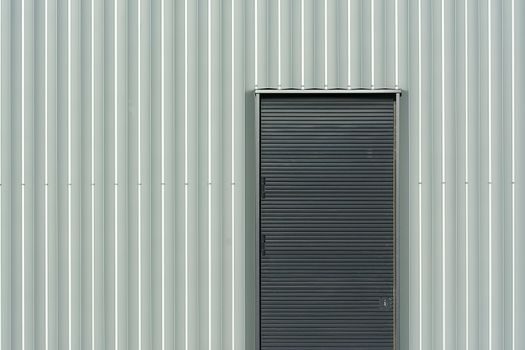
PVDF (70/30 Kynar 500 / Hylar 500 resin-based) is the default topcoat on architectural aluminium: 25–30 µm primer plus 25–30 µm topcoat, total dry film 50–60 µm, with a published colour-retention expectation of ≤5 ΔE at 20 years Florida exposure for the major resin families. FEVE (Lumiflon-type) is the higher-end alternative, with 30-year chalk and fade warranties available from the same coater network and a broader achievable gloss range. Anodising (AA-M10C22A41 / A44, Class I 18 µm or Class II 10 µm) is the most UV-stable inorganic finish and is the right pick where matte and metallic aesthetics dominate, but the colour palette is locked to the alloy's own response to electrolyte colouring. [S3]
Powder coat (polyester, superpolyester, or PVDF-blend powder) is the cost-floor finish and is the dominant specification on Chinese-fabricated aluminium composite and solid panels at the US$15.00/m² tier [S2]. Its 10–15 year fade window is shorter than liquid PVDF, and on curtain wall — where access for recoat is expensive — this is the trade the spec writer is making. Aluminium-engraved cladding panels from Guangzhou-area fabricators are typically released with powder coat or PVDF topcoat and a 100 m² MOQ [S4]. For comparison readers weighing metal panels against concrete-and-ALC alternatives, the ALC panel entry covers the autoclaved lightweight-concrete side of the same envelope trade-off.
Gate 4 — Fixation and Sub-Frame: Unitised Cassette vs. Stick vs. Rain-Screen
Three sub-frame architectures dominate. Unitised cassette panels are shop-fabricated, hung on the floor slab edge via brackets, and most of the air-and-water seal work is done at the factory — this is the dominant system on high-rise commercial curtain wall. Stick systems field-build the mullions and transoms first, then snap-on panels, and are typical on low-to-mid-rise. Rain-screen (open-joint) fixation drops the panel to a ventilated cavity behind, with an open horizontal or vertical joint of 8–20 mm that allows pressure equalisation and drained-and-back-vented water management; this is the architecture that pairs with corrugated and standing-seam profiles. [S4]
The fix that fails first is almost always the bracket-to-slab anchor or the panel-to-bracket clip, not the panel itself, so the spec should call out the bracket grade (typically 6063-T5 or 6061-T6 aluminium extrusions, 3–5 mm wall), the stainless fastener grade (A2-70 / A4-80 minimum for coastal), and the slot direction (vertical slots at the top of the panel absorb slab live-load deflection). Most of the metal curtain wall panel selection literature treats fixation as a parallel design stream to the panel itself, because under-specifying the bracket is what causes the visible field failures three to seven years after handover.
Gate 5 — Supplier Throughput, MOQ, and Lead Time
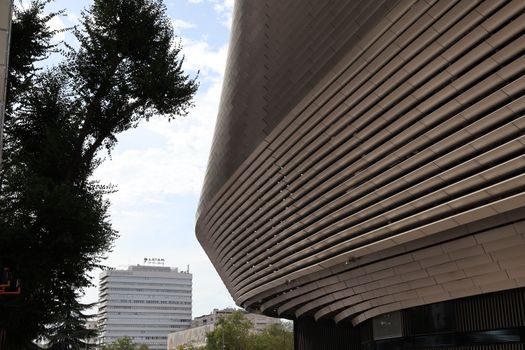
MOQ and capacity discipline the schedule. Standard powder-coated aluminium flat panels are commonly held at 500 m² MOQ in the Made-in-China wholesale channel at roughly US$15.00/m² FOB [S2], while custom-engraved panels from Guangzhou-area fabricators move at 100 m² MOQ with a published supply capability of 80,000 m²/month [S4]. Domestic US roll-formers typically release a 3,000–5,000 m² commercial order in 6–10 weeks depending on the finish [S5].
Three questions to put to the supplier before PO: (1) coil source and mill cert traceability — the alloy-temper proof is what backs the 25-year finish warranty; (2) coating line and applicator qualification — PVDF and FEVE require a licensed applicator for the warranty to be valid, and a "PVDF" label from an unlicensed line is not the same product; (3) third-party fabricated panel testing — ASTM E283 (air leakage), E331 (water penetration), and E330 (structural performance) reports on the proposed panel-to-bracket build-up. For context on how these QA gates sit inside a wider equipment-procurement workflow, the machine tool production technology and angle grinder selection pieces walk the same 5-to-6 gate pattern on adjacent capital-equipment buys.
Comparison: Common Metal Panel Types on Four Decision Criteria
Stacking the four dominant metal panel families against the four criteria that drive spec most often — cost, finish life, weight, and coastal suitability — gives the spread a buyer needs to make a defensible call. Cost figures are the 2026 wholesale baseline drawn from the Made-in-China and Okorder listings referenced above, finish life is the published topcoat warranty in standard Florida-style UV exposure, weight is the metric m² figure for a 3 mm panel (or the dominant gauge where thickness differs), and coastal suitability is a yes/no on chloride-laden air within ~300 m of the surf line. [S5]
Aluminium AA5005 (3 mm, PVDF) — Cost: US$15–35/m²; Finish life: 20–25 yr; Weight: ~8.1 kg/m²; Coastal: yes with AAMA 2604/2605 topcoat. Zinc (0.7 mm, mill finish) — Cost: US$45–70/m²; Finish life: 30–70 yr (patina self-heals); Weight: ~5.0 kg/m²; Coastal: limited, chloride-driven white rust risk. Copper (0.7 mm, mill finish) — Cost: US$80–120/m²; Finish life: 70+ yr; Weight: ~6.3 kg/m²; Coastal: limited, green patina shifts in marine chloride. Galvanised steel G90 (0.85 mm, polyester) — Cost: US$10–18/m²; Finish life: 10–15 yr; Weight: ~6.7 kg/m²; Coastal: not recommended; standard on industrial cladding. The trade is straightforward: aluminium is the volume pick, zinc and copper are the longevity picks on signature builds, galvanised steel is the budget pick on industrial and parking envelopes, and Corten weathering steel is the aesthetic pick with the documented non-coastal gating.
Limitations, Failure Modes, and What the Spec Must Cover
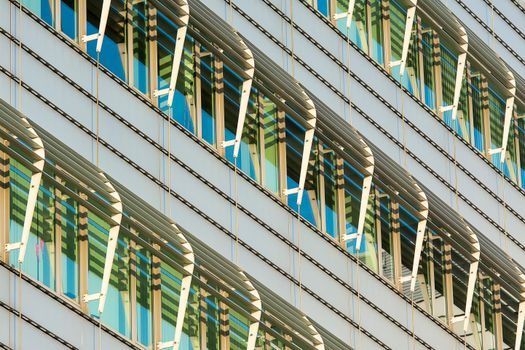
The four dominant failure modes on a metal curtain wall are: (1) oil-canning on broad flat fields — controlled by temper, thickness, and stiffener geometry, not just by the panel supplier; (2) colour drift and gloss loss on south and west elevations — controlled by resin choice (PVDF or FEVE over polyester powder) and by the applicator's licensed-line status; (3) galvanic corrosion at the panel-to-bracket interface — controlled by isolating aluminium from steel with EPDM or nylon washers and by specifying stainless fasteners (A2-70 inland, A4-80 coastal); (4) panel-to-bracket fastener loosening under wind and slab live-load cycling — controlled by the slot direction and by re-torque intervals written into the maintenance manual. None of these is solved by the panel datasheet alone; they are solved by the submittal package that surrounds it. [S6]
The standards the spec writer should pin to — without inventing clauses — are AAMA 2603 / 2604 / 2605 for organic coatings on aluminium, ASTM B209 for aluminium sheet and plate, EN 485-2 for European aluminium sheet tolerances, and the test-method trio ASTM E283 / E330 / E331 for the fabricated panel. Fire performance on tall buildings is governed locally — NFPA 285 in the US, BS 8414 in the UK — and any metal panel that forms part of a non-combustible assembly must carry the test report that matches the wall build-up, not just the panel alone. For readers tracking a related envelope decision in parallel, the skylight vs system window cut covers the transparent openings that share the same slab-deflection and water-management constraints.
Trackable next signals for buyers closing a 2026 spec: confirm the PVDF or FEVE applicator licence status with the coating manufacturer directly, not through the panel supplier; require the mill cert and the applicator's QC tickets on the same submittal package; and write the bracket and fastener spec into the same section as the panel — not into a separate division — so the slab anchor and the panel-to-bracket clip are reviewed together before release.