An IP67/IK10-rated biometric reader delivering 25-28 identifications per minute is the current benchmark for touchless mine access, with dust, vibration, and 24/7 shift rotation driving the spec envelope [S5].
Open-pit, underground, processing plant, and remote camp sites each require layered access control: turnstiles and full-height gates for pedestrians, bollards and barriers for mining dump truck lanes, and zone-specific readers for blasting or confined-space work [S1][S4].
Environmental Ratings and Hardware Survival
Mining sites expose access hardware to dust ingress, water spray, high-impact contact, and temperature swings, so IP67 and IK10 are the two ratings that recur in vendor literature for outdoor and gatehouse positions [S5]. IP67 indicates dust-tight sealing and water-submersion resistance to 1 m for 30 minutes, while IK10 certifies impact survival to 20 joules, roughly equivalent to a 5 kg mass dropped from 400 mm, a level routinely demanded at vehicle gates where panels can be struck by haul-truck mirrors and bucket edges [S5].
ASSA ABLOY frames its mining hardware line as durable enough for "toughest environments", explicitly coupling mechanical lock bodies with electronic readers so the door set survives the same duty cycle as the credential device [S7]. For underground deployments, explosion-protected enclosures (referenced as access control on the category page) are commonly specified; vendors such as 2M Technology bundle explosion-proof cameras, turnstiles, and barriers into the same procurement lot, simplifying hazardous-area approvals [S1].
Biometric Throughput vs Card/PIN at the Gate
Touchless face recognition is the dominant biometric mode for surface mines because workers arrive with dusty hands, gloves, and PPE, and PIN recall fails under fatigue. Vendor data shows the IXM TITAN authenticates 25-28 users per minute in face-only mode, dropping to 12-15 per minute when paired with simultaneous temperature screening [S5]. At a 500-person shift change, the faster mode clears the lane in roughly 18 minutes, the slower in 33-42 minutes, a delta that compounds across three daily rotations.
Card, keypad, and PIN remain the fallback for areas where biometric enrollment is impractical (short-term visitors, regulatory inspectors) and where network drops disable biometric matching. A common architecture uses Wiegand or OSDP readers at the door, OSDP preferred for its Secure Channel encryption over RS-485, and a central controller that simultaneously drives a control cabinet housing the head-end and a control cable run back to the security operations room [S6][S2].
Vehicle and Contractor Flow: Turnstiles, Barriers, and Pre-Registration
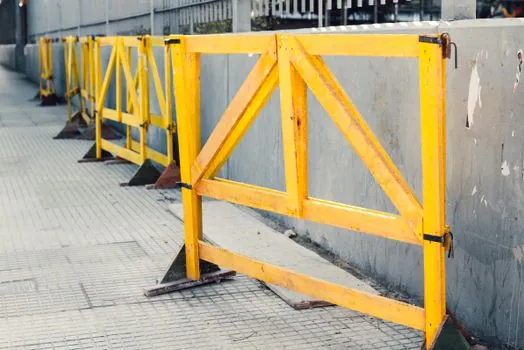
Pedestrian lanes in mining use full-height turnstiles (rotating cage, single-person) where tailgating is a safety concern, and tripod or drop-arm turnstiles for staff and visitor flows at lower threat levels [S1]. For haul roads and light-vehicle gates, bollards and traffic spikes pair with rising-arm barriers; ATG Digital's mining package adds digital gate passes, seal scanning for outbound trucks, and induction-status checks to the same credential event so a driver without a valid induction never gets a green light [S3].
Pre-registration portals are now standard for visitors and contractors: AccessFlow's flow issues a QR code after online induction acknowledgement, supports web kiosks and physical tablets at the gatehouse, and ties every entry to a named host or escort for post-incident traceability [S4]. This audit trail is what regulators, MSHA-style in the US and DMRE/MHSA-style in Southern Africa, expect when reviewing a serious-incident log; the same data populates the muster report during a fire or gas-alarm event [S4].
Compliance Layers: Inductions, Competency, Muster
Access control in mining is rarely "who has a badge"; it is "who has a current induction, valid competency, and matching PPE for this zone". AccessFlow defines categories with differentiated rules: corporate visitors get administrative-area access, contractors and maintenance get operational-area access, and special-risk personnel require additional permits before zones like blasting or confined space unlock [S4]. Document expiry triggers automatic lockout, and approval chains route renewals through safety officers and operations managers before access resumes.
For emergency accountability, real-time muster reports rely on the same reader logs that handle daily entry. Gallagher's mining portfolio integrates access events with perimeter detection and video so the control room can correlate "last seen at gate 3" with the camera feed in the same console [S2]. Miningdoc's October 2025 question thread on securing remote and automated operations lists access control alongside AI-driven video and physical patrols as the three layers mines now expect to combine for autonomous-haulage and remote-operations centres [S8].
Integration Patterns and the Control-Cabinet Footprint

Field readers and turnstiles report back to a control cabinet containing the access panel, power supplies, and network switches; the cabinet is typically IP54 or NEMA 3R rated when placed in unconditioned gatehouse rooms. Cabling between readers and panels most commonly uses shielded control cable such as Belden 3106A or equivalents for OSDP, with segregation from VFD-driven haulage access vehicle charger runs to avoid noise coupling [S6].
Software-side integration is where vendors differentiate. ATG Digital exposes a cloud dashboard for fleet, staff, contractor, and visitor flows with seal scanning, digital gate passes, and configurable alerts for unverified vehicles [S3]. Gallagher's Command Centre ties the access events into a single security-management platform with perimeter, intrusion, and video modules sharing a tag database [S2]. Invixium's IXM TITAN, MYCRO, and TFACE lines integrate with third-party access control through standard protocols, with TITAN additionally bundling temperature screening for pandemic-era shift screening [S5].
Decision Matrix: When to Pick What
For a surface coal or iron-ore operation with a single main gate and 1,000-2,000 daily personnel, an IP67/IK10 biometric reader at full-height turnstiles plus a barrier and bollard array at the truck lane is the common spec. Underground hard-rock mines add explosion-proof housings at the cage and at refuge-station doors, and commonly run dual-factor (card + biometric) where regulatory penalties for tailgating are severe [S1][S5]. Remote camps with fly-in/fly-out rosters benefit most from pre-registration portals and document-expiry automation, because much of the induction work happens at the airport or in transit, not at the gate [S4].
Selection criteria compress to four: (1) environmental rating matched to zone (IP67/IK10 outdoor, explosion-proof underground), (2) throughput in users-per-minute at the busiest shift change, (3) integration with the existing access control head-end and muster software, and (4) audit granularity, specifically whether the system records induction status, document expiry, and host accountability alongside the badge event. Sites that under-spec on (4) tend to retrofit it within 18 months of go-live, after the first regulatory audit or serious incident exposes the gap [S4].
Limitations and Failure Modes
Biometric performance degrades when face templates are enrolled under clean conditions and then matched against dust-covered or PPE-obscured faces; vendors counter with anti-mask and partial-face algorithms, but matching accuracy should be re-baselined seasonally. Network loss disables online matching at remote sites, and offline caching of recent credentials only covers the last synced population, so roster updates must be pushed before connectivity drops are expected [S5].
Card-only systems are vulnerable to tailgating and lost-card reuse, which is why high-risk mining zones pair them with mantraps or full-height turnstiles; ASSA ABLOY positions its mechanical lock bodies as the physical layer that survives even when the electronic reader is down, so a fail-secure door still provides a hard barrier during power or network faults [S7]. Cybersecurity exposure is rising as more access panels sit on IP networks; OSDP Secure Channel, network segmentation, and regular firmware updates are the minimum mitigations, and the same hygiene applies to the cameras and LPR systems that share the security VLAN [S2][S8].
For related PPE that pairs with gated entry, confirm the Mining Safety Glove Selection: EN 388 Specs, Impact Ratings, and Wet-Use Picks and Mining Safety Glasses Selection: AS/NZS 1337.1, Impact Rating, and Lens Spec Criteria requirements before issuing a contractor badge, since most induction portals now enforce PPE compliance at the same checkpoint as competency expiry. Track the next two signals: a wave of mining-specific OSDP v2.2 firmware releases through 2026-Q4, and continued bundling of temperature-screening modules into biometric readers as a permanent rather than pandemic feature [S5][S8].