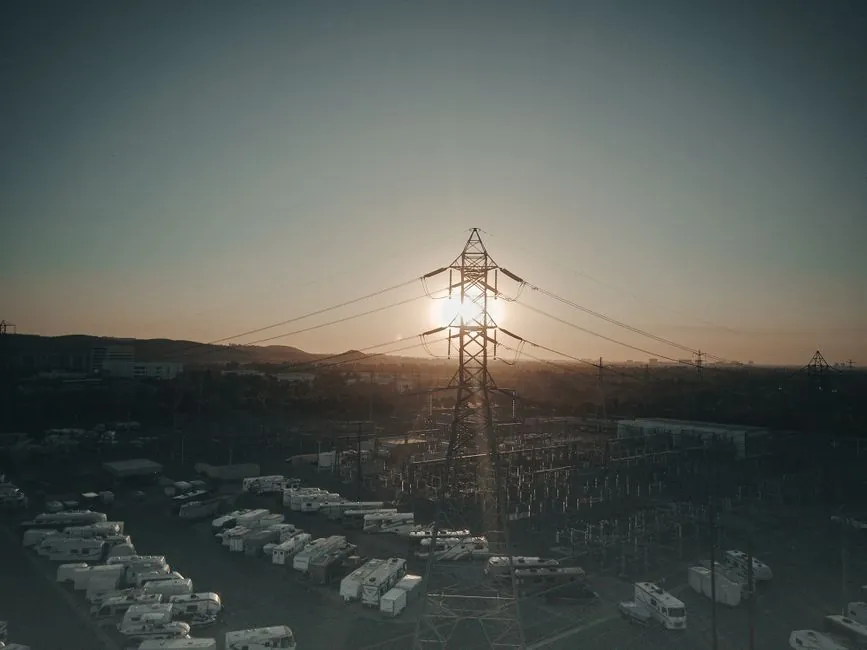
Mobile substation transformers in the 10 to 250 MVA range are running 6 to 10 months lead time for builds up to 150 MVA, and 10 months or more above that threshold, with options and customisations driving the wide spread [S3]. New permanent large power transformers, by contrast, are routinely quoted at 6 years or more, which is why several vendors now sell mobile units specifically as a stopgap [S4].
That lead-time gap is the entire business case. A trailer or skid-mounted package, integrating a power transformer, switchgear, protective relays, metering, and SCADA, can be energised in 12 to 24 hours when pre-positioned, replacing a fixed unit that took a fault, a flood, or a planned outage out of service [S2]. The IEEE Technology Navigator frames the equipment as a contingency asset rather than permanent infrastructure, sized anywhere from a few MVA to several hundred MVA on voltage classes running 13.8 kV distribution through 115 kV, 230 kV, and in some designs 345 kV transmission [S2].
Why Lead Time Forces the Stopgap Decision
When a GSU transformer converts a generator's nominal 25 kV output up to transmission voltage, the unit has no in-place spare if it faults; the U.S. Department of Energy's 2006 Report to Congress under Section 1816 of the Energy Policy Act of 2005 documents how mobile transformers and mobile substations cut mobilisation to 12 to 24 hours for pre-positioned equipment [S1]. IEEE's navigator restates the same 12 to 24 hour mobilisation envelope as the practical ceiling on emergency response [S2].
Against that, fixed large power transformer deliveries are stretching into multi-year windows. Jordan Transformer advertises its new-build mobile substation line specifically as an alternative to "6+ year delays" on permanent units, emphasising U.S.-based build oversight and full spec control over voltage class, impedance, and tap changer configuration [S4]. PDM's published 6 to 10 month window for trailer or skid-mounted three-phase oil-filled units up to 150 MVA is the cleanest public benchmark, and the 10+ month figure for up to 250 MVA reflects the component-driven extension when core steel, winding copper, or bushings push past normal capacity [S3].
Sizing Envelope, Voltage Class, and Standards Anchors
PDM's spec sheet fixes the typical mobile transformer build envelope: 10 MVA to 250 MVA three-phase, 60 Hz or 50 Hz, ONAN/ONAF/OFAF or KNAN/KNAF/KFAF cooling using Type II mineral oil, FR3 natural ester, or silicone dielectric, 55°C, 65°C, or 55/65°C rise, impedance 7% to 15%, primary voltage class 35 kV / 66 kV / 110 kV / 250 kV / 350 kV, and secondary 12 kV / 25 kV / 35 kV / 66 kV / 110 kV [S3]. These are not optional ranges; they map directly onto the bus structures a mobile unit must parallel with at an existing substation, where geometry and connection arrangement vary by site [S2].
Governing standards are NEMA, ANSI C57, IEEE C57.12, and DOE efficiency rules for the transformer itself, with IEEE Standard 1246 covering temporary grounding once the unit is on site [S2][S3]. PDM's build is UL Listed and tested against NEMA, ANSI C57, and IEEE as applicable [S3]. A line item worth flagging: high-voltage and low-voltage bushings are externally clamped, the tank is reinforced carbon steel (stainless optional), and a nitrogen blanket is standard, all of which are the small details that decide whether a mobile unit survives road transport plus a year of temporary service [S3].
Three Stopgap Routes: New Build, Re-engineered, or Remanufactured
Three procurement paths sit in front of a utility or industrial buyer. New build (PDM, Jordan Transformer, Southern States) gives the cleanest specification control and the longest warranty, 5 years on PDM's product, and aligns with ULI sustainability listings [S3][S4][S6]. Re-engineered or remanufactured mobile substations reuse a transformer core, tank, and bushings after rewind, allowing Jordan Transformer to advertise a 6+ year avoidance versus permanent replacement while still hitting field-ready status faster than a ground-up new build [S4].
The trade-off is real and quantifiable. A remanufactured unit ships faster, but impedance, losses, and sound level are inherited from the donor transformer, and FR3 natural ester or on-load tap changer upgrades drive cost back toward a new build. Southern States' offering leans on "high-capacity in-house production and multiple ISO-certified transformer partnerships" to compress delivery into a similar 6 to 10 month band [S6]. For buyers, the decision pivots on (a) required MVA and voltage class match to donor stock, (b) loss evaluation capitalised over the temporary-service window, and (c) whether an on-load tap changer is required (PDM lists it as optional versus a no-load tap changer as standard) [S3].
Decision Criteria Comparison: New, Re-engineered, and Remanufactured Mobile Substations
On four criteria, the three procurement paths line up as follows. Lead time: new build 6 to 10 months up to 150 MVA, 10+ months above 150 MVA [S3]; re-engineered / remanufactured typically below the new-build band but the exact number is not publicly published, with Jordan Transformer positioning "less time" than a permanent new unit at 6+ years [S4]. Spec control: new build gives full impedance, voltage class, rise, and tap-changer choice from the OEM catalog [S3]; re-engineered / remanufactured is constrained by donor transformer geometry and winding space [S4]. Loss profile: new build is DOE-compliant with modern low-loss core steel and 55/65°C rise, while remanufactured inherits the donor transformer's no-load and load losses [S3]. Lifecycle cost: remanufactured is lower on capex; new build is lower on losses and carries a 5-year warranty like PDM's, which can dominate total cost over a 1 to 3 year temporary deployment [S3].
Where the Stopgap Earns Its Keep: Use Cases That Justify the Spend
Eight published use cases cluster around the same economics. Emergency restoration after a fixed substation transformer fails, whether from internal fault, lightning, flood, wind, or ice, is the headline scenario, and IEEE cites mutual-aid fleet sharing as the mechanism that stretches any single utility's contingency inventory across a wide service territory [S2]. Planned maintenance on a fixed unit, including transformer rebuilds and bus refurbishments, is the second-largest bucket, where a mobile substation maintains customer count while the permanent unit is out [S2][S5].
Disaster recovery for hospitals, shelters, and communications hubs is the third, followed by temporary power for construction projects and large events, and grid construction and maintenance windows where a mobile unit feeds a site while permanent infrastructure is being built [S5]. Renewable energy integration rounds out the list: mobile substation transformers distribute power from wind and solar sites that need a grid connection faster than a permanent substation can be permitted and built [S5]. A second-angle use case is the new data-centre container fed by a mobile substation while the permanent utility service is still 12 to 24 months out, an application PDM's customer testimonials reference directly [S3].
Failure Modes and Constraints Engineers Should Not Skip
Mobile substations are not free of constraints. Mobilisation at the 12 to 24 hour figure assumes the unit is pre-positioned and permitted; oversized-load permits, route surveys for bridge weight limits, and police escorts can add days on a long move [S2]. IEEE 1246 temporary grounding has to be installed on site, and protective relay settings must be re-entered to match the system the mobile is paralleling with, which means commissioning tests before energisation, not just after [S2]. For broader context on how transformer copper and steel price swings feed into permanent unit inflation, see the distribution transformer price per kVA in 2026 reference, where similar DOE and copper-driven cost mechanics apply to the mobile substation transformer the trailer is rolling with.
Electrical and thermal stresses on a mobile transformer are the same as a fixed unit, but the mechanical stress of road transport is added on top, which is why external clamped bushings, reinforced tanks, removable radiators, and pressure relief devices show up as standard rather than optional on PDM's build [S3]. For step-up and step-down transformer reference, the power transformer encyclopedia entry covers the underlying design assumptions, while dry-type transformer is the right reference where a mobile dry-type unit is required for indoor or fire-rated deployment.
Market Signal and Trackable Next Nodes
Fortune Business Insights sized the global mobile substation market at a projected USD 1.9 billion by 2034, expanding at 4.45% CAGR over 2026 to 2034 [S7]. That figure includes both the trailer-mounted transformer discussed here and the broader substation package. For a deeper look at how pressure instrumentation survives a similar long-lead-time squeeze in process plants, the pressure transmitter reference covers the parallel procurement tactic of stock-and-deploy versus long-cycle order. Trackable signals to watch over the next two quarters: (a) public release of the IEEE C57.12 update that mobile transformer design rides on, (b) any movement in U.S. DOE large power transformer lead-time reporting that would close the gap on the 6+ year permanent unit figure Jordan Transformer cites [S2][S4].