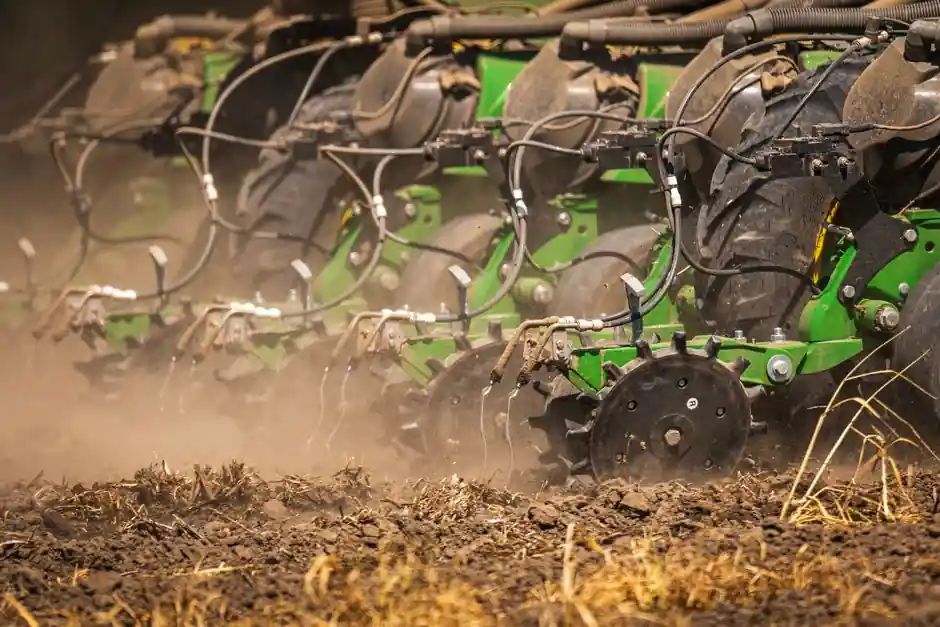
Agricultural plastic components, from pump housings to UV-exposed crates, push mold bases into a specific selection path where machine tonnage, shot volume, and glass-filled or UV-stabilized resin behavior dominate the decision over general consumer-toy tooling choices [S2][S4].
Standard mold bases (pre-engineered H-type and I-type frames) now supply most of the structural skeleton, leaving only inserts, ejection details, and cooling to be custom-machined [S3]. For a farm-equipment program this means the base-spec conversation is really a machine-fit and shot-volume conversation first, and a material-tolerance conversation second [S6][S7].
Mold base anatomy and what each plate actually does
A mold base is the pre-engineered steel frame that holds every moving component in alignment: top clamp plate, A and B plates, optional support plate, C plate (spacer block), rear clamp plate, ejector pin plate, ejector retainer plate, guide pins, and return pins [S3][S5].
The A plate carries the cavity insert or, on a simpler two-plate tool, forms the part surface directly; the B plate holds the core insert and can extend the runner system between shots; the C plate height sets the available ejection stroke and the maximum part depth [S3]. The reference mold base article in this encyclopedia confirms the same plate stack: top clamp, A, B, C (spacer), rear clamp, and the ejector/return-pin pair that resets between cycles.
Why agricultural programs change the base decision
UV-stabilized polypropylene, glass-fiber-reinforced nylon, ABS, and HDPE are the four resin families that recur across irrigation, chemical-handling, and livestock equipment, and each one rewrites what the base must tolerate [S2][S4].
Glass-filled nylon for a pump housing needs a base stiff enough to resist the higher clamp tonnage and the abrasive wear of the glass charge; polypropylene crates with integrated stacking ribs need a deep C plate and a guided ejection system to handle long ejection strokes without the part skewing [S2][S4]. Compared to a consumer enclosure, the same base width on a farm tool is typically driven by a thicker wall section (3–5 mm) and a 15–25% higher shot weight, which forces a step up in platen size [S7].
Standard H-type vs I-type vs two-plate custom

Standard mold bases split into two reference frames: H-type (larger footprint, two parting lines, often a three-plate runner) and I-type (compact, two-plate, single parting line), and a mold maker picks between them on size, cavity count, and runner strategy rather than on the end market [S6].
The agricultural crossover is straightforward: small valve bodies and connector brackets usually live on I-type bases with two cavities; large irrigation crates, fan shrouds, and reservoir tanks jump to H-type bases to gain the 400–800 mm platen width and the deeper C-plate travel that the part height demands [S6][S7]. The other decision branch is two-plate custom versus standard, and the rule from buyer guides is simple, the base size drives the machine clamp tonnage, which in turn fixes cycle cost, so a custom frame only pays back when the standard off-the-shelf catalog cannot match the platen footprint or the ejector stroke [S7].
Selection criteria tied to farm-equipment duty cycles
Three numbers govern the final call: machine clamp tonnage, maximum shot weight, and required ejection stroke, with the chosen resin setting the wear budget on the A/B plates and the ejector pins [S3][S7].
For a typical 500 g PP irrigation-component tool the rough target is a 150–220 ton clamp, a 250–350 mm platen width, and an ejection stroke of 40–80 mm; a 2 kg glass-filled nylon pump-housing tool jumps to 400–600 ton clamp, 400–600 mm platen, and 60–120 mm ejector stroke [S7]. Material choice then re-opens the steel spec: P20 (pre-hardened 30–36 HRC) is the default for PP and HDPE parts, while H13 or S7 at 48–52 HRC is the safer call once the tool runs glass-filled nylon above 30% glass load because glass charge erodes cavity surfaces roughly twice as fast as unfilled resin [S3]. The broader construction machinery and equipment reference covers how platen width and shot weight scale together across heavy-industrial tooling, the same relationship that applies to large farm implements.
Failure modes seen on agricultural tooling
The most common in-service failures on farm tools are ejector-pin galling, guide-pin bushing wear from dust ingress, and cavity-surface wash on glass-filled parts, all three accelerated by the high UV, fertilizer, and dust exposure that agriculture adds on top of normal cycle stress [S2][S4].
A standard base with a separate stripper plate is the typical fix for thin-walled PP parts that would deform under pin ejection, while a guided ejector frame with four rather than two guide pins is the insurance on long-stroke crates [S3]. Abrasive glass-filled nylon compounds the wash problem, so the A/B plates need hard chrome or nitrided surfaces and the ejector pins should move to H13 with nitrided skin rather than the default through-hardened SKD61 [S3].
Standards, sourcing, and what to verify before signing a PO
There is no single farm-tooling-only standard; the most common spec stack is JIS B 5111 / DME type catalogs for the standard frame, plus a documented steel-grade callout (P20, H13, S7, 2738) on the custom inserts, and an ejector and guide-pin drawing that matches the chosen resin [S1][S3].
Before signing off, confirm four things: platen footprint and clamp tonnage match the target injection machine, the standard base catalog code is in stock or has a quoted lead time, the C-plate height supports the tallest part plus the ejection stroke, and the steel-grade callout for the A/B plates is on the drawing rather than left to the shop floor [S1][S7]. A related reference on material selection is the casting mold encyclopedia entry, which shares the same plate-stack logic for sand-cast tooling where the base must also resist abrasive filled resins.
Trackable signal: watch the 2026 DME and MISUMI standard-base catalogs for new pre-hardened 2738 frames in the 500–800 mm platen range, a size band that fits the next generation of large UV-stabilized PP irrigation and storage tools. Related site coverage on agricultural handling equipment, such as this overhead bridge crane guide for agricultural facilities, tracks the same downstream handling-side decisions that a new molding program has to plan around once parts come off the tool.