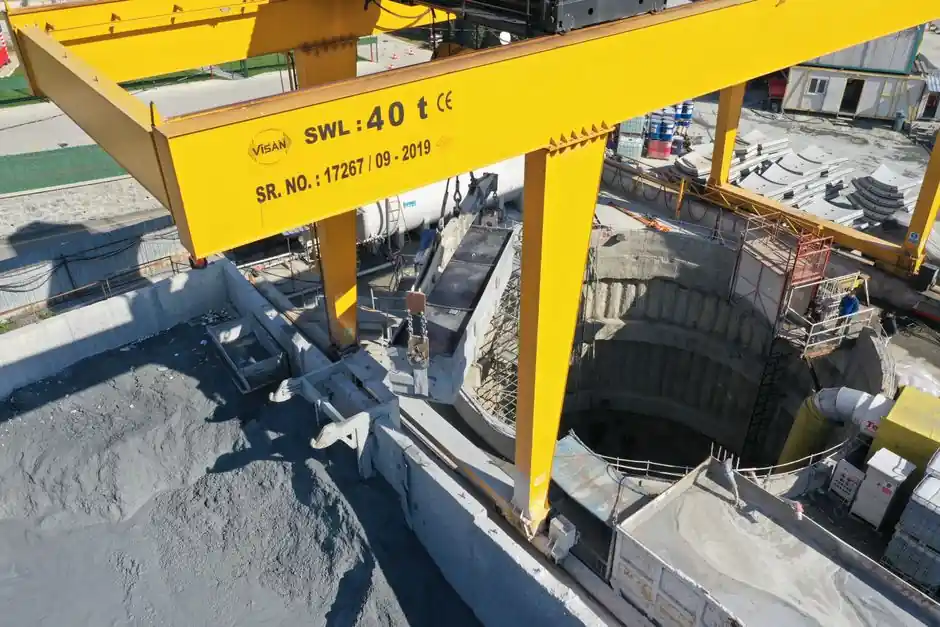
An overhead bridge crane in an agricultural setting is a movable bridge on a fixed overhead runway carrying a hoist and trolley, defined under 29 CFR 1910.179(a)(8) [S1], and is most often specified as a single-girder unit between 1 and 10 tons for spans to 65 ft [S2][S4].
On farms, feed mills, grain elevators, and equipment dealerships, the crane replaces forklifts for repeated heavy lifts of motors, gearboxes, seed containers, and implement sub-assemblies, with three axes of hook travel inside a rectangular work envelope [S3]. The dominant builds remain top-running single-girder for new construction and underhung (under-running) single-girder for retrofit buildings without runway columns [S4].
Regulatory Frame: OSHA 1910.179 and ANSI B30.2
29 CFR 1910.179 covers overhead and gantry cranes and defines an overhead crane as a crane with a movable bridge carrying a movable or fixed hoisting mechanism and traveling on an overhead fixed runway structure [S1]. The standard groups cranes into cab-operated, floor-operated, pulpit-operated, and remote-operated categories, with daily visual inspection and annual documented inspection required for power-operated units [S1].
Agricultural operators installing a new bridge crane should verify the equipment is designed to ASME B30.2 (the consensus standard referenced in 1910.179) and that the runway structure, end trucks, and bumpers (buffers) meet the energy-absorbing limits in 1910.179(a)(23) [S1]. The appointed person under 1910.179(a)(15) must own the inspection records, including brakes, clutches, sheaves, rope assemblies, and load-bearing structural components [S3].
Capacity and Span: Where 1–10 Ton Single-Girder Wins
TRSG (top-running single-girder) overhead cranes are commonly built with capacities up to 15 tons and spans to 98 ft, with most agricultural orders landing between 5 and 10 tons at 20–40 ft spans [S2]. Single-girder cranes are ideal for lifts under 15 tons and spans of 65 ft or less, with fewer parts, faster installation, and lower maintenance than a double-girder [S4].
Agricultural work rarely justifies a double-girder build. Double-girder cranes become the right answer above 25-ton lifts or spans of 65 ft and beyond, especially when cabs, magnet reels, walkways, or heavy-duty hoists are required [S4]. For a 1–10 ton farm installation, the under-running (underhung) configuration, where the bottom flange of the runway beam supports the crane wheels, lets owners mount the runway on existing roof trusses and avoid ground-level rails [S4].
Top-Running vs Under-Running: Building-Driven Choice
Top-running cranes run on rails mounted atop the runway beams and transfer wheel loads directly down through the columns, allowing the highest capacities and longest spans, but they require new structural steel or reinforced columns [S4]. Under-running (underhung) cranes hang from the bottom flange of the runway beam, which removes the need for column-top rails but caps the practical capacity lower because the runway beam carries both bending and the wheel reaction [S4].
For an existing metal-clad equipment shed or a converted dairy barn, underhung is often the only feasible fit because there is no runway column line. For new build grain-handling or feed-mill construction, top-running single-girder is usually more cost-effective per ton because the runway columns are already in the building design. The encyclopedia entry on overhead bridge crane configuration walks through the same top-running vs under-running trade-off with attention to wheel-load and runway-beam sizing.
Duty Cycle, Environment, and Hoist Selection
Agricultural overhead cranes run intermittent, light-duty cycles compared with steel-mill or paper-mill service, so most fall into CMAA Class A or B service (standby or light service) rather than Class D or E [S3]. Wire-rope hoists dominate above 2 tons because they tolerate dust and temperature swings better than chain hoists; chain hoists in food-grade or seed-handling areas are typically rated for indoor, dry service and lower duty cycles.
Dust from grain, fertilizer corrosion, and ambient humidity push buyers toward enclosed conductor bars rather than festoon cable, and toward galvanized or epoxy-coated runway steel where ammonia exposure exists in livestock buildings. The encyclopedia crane scale reference notes that integrated load cells are now common on agricultural builds to prevent over-capacity lifts of tractor weights and implement sub-assemblies, which can exceed the nameplate rating by 20–30% if chained from a single lift point.
Runway, Power Delivery, and Controls
Runway alignment tolerance under 1910.179 is checked at installation, and a bridge crane with a 40 ft span running on a runway that is out of parallel by more than the rail-manufacturer's spec will produce wheel climb and trolley skew [S1]. Power delivery is normally a three-phase 460 V (or 230 V) supply through a four-rail conductor bar, with a fused disconnect at the runway end and a mainline pendant or radio control at the operator station [S4].
Radio remote control is now standard on agricultural bridge cranes above 3 tons because it removes the operator from under suspended loads and lets one person position a load while a second hooks it. Pendant control with a 20% voltage drop limit on the control circuit remains common on sub-2-ton workstation and jib applications that sometimes pair with a gantry crane for outdoor implement work.
Selection Checklist and Sourcing Notes
Selection criteria in priority order: required lift (ton) × duty cycle (lifts/shift) × span (ft) × building structure (top-running vs underhung) × environment (dust, corrosion, temperature) × controls (pendant vs radio) [S4]. The threshold for moving from a forklift or front-end loader to a bridge crane is usually 4–6 lifts per shift above 1 ton, where manual handling risk and forklift travel time make a fixed installation pay back inside 2–3 seasons.
Specification should be cross-checked against CMAA 70/74 duty classification, ASME B30.2, and 29 CFR 1910.179, with documented daily and annual inspections logged under the appointed person [S1][S3]. For agricultural operations also running mobile lifting, the side-by-side mobile crane comparison is useful for yard work, while the dedicated overhead bridge crane reference covers fixed-installation geometry. Buyers comparing fixed-bay crane choices against portable options can also review the spec-driven framework in Truck Crane vs Tower Crane selection for 2026 job sites, which carries the same capacity-versus-span logic for mobile units.
Trackable signals for the next buying cycle: ANSI B30.2 revision updates referenced in OSHA 1910.179 commentary, plus a measurable shift from CMAA Class A/B to Class C agricultural crane orders as farms consolidate equipment dealerships into single repair halls. A useful engineering comparison for buyers weighing fixed-bay vs mobile lifting across mixed sites is the broader spec logic in Aerial Work Truck specs for snow removal: 2026 chassis and lift selection, which uses the same chassis-and-lift matching discipline on a different duty profile.