
A molding line is a capital-intensive production system whose economics flip sharply with volume: at 10,000+ parts it is the cheapest per-unit path on the shop floor, while below ~1,000 parts the same line is the most expensive option available [S4].
The technology spans plastic injection molding, reaction injection molding (RIM), and blow molding, each with its own cycle-time, tolerance, and material envelope — the three share a common backbone of a heated plastic feed, a clamped mold, and an automated part-ejection stage, but diverge sharply on clamp tonnage, cure kinetics, and tooling cost [S3][S6][S9].
Cycle Time, Volume, and Per-Part Cost
Once a mold is cut, injection-molding cycle times fall to 10-30 seconds for thin-wall parts, with a typical 20-60 second envelope for general parts and longer cycles only for thick-walled or large-area parts [S3][S4]. Multi-cavity and family molds multiply output per press and drop per-part cost proportionally, which is why the 10,000-100,000+ unit run is the line's economic sweet spot [S4].
The flip side is that mold design and fabrication is a heavy upfront cost: tooling, machinery, and process setup are the dominant line items, and break-even against CNC or 3D printing sits in the low-thousands of parts depending on geometry [S7]. For comparison, a concrete groove cutter project follows a similar logic where capital cost only amortises above a project-volume threshold.
Geometric Complexity and Tolerance Envelope
Complex shapes — undercuts, internal passages, fine surface texture — are the molding line's strongest card: mold cavities carry the geometry, and molten polymer replicates it on every cycle, so a part that would be expensive on a 5-axis CNC becomes cheap at scale [S3]. Tolerance and repeatability meet the requirements of automotive, aerospace, electronics, and medical-device production for most non-critical dimensions [S5].
However, precision is slightly below CNC machining, and the surface finish is dictated by the mold — every change costs a tooling iteration. This is one reason the same trade-off shows up on floor grinder selection: the tool defines the surface, and the line defines the throughput.
Automation, Labour, and Throughput Integration
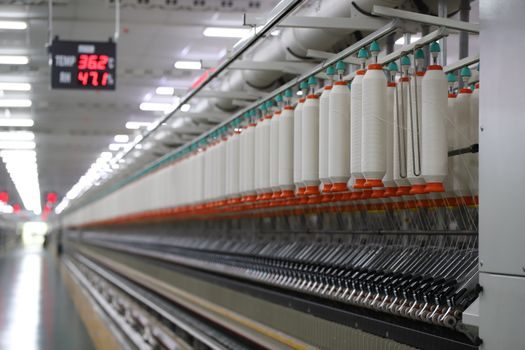
An injection-molding production line is highly automatable: automatic demoulding, robotic extraction, and downstream inspection can be strung together with minimal manual intervention, leaving only trim and visual-inspection steps for operators [S3]. Electric machines cut cycle times by up to 20%, eliminate hydraulic oil, and reduce power draw, but they cannot match the clamp tonnage of a hydraulic press [S8].
RIM in-mold painting trims labour and paint consumption versus post-mold spray, but complex mold shapes resist uniform coating and the painting station has to live on the molding line itself [S6]. Blow molding sits in the same automated-line family — see the blow molding vs rotational molding trade-off — where throughput is high but tooling and parison control cap the geometry.
Material Range, Waste, and Sustainability
Modern molding lines run commodity polymers, engineering plastics (ABS, PA, PC, POM), and high-performance grades that match or beat certain metals on strength, heat, and corrosion resistance [S3]. Material utilisation is high because sprue and runners are the main waste stream and can be reground and re-fed, which makes the line attractive for closed-loop production [S3][S7].
The material range is also where molding lines share a selection pattern with nitrile rubber (NBR) applications: the polymer grade sets the temperature, chemical, and mechanical envelope, and the line must be configured around that envelope, not the other way around.
Press Comparison: Hydraulic, Electric, Toggle
The three press architectures split on clamp force, speed, cleanliness, and cost. Electric presses win on cycle time (up to 20% faster), energy use, and cleanroom suitability; hydraulic presses deliver the highest clamp tonnage for large-area parts; toggle presses sit in the middle on cost and clamp force [S8]. Selection is therefore a function of part projected area, shot weight, and tolerance — not brand.
For large ferrous castings the analogous decision is between a static-pressure molding machine and a shell molding machine, where the same trade-off — capital cost vs clamp force vs cycle time — applies; for high-volume sorting downstream of the press, a conveyor sorting line is the throughput-matching companion.
Failure Modes, Limitations, and Selection Gates
Three failure modes dominate: (1) short-shot and flow lines when melt temperature, injection speed, or mold venting are wrong; (2) warpage and sink marks when wall thickness is non-uniform or cooling channels are poorly placed; (3) flash and over-pack when clamp tonnage is undersized or shot volume is miscalculated. All three are mold-design failures before they are machine failures, and they are why the upfront engineering effort is non-negotiable [S3][S5].
Selection gate: choose an injection-molding line when annual volume clears ~10,000 parts, geometry is complex, and the part family is stable for at least 12-24 months; skip it when volume is low, design is still iterating, or part size exceeds the largest press in the candidate cell. The same gate logic appears on order picker selection and fire extinguisher class selection: capital cost amortises only above a defined use threshold.
Standards, Sourcing, and Trackable Signals
No single ISO or ASTM number governs the line as a whole; instead, compliance is built from part-level standards — material datasheets (ISO 1043, ASTM D638), dimensional tolerance (ISO 2768, ISO 1101), and end-use industry rules (automotive IATF 16949, medical ISO 13485, food-contact FDA/EC 1935). The line itself is selected on clamp tonnage (kN), shot volume (cm³), platen size (mm), and dry-cycle time (s) [S5][S7].
Trackable signals to watch over the next two quarters: (1) electric-press market share as energy-cost pressure pushes retrofits, and (2) tooling-cost inflation in low-volume moulding where additive manufacturing is increasingly absorbing the prototype niche. For a fuller process overview, the automatic molding line reference and the broader molding line spec map cover the same selection axes from a different angle.