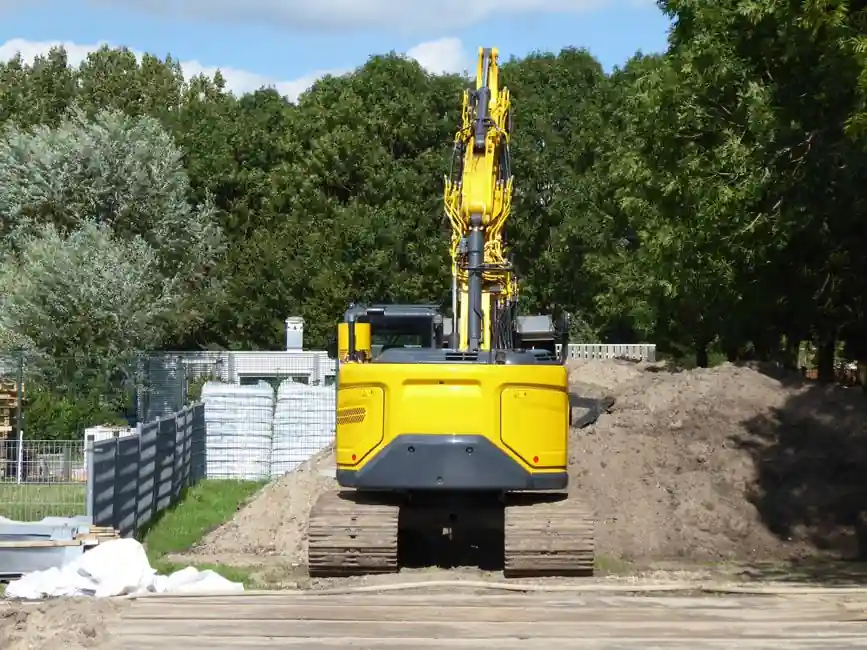
Tunneling excavators are a distinct machine class, not a paint job on a standard excavator: a short boom-arm geometry, reduced tail swing, and a protected operator envelope are mandatory for confined headings, as defined in ScienceDirect's tunneling-excavation overview [S1].
For urban transit, hydro, and mining headings, selection reduces to four levers: operating weight class, engine power, attachment quick-coupler type, and aftertreatment/emission stage. Compact short-radius models in the 12-15 t band dominate inner-city microtunnel drives, while 20-25 t class machines handle station caverns and rail bores [S2][S3].
Compact Short-Radius Class: The 12-15 t Tunnel Workhorse
The Hitachi ZX135US-7 SRF is engineered around a short boom and short arm geometry, with reduced rear overhang so the machine can swing inside a tight cross-section without striking ribs or shotcrete [S4].
Hitachi publishes this class as accepting attachments sized for larger 20-tonne machines, including hydraulic breakers and crushers, which matters because the same carrier has to load shotcrete buckets, trim the face, and break oversize in a single shift [S4]. For broader context on the excavator family and how tunneling variants differ from surface machines, the engineering trade is compactness versus reach.
Mid-Range Class: 20-25 t for Station Caverns and Rail Drives
The DEVELON DX235RTF-7 sits in the 20-25 t operating-weight band, sized for station caverns, NATM rail drives, and longer tunnel headings where higher hydraulic flow and larger bucket capacity outweigh the need for ultra-short tail swing [S3].
DEVELON documents engine and hydraulic specifications for the DX235RTF-7 in its European tunneling brochure, with quick-coupler compatibility as a headline feature so crews can switch between buckets, breakers, and rotary cutters without leaving the cab [S3]. When the carrier must also install ground-engaging tools cleanly, the quick-coupler plumbing and track gauge are the first items to verify on the data sheet.
Selection Criteria: Power, Emissions, and Hydraulic Flow

Engine power is the most cited selection metric: the DX235RTF-7 publishes engine output in its brochure, paired with hydraulic flow figures that govern breaker and cutter-head performance [S3]. Tier 4 Final / Stage V aftertreatment is now standard for European-market tunneling builds, driven by tunnel ventilation air-quality rules.
Decision criteria for tunneling excavator selection, ranked by impact on cycle time: (1) engine power and hydraulic flow, (2) short-radius geometry and tail-swing envelope, (3) quick-coupler type and attachment availability, (4) emission stage for underground air permits, (5) undercarriage width versus heading cross-section. A carrier that is 200 mm too wide will not enter the drift; one with 10% less hydraulic flow will stall a 1.5 t breaker on hard rock.
Attachment Fit: Breakers, Crushers, and Cutter Heads
Hitachi's tunneling carrier is explicitly rated for attachments that would normally hang on a 20-tonne machine, including crushers and breakers, a deliberate upsizing for hard-rock headings [S4]. This means the carrier's boom cylinders, stick pin, and hydraulic lines are sized above the machine's nominal class.
DEVELON's quick-coupler-first design philosophy allows a single DX235RTF-7 to swap between face-scaling buckets, hydraulic breakers, and rotary cutting heads across one heading cycle, reducing the number of support machines on the muck pile [S3]. For crews that also deploy diaphragm wall grabs on the same project, see this diaphragm wall grab types and classifications reference to keep carrier classes consistent across the site fleet.
Used-Market Caveats and Maintenance Records
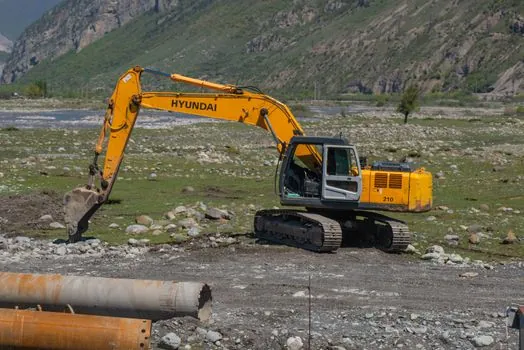
Used tunneling excavators carry a meaningful discount versus new, but the discount evaporates quickly if boom pin bushings, hydraulic seals, and emission-system DPF/DPF+SCR modules are at end-of-life. Review maintenance logs, underground-hour meter readings, and shotcrete-corrosion history before signing [S2].
Hitachi's special-applications product page notes that tunneling carriers are designed to "dig deep for lengthy periods of time", a clue that mean time between overhauls is the real TCO driver, not the sticker price [S4]. Filter cycle hours, undercarriage wear, and front-link pin grease intervals are the three numbers to confirm in writing.
Who Tunneling Excavators Are For, and Who Should Pass
Tunneling excavators are built for: urban metro contractors, hydro and sewer heading crews, mining development drives, and station-cavern finish work where short-radius geometry and breaker-rated hydraulics dominate the cycle. They are not for open-pit bulk earthmoving, large-diameter TBM slurry support, or soft-ground drives where a roadheader or shield machine is the right primary tool [S1][S2].
If the project requires a full-face cutterhead with continuous muck extraction, a shield TBM is the correct specification, and an excavator is a support machine only. For long-distance drives in stable rock, a conventional drill-and-blast cycle with a compact tunneling excavator for muck loading is the conventional method described in tunneling practice [S1].
Standards, Sourcing, and Trackable Signals
Applicable frameworks for tunneling excavator deployment include EU machinery safety rules, underground diesel emission limits (typically tied to MSHA/CanMET-style limits or local equivalents), and project-specific RAMS documentation. No single ISO standard governs the tunneling-excavator category itself; instead, the carrier must meet general machine safety standards plus project-specific ventilation and fire-suppression requirements [S1].
Trackable signals for the next quarter: OEM publication of Tier 4 Final / Stage V engine options for the 12-15 t class, expanded quick-coupler attachment catalogues for short-reach carriers, and operator-training program updates from tunneling OEMs. For projects that also involve dewatering and concrete placement, see this concrete pump truck installation reference to align heading and surface-plant commissioning.
Spec-level background on the components involved: pressure transmitter, and flow meter.