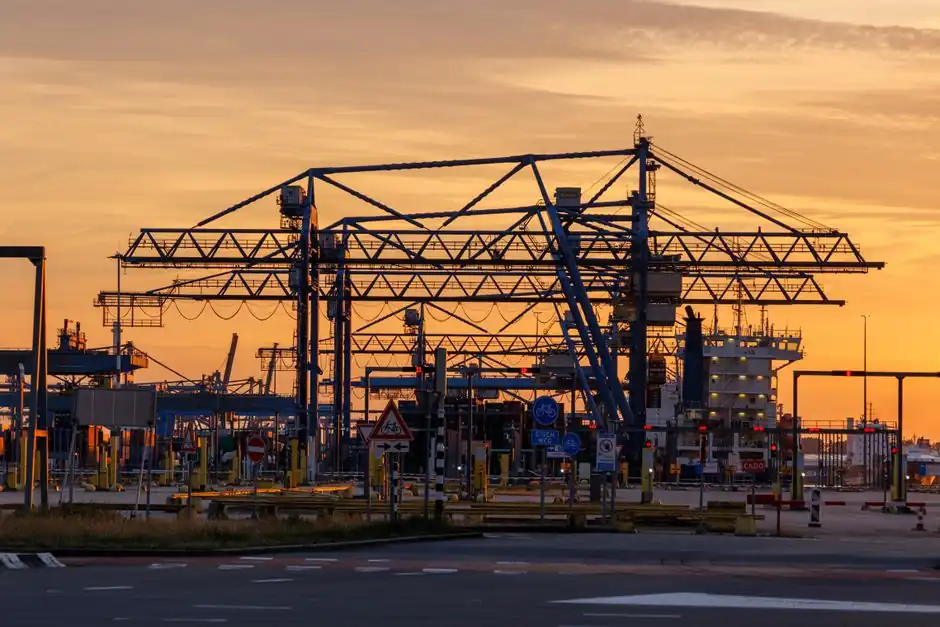
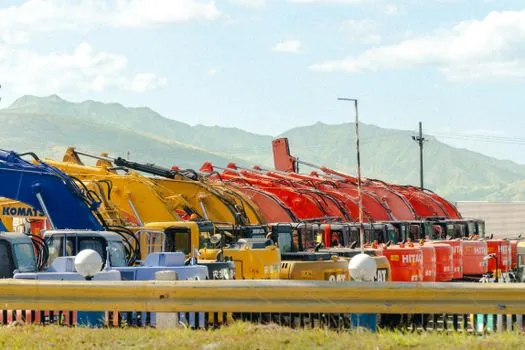
Port and terminal excavator fleets in 2026 are typically built around 20-40 tonne hydraulic machines (Cat 320/323/330 class) for quayside bulk handling and 50-90 tonne units (Cat 336/345/374) for dredging, scrap, and heavy-lift cycles, per dealer selection guidance from Ziegler Cat [S2].
Selection hinges on four measurable axes: operating weight, bucket capacity, maximum reach at ground level, and hydraulic flow available for powered attachments such as grapples, magnets, and shears. The machine class must also match the quay surface rating and the average ship-vessel turnaround window, since under-sized units inflate cycle time and over-sized units waste fuel and ballast deck capacity [S2][S3].
Operating weight class and port duty cycle
Ziegler Cat's buying guidance places compact excavators below 6 metric tonnes in the landscaping/utility bracket, midsize 7-45 tonne machines in the general construction and small-quayside bracket, and large 45+ tonne units in the heavy construction, mining, and port-bulk bracket [S2]. For container terminals handling break-bulk, scrap, or aggregate, the practical band is 20-40 tonnes; for dry-bulk stockyards and ship-loader feed, 30-50 tonnes is the dominant choice.
A 20-tonne Cat 320-class machine typically delivers roughly 1.0-1.5 m³ bucket capacity and 9-10 m maximum reach, while a 50-tonne Cat 336/345 class moves to 1.5-2.5 m³ and 10-12 m reach, per the dealer's class-by-class mapping [S2]. Port operators should size the unit to the heaviest single-lift expected in 90% of cycles, not the absolute maximum, to avoid chronic under-utilisation.
Grapple attachment geometry and hydraulic integration
Excavator grapples use hydraulically actuated opposing jaws rather than a fixed bucket envelope, and their performance is set by jaw closing angle, arm reinforcement, and hydraulic pressure matching to the carrier, per Guven Grab's engineering write-up on dredging and port grapple design [S1]. Reinforced arms and wear-resistant steel are required for abrasive sediment, rip-rap, and scrap flows common in port work.
Grapple rotational capability (typically 360° continuous via an integrated slewing ring) adds a positioning axis that lets the operator orient loads without slewing the entire upperstructure, which shortens cycle time in close-quarters quay work [S1]. Hydraulic flow demand for a 5-finger grapple generally runs 60-120 L/min at 200-350 bar, so the carrier's auxiliary circuit must be spec'd at purchase or retrofit with a third-line proportional valve package.
Site selection context: how the terminal layout constrains the machine
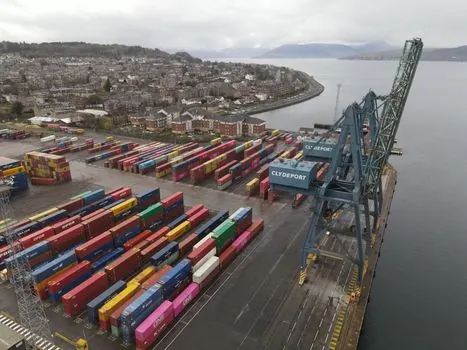
Ausenco's site-selection framework lists the criteria that ultimately pin down the excavator spec: berth depth, wave and current shelter, landside access (road, rail, conveyor, pipeline), and on-shore footprint for storage and future expansion [S3]. A quay with limited landside area favours long-boom, tight-tail-swing machines; a facility requiring frequent dredging favours a heavier carrier matched to a high-capacity grapple and longer undercarriage for stability on reclaimed ground.
The same framework flags dredging as one of the trade-off decisions in port design, alongside breakwater construction and tug-harbour provision [S3]. Where routine maintenance dredging is on the cycle, the fleet typically dedicates at least one 50-90 tonne long-reach excavator to the dredge grapple, separate from the quayside material-handling fleet, to keep vessel-turnaround cycles independent of dredge availability.
Selection criteria comparison: compact vs midsize vs large port excavators
Across three weight classes, the decision criteria for port use line up as follows. Bucket capacity scales roughly from under 0.3 m³ (compact, under 6 t) to 0.5-1.5 m³ (midsize, 7-45 t) to 1.5-3.0 m³ (large, 45+ t), per Ziegler's class table [S2]. Maximum dig depth and reach scale on a similar curve, with compact units topping out around 4 m reach and large mining-class units exceeding 12 m.
On grapple compatibility, compact machines are generally limited to static (non-rotating) grabs in the 0.5-2 t class, midsize units cover most 2-8 t hydraulic rotatable grapples used in scrap and timber ports, and only 30+ tonne carriers provide the hydraulic flow and stability envelope for 8-15 t heavy-duty dredge grapples [S1][S2]. Fuel burn and total cost of ownership scale almost linearly with operating weight, so the rule of thumb is: pick the smallest machine that still lifts the median load with a 20% margin.
Limitations, failure modes, and what to over-spec
Guven Grab flags three recurring failure modes in port grapples: jaw pivot pin wear under abrasive sediment, hydraulic cylinder seal failure from contaminated return oil, and slewing-ring fatigue on continuously rotating units [S1]. The first two are addressed by hard-faced pins and a 10-25 micron return-line filtration upgrade, while the third is a design-life limit typically rated at 8,000-12,000 hours before bearing replacement.
The structural limits of the carrier itself are often the binding constraint: a 20-tonne excavator should not be routinely loaded above roughly 3-4 tonnes per grapple lift, even if the grapple is rated higher, because the machine's lift charts derate sharply at full reach [S2]. For quayside work where the load is often at maximum radius, oversizing the carrier by one class typically pays back through reduced cycle time and lower structural fatigue over a 10,000-hour service life.
For terminals planning a new build or fleet refresh, the next decision node is the hydraulic auxiliary circuit spec at order time: a machine ordered without proportional auxiliary lines and adequate return-line filtration is costly to retrofit, and the retrofit often forces a smaller grapple than the carrier could otherwise handle. Two trackable signals to watch in 2026 are OEM announcements of factory-fitted grapple-ready hydraulic packages on 20-40 tonne Cat-class machines, and any port-tender documentation that names a specific grapple tonnage class rather than a generic "suitable attachment" clause.
Spec-level background on the components involved: excavator, terminal block, and construction machinery and equipment.
Background reading: Concrete Pump Truck vs Vacuum Pump: Function, Specs, and Selection.