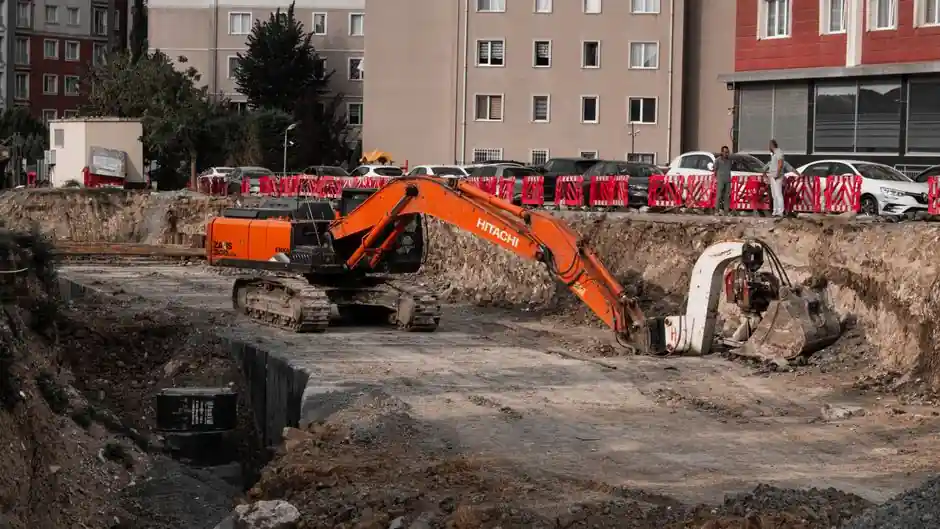
For farms, an excavator choice is driven by operating weight, dig depth, and attachment compatibility rather than engine kW rating; sub-1 t, 1-2 t, 2-5 t, and 5-6 t classes each map to a distinct set of tasks from greenhouse trenching to pond dredging [S2][S3].
Across published agricultural use cases, the same machine is expected to dig post holes, maintain drainage, clear brush, plant trees, and grade farm lanes, so over-spec'ing on weight wastes fuel and compacts soil, while under-spec'ing stalls the work cycle. Compact machines from 638 kg up to 5820 kg cover the full range, with bucket capacities from 0.022 m³ to 0.22 m³ and dig depths from 1.30 m to 3.81 m [S3].
Operating-Weight Classes and Where Each One Fits
Operating weight below 1 t (for example 638 kg, 758 kg, 850 kg units) is the right band for greenhouse rows, narrow orchard lanes, and inside livestock pens where access width is below about 1 m and ground pressure on cultivated soil must stay low; dig depth in this class sits at 1.30-1.79 m, which covers shallow drainage and post-hole work [S3].
The 1-2 t band (1.7-1.8 t) raises dig depth to 2.07-2.31 m and bucket capacity to 0.04-0.05 m³, the typical choice for fence-post lines, small irrigation trenches, and tree planting on mixed terrain [S3]. For broader field work, pond work, and feedlot grading, the 4.2-5.8 t class delivers 3.4-3.8 m dig depth, 5.4-6.1 m ground-level reach, and 0.17-0.22 m³ buckets that move volume in fewer cycles [S3]. A 10 kW jump between the 1.8 t and 4.2 t classes (14.7 kW to 25.2 kW) is the rough hinge where cycle time on trenching changes from "acceptable" to "comfortable" [S3]. Buyers who intend to mount hydraulic attachments such as augers, grapples, or tilt buckets should verify auxiliary flow before sizing, not after [S2].
Access Width, Transport, and Site Constraints
Access width is usually the binding constraint on a farm: a 1.0-1.2 m greenhouse door, a 1.5 m orchard gate, or a 2.0 m livestock pen opening will eliminate the 4-6 t class regardless of how much digging depth it offers [S2].
Machines in the 638-850 kg range can be trailered behind a standard pickup, while 1.7-1.8 t units typically need a 2-2.5 t rated trailer with brakes, and the 4.2-5.8 t class usually requires a lowboy and a commercial tow vehicle because transport mass crosses the 5 t threshold where most jurisdictions require a heavier vehicle class [S3]. Ground pressure on tracks also rises with class: a 5.8 t machine on standard tracks can rut soft field edges after rain, so rubber-track width and track-pad pattern are a real selection item, not a brochure line [S2].
Engine, Hydraulics, and Attachment Compatibility
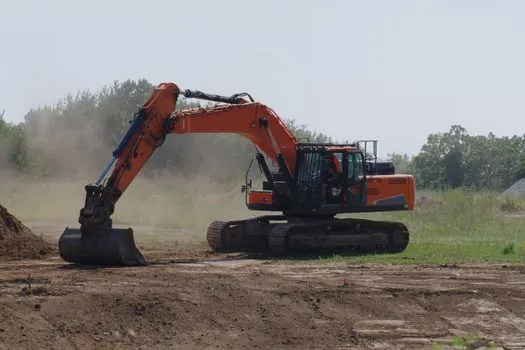
Engines in the 7-14.7 kW band cover the sub-2 t classes, with the 4-6 t segment stepping up to 25.2-36.2 kW; the published agricultural compact lineup pairs these with Yanmar 3TNV/4TNV and Kubota D902 series engines, which is the dominant pattern in the sub-6 t segment [S3].
Hydraulic flow and auxiliary circuit type determine whether a unit can run an auger, a thumb, a tilt bucket, or a hydraulic breaker without downgrade. A buyer planning brush clearing and stump work should spec a machine with confirmed auxiliary flow, return-line, and case-drain provisions rather than discovering the limit after delivery [S2]. For pond dredging, the long-reach geometry matters more than raw power: the 4.2 t class reaches 5.4 m at ground level and 5.0 m digging height, the 5.8 t class reaches 6.1 m and 5.9 m respectively, both well above what 1-2 t units can present over a pond bank [S3]. A wheeled vs tracked comparison is worth scanning for farms with hard-surface yards where road-to-yard travel is constant.
Stability, Undercarriage, and Farm-Terrain Behaviour
Stability on farm ground depends on three numbers working together: track length, track width, and tail-swing radius. A 1.0-1.8 t zero or reduced tail-swing machine is the safer pick inside barns and between orchard rows where a full swing would clip posts or livestock infrastructure [S2].
Track-pad choice (rubber, steel, or segmented) should follow ground type: rubber pads on soft cultivated soil minimize damage, steel pads on rocky, abrasive ground resist cuts, and hybrid segmented pads are common where a machine moves between a yard and a field in the same shift [S2]. On slopes, the wider the undercarriage relative to length, the better the lateral stability when the boom is swung to the high side, a rule that pushes buyers toward the longer-track variant within a given weight class [S2].
Comparison: Which Class for Which Farm Task
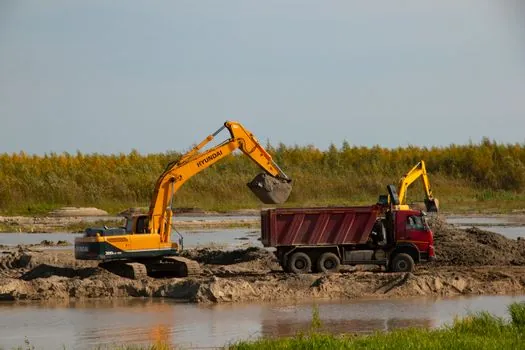
The four operating-weight classes line up against four task profiles as follows: sub-1 t fits greenhouse trenching, post holes, and small drainage repairs at 1.3-1.8 m dig depth; 1-2 t fits fence lines, tree planting, and irrigation runs at 2.0-2.3 m dig depth; 2-5 t fits pond-edge work, feedlot grading, and medium trenching at 3.4-3.5 m dig depth; 5-6 t fits large pond dredging, heavy land clearing, and contractor work at 3.8 m dig depth and 0.22 m³ bucket volume [S3].
Fuel and parts cost scale roughly with engine kW: a 36.2 kW machine burns about 5x the fuel of a 7 kW unit per hour and pulls from a different service-parts inventory, so a farm running only seasonal work should not buy a class it cannot economically keep loaded [S3]. Buyers who already operate a backhoe should review backhoe selection logic before adding a mini excavator, since the overlap is real and the wrong pair doubles up cost without doubling throughput.
Maintenance, Spare Parts, and Supplier Support
Service access for daily checks (filters, grease points, hydraulic connections) is a selection criterion that shows up only after a season of use, so buyers should physically inspect the engine bay layout before purchase rather than trusting a brochure [S2].
Parts supply from the manufacturer or its dealer network is the single most cited cause of long downtime on compact agricultural machines, more than mechanical failure itself; a unit with a confirmed regional dealer, common filters shared with other models in the lineup, and stocked wear parts (track pads, bucket pins, hydraulic hoses) will outwork a slightly cheaper unit with thin support [S2]. For buyers comparing across machine types, the excavator category page gives a neutral spec frame for the class before diving into model-level comparison.
Operator Comfort, Safety, and Daily Usability
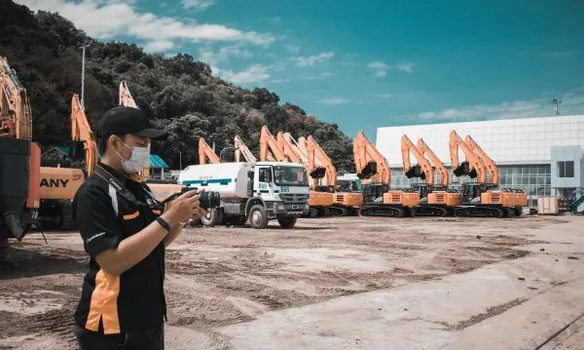
ROPS/FOPS canopy or cab, control layout (ISO or SAE pattern), and noise level at the operator station are the day-one comfort items that determine whether a machine gets used or parked; a farm owner running 200-400 hours a year will feel a poorly laid out cab on every shift [S2].
Visibility to the bucket, the rear swing area, and the right-side track is critical in tight farm spaces, so glass area, mirror count, and optional rear-view cameras are a real safety spec, not a luxury add. Quick-change attachment couplers, which swap a bucket for an auger in under a minute, materially raise daily productivity on farms that switch tasks four or five times per shift [S2].
Limitations, Failure Modes, and What a Mini Excavator Will Not Do
A mini excavator is not a tractor replacement: ground-drive speed is low, three-point implements do not fit, and PTO-driven attachments are out of scope, so a farm that needs mowing, tilling, or balework still needs a tractor alongside the excavator [S2].
The 0.6-6 t compact segment will not replace a full-size excavator on heavy land clearing, large pond construction, or deep foundation work; the 0.22 m³ upper-end bucket is a fraction of a full-size machine's capacity, and cycle times on truck-loading scale poorly past about 6 t of operating weight [S3]. Common failure modes on farm units are hydraulic-hose damage from brush, track-pad wear from abrasive soil, and bucket-pin wear from rocky ground; each is a consumable, not a design defect, and should be budgeted as a scheduled cost rather than a surprise [S2].
For a farm sizing a new compact machine in late 2026, the decision order is: measure access widths on the property, list the three to five most frequent tasks with their required dig depth and reach, confirm attachment hydraulics and dealer support, then size the operating-weight class. The track record through 2026 is that buyers who skip the access-and-task step and pick by engine kW or bucket size alone re-trade within two seasons [S2].
Spec-level background on the components involved: pressure transmitter, and flow meter.