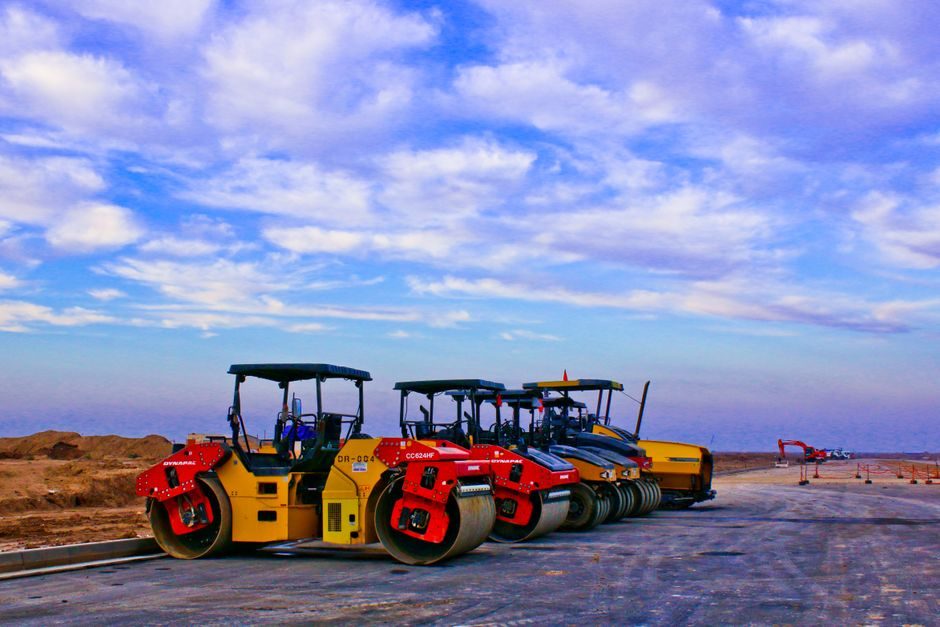
A motor grader for road construction is sized primarily by engine net power, operating weight, moldboard width, and drivetrain architecture; current production units span roughly 135 hp compact machines up to 290 hp in the Cat 16-class, which posts 290 hp base power (1st gear, net) and 71,454 lb typically-equipped operating weight with a 16 ft blade [S6].
Selection discipline matters because the machine that finishes a sub-base to within 5 mm tolerance is rarely the same one that maintains a haul road under a 40-ton mining truck, and the wrong transmission choice alone can halve productivity on soft terrain. Three drivetrain families dominate the global market — hydrostatic, direct-drive (powershift), and torque-converter-drive — each with a different traction and duty profile [S9].
Power and Weight Classes on Offer in 2026
The compact / small-motor-grader segment runs 135-180 hp, with 180 hp units such as the GR180 commonly listed around US $43,400 FOB with rippers as an option [S5]. Mid-frame machines such as the Caterpillar 12M3 AWD sit in the 200-240 hp band and add all-wheel drive for loose or wet subgrade work, with the AWD configuration specifically aimed at traction on challenging terrains [S2].
At the top end, the Cat 16-class machine delivers 290 hp base power, 71,454 lb operating weight, and a 16 ft moldboard — specifications that place it firmly in the heavy-haul-road and motorway-finishing segment rather than municipal street work [S6]. Used inventory from 2026 listings includes older units such as a 1999-vintage Cat 14G with Cat 3306 engine, powershift transmission, and 192 in (16 ft) blade width still offered through Shanghai-based resellers with 3-day delivery terms [S3].
Drivetrain Choice: Hydrostatic vs Powershift vs Torque-Converter
Motor graders carry one of three transmission types — hydrostatic, direct-drive, or torque-converter-drive — and the choice controls how the machine behaves under load and on grade [S9]. Hydrostatic drives give infinite, clutchless speed control across the working range, which is the preferred characteristic for finish grading where the operator is constantly modulating blade pressure.
Direct-drive (powershift) transmissions, as fitted to the Cat 14G and many M-series Cat graders, lock the engine to the wheels through a multi-speed gearbox and tolerate sustained high draft loads better, which is why they remain common on heavy road-build applications [S3]. Torque-converter drives sit between the two, multiplying stall torque for scraper-push or ripping duty at the cost of some efficiency at steady speed. All-wheel-drive variants such as the 12M3 AWD layer an additional driven front axle on top of the base transmission to maintain tractive effort when the rear wheels slip on a wet, clay-rich subgrade [S2].
Moldboard, Cutting Edges, and Ground-Engaging Tooling
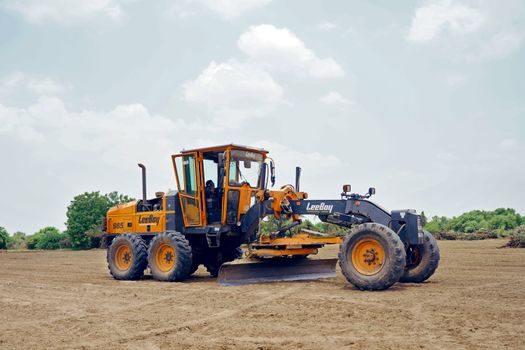
The moldboard is the defining component of any motor grader, and its consumable cutting edge dictates hourly operating cost. Standard edges for the 24M-class machine are coded 4T6508ICE in dimension 25 x 254 x 2133 mm at 79 kg net weight, typically produced from 30MnB boron steel or Q345B high-strength low-alloy plate depending on supplier [S8].
Blade width on production graders clusters around 12 ft for compact units, 14 ft for mid-frames, and 16 ft (192 in) for the heavy class — a value that has stayed essentially constant since the 14G generation in the late 1990s [S3][S6]. For applications that need below-grade work — breaking up hardpan, ripping frozen surface, or pulling a sub-soiler — rear rippers are the standard attachment, with the GR180 ripper package listed at the same ~US $43,400 price point when configured for OEM/ODM supply [S5].
Application Mapping: Road Build, Maintenance, Mining, Snow
For new road construction — sub-base trimming, base-course leveling, and final surface preparation — a 180-240 hp mid-frame grader with hydrostatic drive and 14 ft moldboard is the workhorse configuration, because the work cycle is dominated by low-speed, high-precision passes rather than long-distance tramming. Compact 135-180 hp units are the right size for street patching, parking-lot grading, and shoulder work where the machine must operate in confined urban space without tearing up adjacent pavement. [S2]
For mining haul-road maintenance, the heavy 290 hp class with 71,454 lb operating weight and 16 ft moldboard is the appropriate match, because the grader must hold grade against continuous heavy-truck deformation; the same machine doubles for snow removal on long arterial routes [S1][S6]. Volvo graders in the G960-class are positioned for exactly this haul-road, shoulder, and drainage-profile work, with OEM guidance emphasising shape, level, and finish precision as the primary deliverables [S1]. Municipal maintenance fleets typically run a smaller class to optimise transport and fuel cost per lane-km.
New, Used, and Supply Channels in 2026

The supply side splits into three channels: OEM new machines (Cat 16-class at 290 hp / 71,454 lb [S6]), dealer-used inventory (Volvo G960-class and Cat 12M3 AWD listings on major equipment aggregators [S1][S2]), and a large China-domestic aftermarket covering Shantui, SDLG, and SEM units alongside a deep cutting-edge and ripper parts supply chain [S3][S5][S7][S8].
Used 14G units from the late 1990s remain actively traded in 2026 with T/T payment and Shanghai-based ex-yard delivery within 3 days, indicating a working secondary market for older but serviceable powershift machines [S3]. For procurement teams, the practical decision tree is: confirm the duty profile (finish grading vs heavy maintenance), pin the power band from that, choose the drivetrain family, then validate parts supply for the moldboard cutting edge (e.g. 4T6508ICE for 24M-class) and rear ripper before signing. A 180 hp GR180-class machine with ripper starts around US $43,400 FOB for OEM/ODM orders, while a new 290 hp Cat 16-class sits in OEM suggested-retail pricing exclusive of freight, taxes, and dealer setup [S5][S6].
Common Selection Pitfalls and Failure Modes
Under-specifying power is the most frequent error: a 135 hp compact unit will stall on a cohesive-clay subgrade when the moldboard is loaded to design depth, and the operator compensates by raising the blade, which leaves a high spot that has to be re-cut — a hidden productivity tax. Over-specifying AWD on a dry, well-drained gravel road adds capital cost and parasitic loss for no traction gain; the 12M3 AWD configuration is justified specifically where the rear wheels would otherwise slip on loose, wet, or uneven surfaces [S2].
Transmission mismatch is the second trap: a powershift direct-drive machine is excellent for sustained heavy draft but slow to modulate for finish work, while a hydrostatic machine modulates perfectly but runs hot under continuous high-load ripping. Mixing moldboard width with frame size also fails — a 16 ft blade on a chassis designed for 14 ft overloads the drawbar and twists the circle. For related heavy-equipment decisions such as matching a road roller to the grader's pass count, the motor-grader encyclopedia entry covers the broader machine class in detail.
Standards, Verification, and Procurement Checklist
OEM specification pages list base power under SAE net conditions and operating weight in the "typically equipped" configuration — that qualifier matters, because adding a ripper, push plate, or front scarifier can add 1,500-3,000 lb to the bare chassis [S6]. Verification at the equipment yard should confirm: engine net hp at 1st gear (Cat 16-class: 290 hp), operating weight with all standard fluids (71,454 lb), moldboard width (16 ft), and the presence of any AWD or torque-converter option stated in the build sheet.
For parts continuity, confirm the cutting-edge part code (e.g. 4T6508ICE for the 24M-class, 25 x 254 x 2133 mm, 79 kg, 30MnB or Q345B) is in active supply before committing to a used chassis [S8]. Cross-checking the motor grader reference page against the OEM's most recent product bulletin is the fastest way to catch superseded part numbers on older units. Track next two signals: any 2026-Q3 OEM price-list update for the 16-class machine (freight and dealer setup excluded from MSRP [S6]) and any change in powershift vs hydrostatic mix on new mid-frame M-series deliveries.
Component reference pages worth checking: ac motor.
For related coverage, see Combustible Gas Detector Spec Map for Laboratory Selection.