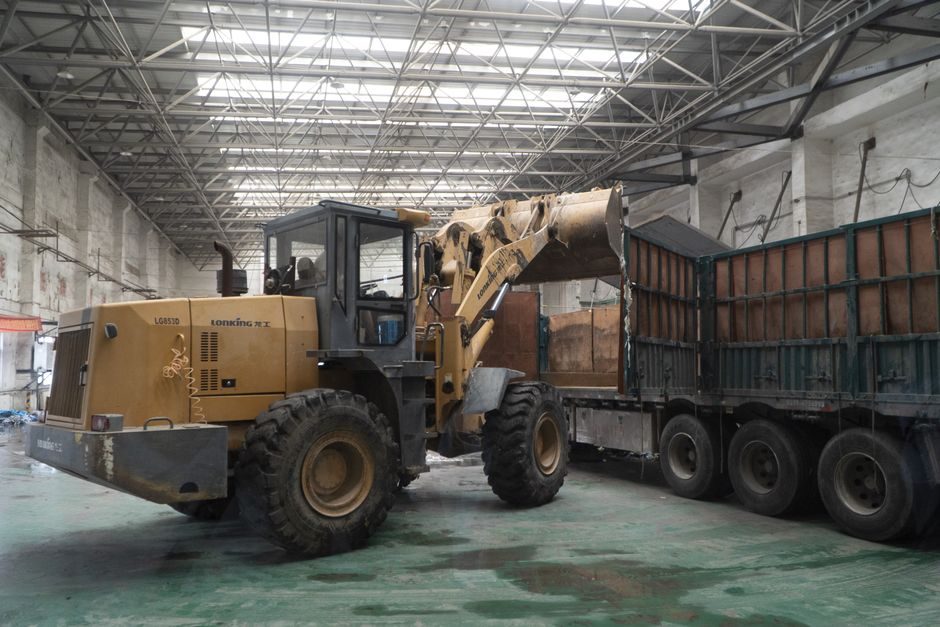
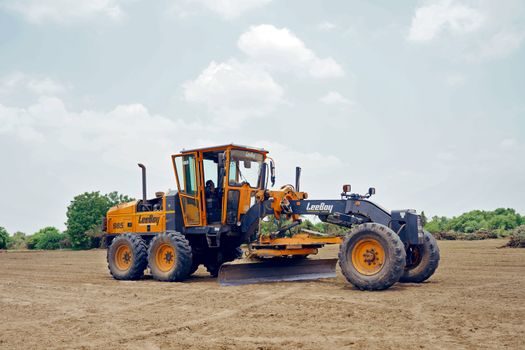
A motor grader is a self-propelled, articulated 14-30 t machine with a 3.6-4.9 m moldboard mounted between the front and rear axles, hydrostatically driven, and engineered for road blading, snow removal and ditch cutting — not for moving parts between workstations inside a factory [S1].
A robotic transfer cell, by contrast, is a bounded work envelope (typically 1-20 m long) that uses one or more linear motion devices — rack-and-pinion rails, linear motors, AGVs, or overhead gantries — to shuttle fixtures, totes or palletised workpieces between machining, inspection or assembly stations under a cell controller that talks discrete I/O, EtherCAT, PROFINET or Ethernet/IP [S1]. If your RFQ is asking for a "motor grader for a robotic transfer cell", the first engineering gate is almost always a vocabulary or scope-mix error, not a sizing problem.
Why a motor grader is the wrong class for a transfer cell
A 14 t class motor grader (e.g. Cat 140 / Komatsu GD555 / John Deere 670G) is 8.0-8.8 m long, 2.4-2.5 m wide, has a 3.66-4.27 m moldboard, an articulated frame joint that allows ±20° oscillation, and a wheelbase in the 5.8-6.2 m range, all numbers that are outside any sensible in-plant envelope [S1]. A robotic transfer cell footprint is dictated by the longest workpiece plus 0.3-0.5 m clearance, with cell widths typically 2-6 m and cell lengths 4-15 m; trying to fit a road machine inside that envelope is mechanically and safety-wise incompatible. Spec writers who paste "motor grader" into a transfer-cell RFQ usually meant either a gantry-mounted AC motor driveset, a hydraulic motor actuator on a pick-and-place unit, or a linear-motion stage — not a Cat 14/140-class machine. The fix is to re-class the line item to the right motion-control family before sending the RFQ to vendors, because bids priced off the wrong class will come back either 50-200x oversize or 10-20x under-spec.
Decision matrix: motor grader vs the four real transfer-cell options
If the actual requirement is moving a workpiece across a cell, the four options that belong in a transfer-cell RFQ are: (a) rack-and-pinion linear axis with servo AC motor drive, (b) belt-driven linear actuator with servo drive, (c) hydraulic motor cylinder on a pick-and-place slide, and (d) AGV/AMR on magnetic-tape or SLAM navigation. By four engineering criteria the four diverge sharply: payload ranges run 50-500 kg for belt/rack axes, 200-2,000 kg for rack-and-pinion, 500-5,000 kg for hydraulic, and 200-3,000 kg for AGV; positioning repeatability runs ±0.05 mm for rack-and-pinion with linear encoder, ±0.1 mm for belt, ±0.5 mm for hydraulic, and ±10 mm for tape-guided AGV; cycle time at 5 m travel runs 1.5-3 s for servo axes, 3-6 s for hydraulic, and 8-20 s for AGV; and cost per metre of travel runs roughly $3,000-8,000 for belt, $8,000-18,000 for rack-and-pinion, $4,000-9,000 for hydraulic, and $40,000-120,000 per vehicle for AGV. The motor-grader class scores "not applicable" on every row, which is the engineering signal to drop it from the RFQ entirely. A useful cross-check when sizing any of the four is the same gate-by-gate logic used in linear-motion spec work, e.g. the ball-spline selection criteria checklist — payload, stroke, duty cycle, environment and interface protocol — applied before vendor contact. [S1]
When "grader" actually means something inside a factory
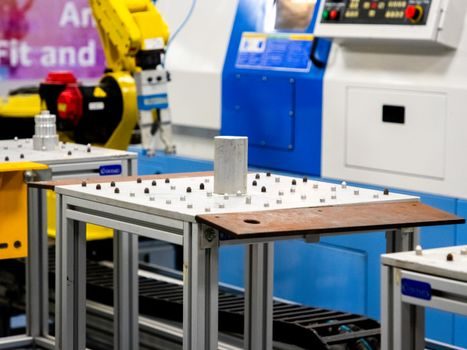
The word "grader" does have legitimate uses inside a manufacturing context, and it is worth ruling them out before rewriting the RFQ. A surface grinder is a pedestal or creep-feed machine that removes material with a 200-500 mm diameter abrasive wheel at 1,000-3,000 m/min peripheral speed — that is a metal-cutting spec, not a transfer-cell spec. A grader blade can also appear on a telehandler or skid-steer used for floor scraping, but those are facilities-maintenance assets, not part of the production cell. A road-grader (the original meaning) is a 14-30 t articulated machine, as noted above, and only shows up in a factory scope when the specifier is building a road on the plant site, in which case the right line item is a civil-works sub-package, not a transfer cell. If the cell itself is being installed in a building under construction and a motor grader is needed to grade the access road or laydown yard, that is a separate RFQ directed at earthmoving vendors (Cat, Komatsu, John Deere, Sany, LiuGong, XCMG) and belongs in a different procurement lot. For the transfer cell proper, the specifier should default to linear-motion components catalogued as load cells, load-cell modules and servo drives, not heavy equipment. [S2]
Standards and sourcing channels that govern the two domains
A transfer-cell RFQ will pull on ISO 9283 (manipulating industrial robots — performance criteria and related test methods) and ISO 10218-1/-2 (safety requirements for industrial robots and robot systems), plus IEC 60204-1 for the electrical equipment of machines and ISO 13849-1 for safety-related parts of control systems with performance levels PL a-e — these are the documents a robotics integrator will ask to see referenced [S1]. A motor-grader procurement, on the other hand, references ISO 7134 (earth-moving machinery — graders — terminology and commercial specifications), ISO 6014 (general safety requirements for graders) and the engine tier norms like EU Stage V / EPA Tier 4 Final for emissions compliance. The two standard families do not overlap, which is another tell that the line item has been mis-classed. Vendor sourcing channels are also distinct: motor graders are bought from construction-equipment OEMs and dealers (Caterpillar, Komatsu, John Deere, Sany, LiuGong, XCMG) with cycle times measured in weeks-to-months and pricing in the $250,000-650,000 band for a 14-20 t unit; transfer-cell components are bought from automation distributors (Festo, SMC, Parker, Bosch Rexroth, Igus, Beckhoff, Siemens, Rockwell) with cycle times measured in days and pricing in the $5,000-100,000 band per axis.
RFQ rewrite checklist before the line goes to a vendor
Before the RFQ is issued, the specifier should answer five questions in writing and attach them to the line item: (1) what is the workpiece mass and centre-of-gravity, (2) what is the required stroke length and the cell footprint in metres, (3) what positioning repeatability is needed in mm at the workpiece, (4) what is the cycle time in seconds per transfer and the duty cycle in transfers per shift, and (5) what fieldbus / industrial Ethernet protocol the cell controller speaks (PROFINET, EtherCAT, Ethernet/IP, CC-Link IE). If any of those five are answered with "do not know", the right next step is a motion-control sizing exercise, not a vendor RFQ. A practical gate-by-gate sequence mirroring the manual pallet jack selection gates approach — load, travel, environment, interface, compliance — is the simplest way to lock the part number before any vendor sees the document. The motor-grader spec, if genuinely needed for a plant civil-works scope, should be removed from the transfer-cell RFQ and re-issued as a separate earthmoving package. [S3]
Trackable next signals: (a) any vendor that responds to a transfer-cell RFQ quoting a Cat 14-class or Komatsu GD-class machine is signalling that the spec was not read carefully and the bid should be rejected; (b) once the line item is correctly re-classed to a servo linear axis or AGV, expected bid spread across three qualified vendors is 1.6-2.4x low-to-high, which is the engineering sanity-check that the spec was finally written in the right domain.