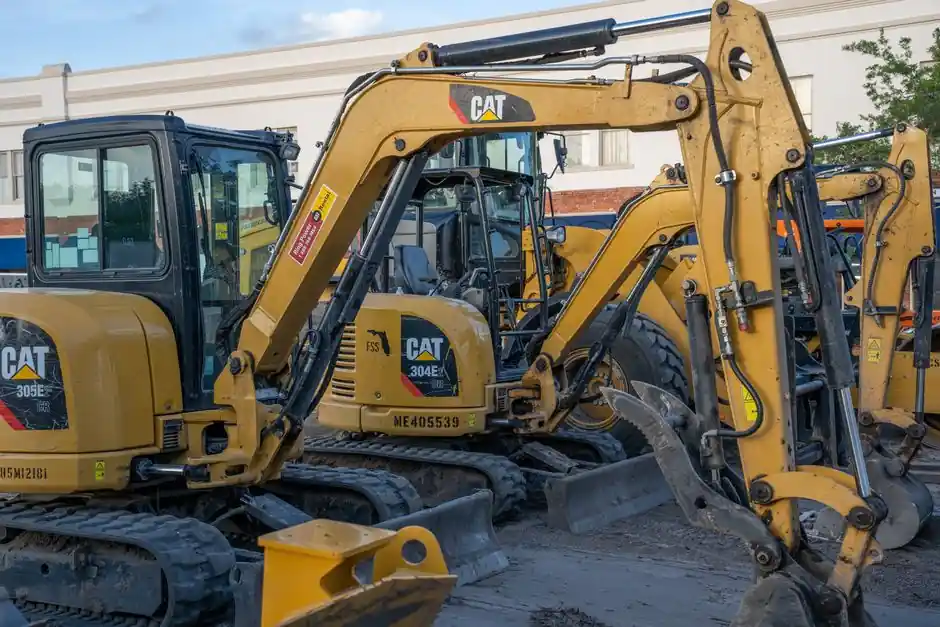
A motor grader and a cold milling machine sit on the same paving train but do opposite jobs: the grader profiles unbound material, the cold mill strips bound pavement to a controlled depth.
Specifying between the two starts with the surface type. A motor grader's 3.7–4.3 m moldboard cannot remove asphalt; a cold milling machine rotating at 80–120 rpm with tungsten picks is the wrong tool to spread and compact a granular base.
Cutting Action and Surface Type
A cold milling machine removes bound pavement with a drum studded with tungsten carbide picks, working widths from 0.35 m on micro units to 2.2 m on large highway-class mills and cutting depths from 100–150 mm on micro mills up to 300–350 mm on 2.0 m class machines [S3]. Production scales roughly linearly with the squared width and the depth: a 1.0 m mill at 200 mm depth moves about 0.20 m² per linear metre of travel, while a 2.0 m mill at 300 mm depth reaches 0.60 m²/m, a 3× throughput jump on long motorway stretches [S3].
A motor grader does no milling at all. Its 3.7–4.3 m moldboard, articulated frame and 6×6 or all-wheel-drive hydrostatic drive cut, spread and finish unbound granular material, base course, and snow, with engine power clustered in the 100–250 kW band and operating weights typically 12–25 t. Putting a grader against bound asphalt simply polishes it; putting a cold mill on a wet aggregate base pulverises the structure it is meant to leave intact.
Power, Weight and Class Match
Cold mill engine output spans roughly 80 kW on micro mills to 640 kW on large highway-class machines, and the engine is sized so that specific energy stays inside the envelope the rotor can transmit without stalling [S3]. Operating weight rises in step: a sub-0.5 m micro mill sits near 6–9 t, a 1.0 m compact class lands in the 13–16 t band, and 2.0 m class machines routinely exceed 30 t with rotor, conveyor and water tank ballasted for traction [S3].
Motor graders trade that concentrated rotor power for traction and blade-down pressure. A 14–18 t, 150–200 kW grader running all-wheel drive can sustain moldboard down-pressure of roughly 5,000–7,000 kg on a hard base, which is what allows finish grading to within ±10 mm of design grade; a 5–6 t compact grader drops to 3,000–4,000 kg of blade pressure and is limited to parking lots, residential streets and haul-road maintenance.
Cutting Depth, Pick Spacing and Tooling
Maximum milling depth is the second selection lever after width, and on the current generation it runs 100–150 mm on micro mills, 200–250 mm in the 1.0–1.3 m compact envelope, and 300–350 mm on 2.0 m class machines [S3]. Pick spacing is set by application: 15 mm for fine milling of thin overlays at 30–50 mm depth, 18–20 mm for standard asphalt removal, and 22–25 mm for full-depth cuts into bound base.
Tooling cost is the cold mill's hidden operating expense. A 1.0 m drum carries on the order of 80–100 tungsten picks, each rated for 200–400 m² of asphalt depending on aggregate hardness, so a 1.0 m compact mill working an urban resurfacing contract can consume 20–40 picks per shift. By contrast, a motor grader's cutting edge is a single bolt-on blade, typically 3.7–4.3 m long, 15–19 mm thick, rated for several hundred hours of dry grading before reversal or replacement.
Material Handling and Productivity
A cold milling machine granulates the lifted pavement and discharges it through a slewing, height-adjustable conveyor, either rear on small mills or front-split on large mills, directly into waiting trucks for reclaimed asphalt pavement (RAP). The pickup-and-convey action is what makes the cold mill a one-pass removal tool: in a single pass it can machine working widths up to 14 ft 5 in (about 4.4 m) and working depths up to 1 ft 2 in (about 0.35 m) [S2]. A 2.0 m class mill in highway mainline work routinely sustains 1,500–2,500 m²/hr at 30–50 mm depth, which is the production rate that lets a 10 km resurfacing contract finish inside a weekend closure.
A motor grader handles material the opposite way. It windrows, spreads and trims; it does not load. Production on a finish-grade pass is closer to 800–1,500 m²/hr depending on haul-road length and base stiffness, and the grader is almost always paired with a truck-and-trailer fleet for cut-to-fill haul and with a vibratory compactor for the next pass. For a perspective on how a similar size-versus-throughput cascade plays out in adjacent road-maintenance equipment categories, see the plasma cutter spec map for road maintenance fleets.
Comparison Matrix: Four Decision Criteria

The decision between these two machines is unusually clean because the use cases barely overlap. The matrix below lines them up on the criteria that actually drive equipment selection on a paving contract. [S1]
Function: cold mill removes bound asphalt and concrete to a fixed depth; motor grader shapes, spreads and trims unbound granular base, sub-base and snow. Surface type: cold mill is required on bound surfaces, optional on cement-treated base; motor grader is required on unbound surfaces, ineffective on bound asphalt. Production: cold mill sustains 1,500–2,500 m²/hr on a 2.0 m class machine in 30–50 mm cuts; motor grader sustains 800–1,500 m²/hr on a finish-grade pass over granular material. Tooling cost: cold mill burns 20–40 tungsten picks per shift on a 1.0 m drum; motor grader consumes a single reversible cutting edge over several hundred hours.
When to Choose the Grader, When to Choose the Mill
Choose a motor grader when the scope is grading, mixing, and finishing unbound material. A 14–18 t, 150–200 kW class grader is the right tool for sub-base trimming, gravel-road maintenance, haul-road upkeep, snow removal with a front-mounted wing, and shoulder work. Compact graders in the 100–130 kW band cover parking lots, residential streets, and confined urban work where a 12 m machine will not fit. [S3]
Choose a cold milling machine when the scope is removal of bound pavement. A 1.0–1.3 m compact mill at 150–260 kW covers urban street resurfacing and partial-depth removal, while a 2.0 m class mill at 300–470 kW runs highway mainline work, and a 2.0–2.2 m large mill at 470–640 kW tackles full-depth removal on motorways and airport aprons [S3]. North American literature and Caterpillar favor the term cold planer; the milling itself is the same mechanical cutting process in both terminologies, removing asphalt or concrete to a defined depth and grade [S7]. Small machines in the 0.3–1.0 m range suit utility cuts, patch repair, edge milling and confined urban work, while compact machines around 1.0–1.3 m cover mainline resurfacing [S7].
Standards, Compliance and Sourcing
No single ISO or EN standard governs the choice between a grader and a cold mill, but several govern the work each one produces. Cold milling tolerance and surface texture are typically specified against project-specific roughness and bond criteria written into the resurfacing contract, while grader finish-grade tolerance on unbound layers is set against the pavement design cross-fall, commonly ±10 mm on the centreline and ±0.5% on cross-fall. [S4]
From a sourcing standpoint, the global cold mill fleet is dominated by Wirtgen, Caterpillar, BOMAG, Roadtec, CMI and a long tail of Chinese suppliers offering compact 1.0 m class models such as the CLX-1000 built around a 1.0 m drum for expressway, road, airport, parking-lot and freight-yard surface removal, including oil films, bitumen protrusions and rut tracks [S3]. Mainline motor graders are dominated by Caterpillar, Komatsu, John Deere, Case, LiuGong and SDLG, with the 14–18 t, 150–200 kW segment the most competitive.
Limitations and Failure Modes
Each machine has a clear failure mode when pushed off-design. A cold mill pushed past its rotor's specific-energy envelope stalls, and a stalled rotor in a deep cut can shear the mechanical belt drive or strip the hydraulic-mechanical gearbox on large-class mills. Pick consumption spikes on concrete with rebar or on aggregate harder than 7 on the Mohs scale, and water-suppression failure on a dry cut creates airborne silica dust that can breach municipal air-quality limits. [S3]
A motor grader pushed past its tractive envelope spins all four wheels, bulldozes the base, and leaves a wavy surface that has to be re-graded. On bound asphalt the moldboard simply bounces; the machine is not built for that load case and the circle-drive can crack under impact. The hard rule on site: grader for unbound, mill for bound.
Watch two signals over the next quarter to validate the choice on a live project. First, monitor whether the cold mill's RAP output rate (tonnes per shift) is hitting the 200–300 t/shift band that makes in-place recycling economic, or whether it falls below 100 t/shift and forces the contractor to send RAP to a stockpile. Second, monitor whether the grader's fuel burn (typically 15–25 L/hr at full load) is in line with the 0.8–1.2 L/m² grading intensity expected on a well-organised base course, or whether it is trending higher and indicates over-excavation or a moisture problem in the fill.
Detailed specification references: cold chamber machine.