
For three-phase industrial motors up to 400V, a motor protector is sized first by full-load amperes (FLA) and second by the fault set it must clear: thermal manual motor protectors (MMPs) such as Fuji BM3R series cover 0.1-32A branch service with adjustable current dials, while electronic motor protectors (HangShen HSD1/HSD2) span 0.5-300A and add logic for phase failure, unbalance, underload, stall and grounding [S1][S3].
Buyers in 2026 are looking at three families side by side: rotary-handle thermal MMPs, multi-function electronic motor protection relays, and PTC-based winding-temperature cutouts that bolt onto a contactor circuit [S1][S3][S5]. The right pick is set by motor kW, duty cycle (S1 vs S4/S5), coordination with the upstream AC motor contactor, and whether the panel builder needs UL 508 / IEC 60947-4-1 Type 2 coordination or can accept Type 1.
FLA Sizing and Frame Width
Manual motor protectors are frame-sized by their adjustable current range. Fuji BM3RHB-010 in a 45mm frame sets 6.3-10.0A with a 130A instantaneous magnetic trip, suited to a 4-pole 2.2-4 kW induction motor at 400V; BM3VHB-025 in a 55mm frame sets 19.0-25.0A with a 325A instantaneous trip, sized for a 7.5-11 kW motor [S3][S4]. Both are rotary-operated, open-style (no enclosure), and ship as thermal-magnetic elements only — short-circuit and overload protection without a contactor coil.
For higher current, HangShen HSD1 extends the range to 300A at 400V AC 50Hz, so a single electronic unit can cover a 132 kW motor without paralleling CTs [S1]. Always pick a frame whose trip setting lands in the upper third of the dial: a 10A motor on a 6.3-10A MMP should run at 7.5-9.0A to keep the bimetal in its calibrated band and avoid nuisance trips on cold starts.
Trip Class and Overload Behaviour
Trip class (IEC 60947-4-1) sets how long the protector will hold 7.2× FLA before tripping: Class 10 is the default for standard-duty fans, pumps and conveyors, Class 20 fits heavy-start loads (compressors, mixers), and Class 30 covers extra-high inertia drives such as large centrifuges [S1]. Electronic units like HSD2 let the integrator dial the class in software, whereas thermal MMPs are fixed by the bimetal mass and cannot be re-classed in the field.
Lock-rotor endurance matters where the protector sees stall current for long periods: Sang Mao M-9005 (Taiwan, C-UL listed) is rated for 1/2HP to 2HP at 125/250V AC with 1000V AC / 1 minute dielectric strength, 100 MΩ insulation, and 500 lock-rotor cycles (or 2,000 cycles for the M-9005Q/R variant) [S2]. That cycle rating is the number to track, not the horsepower — a unit with 500 lock-rotor cycles will burn out if the driven load jams once a week.
Fault Coverage: Phase, Ground, Stall, Temperature
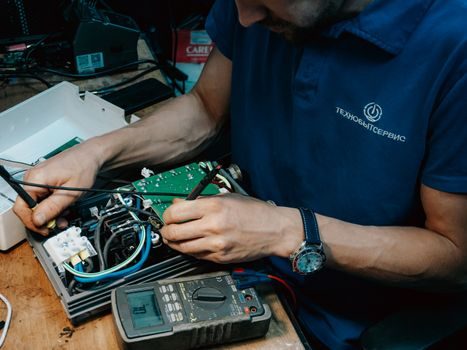
Electronic protectors earn their price premium by tripping on faults a bimetal cannot see. HSD2 explicitly lists overload, phase failure, phase unbalance, underload, grounding, stall, blocking, starting overtime and temperature [S1]. Phase-failure and unbalance trips protect a motor from the negative-sequence heating that destroys rotors long before the running current rises; underload trips protect pumps from dry running.
Stator temperature is closed by a separate PTC chain: the Dandong Yalujiang PTC protector reads a PTC thermistor embedded in the windings, goes high-impedance when the trip temperature is reached, and is wired to the contactor hold coil so the motor de-energises [S5]. This is the only credible overtemperature path on a totally enclosed fan-cooled (TEFC) motor — running current tells you nothing about blocked ventilation. For explosive atmospheres, ATEX-certified motors must use a PTC cut-out inside the terminal box; the protector itself sits outside the Ex enclosure.
Coordination With Contactor and Short-Circuit Device
An MMP is a protective device, not a motor switch — it is paired with a contactor for start/stop and an upstream breaker or fuse for short-circuit. Type 1 coordination (IEC 60947-4-1) allows contactor welding after a fault; Type 2 demands the contactor remains serviceable. The 130A instantaneous trip on a 10A-class BM3R is what gives the contactor a chance to survive a weld-free trip on a bolted fault downstream [S3].
Voltage drop across the protector is also a real spec to check, not just a footnote. At 25A, an MMP that drops 50 mV at FLA wastes 1.25 W continuously — across a 100-unit panel that is 125 W of additional cabinet heat, which derates the bimetal in adjacent devices. For a deeper comparison of frame-width and short-circuit strength, see the linear motor cost guide, which uses the same FLA-to-frame logic for sizing motion-axis drives.
Selection by Application

Conveyor (steady load, Class 10): BM3RHB series thermal MMP + NEMA or IEC contactor, 45mm frame, 6.3-10.0A adjustable [S3]. Centrifugal pump (dry-run risk): HSD2 electronic unit with underload trip enabled, plus PTC chain for bearing protection [S1][S5]. Compressor (high inertia, locked-rotor events): Class 20 electronic protector with stall trip, or a Sang Mao M-9005Q/R if the compressor is single-phase 1/2HP-2HP and C-UL listing is required [S2].
Hazardous-area (ATEX zone 1/2): certified motor + ATEX-rated PTC protector module wired through an intrinsically safe barrier, contactor in safe area; the protector itself is a certified assembly, not a generic motor protector. For an industrial process panel that mixes 400V motors with servo-driven axes, the telehandler selection guide walks through the same duty-cycle and trip-class decisions from the machine-builder side.
What to Verify Before Ordering
Confirm four numbers: (1) motor FLA on the nameplate, (2) adjustable dial range of the candidate protector with FLA landing in the upper third, (3) trip class needed for the driven load, and (4) coordination type with the contactor (Type 1 vs Type 2 per IEC 60947-4-1) [S1][S3]. For PTC chains, verify the trip temperature of the thermistor (typically 130°C, 150°C or 155°C for insulation class F/H) matches the protector's input threshold [S5].
Trackable signals for the next sourcing cycle: the AutomationDirect listings for BM3RHB-010 and BM3VHB-010 are flagged "discontinued once out of stock" with MPW40-3-U010 and MPW40-3-U025 as the proposed replacements — buyers building long-life panels should qualify the MPW40 line on 130A / 325A instantaneous trip equivalence before committing [S3][S4]. Sang Mao's M-9005 family on HKTDC sourcing is the reference single-phase protector to bench against for C-UL accepted alternate sources [S2].
For component-level specifications, see linear guide.